


Ashes of archives, songs of resilience: Chhayanaut and Udichi still undeterred

Culture is the quiet pulse of a nation, a whispered map of our origins, memory, and the paths that have carried us through time.
Can we imagine a day without Rabindranath's songs, Nazrul's poetry, or the Bauls' wandering melodies? In our streets, in our homes, children learn the story of Bangladesh not from walls or books alone, but through music, theatre, and performance—the living pulse of heritage. When cultural institutions crumble, archives burn, and instruments shatter, it is not merely walls that vanish—it is memory, identity, and moral courage. Culture cannot be revised; it is what history has written. Every assault upon it shakes the quiet foundations of a nation's conscience.
 For all latest news, follow The Daily Star's Google News channel.
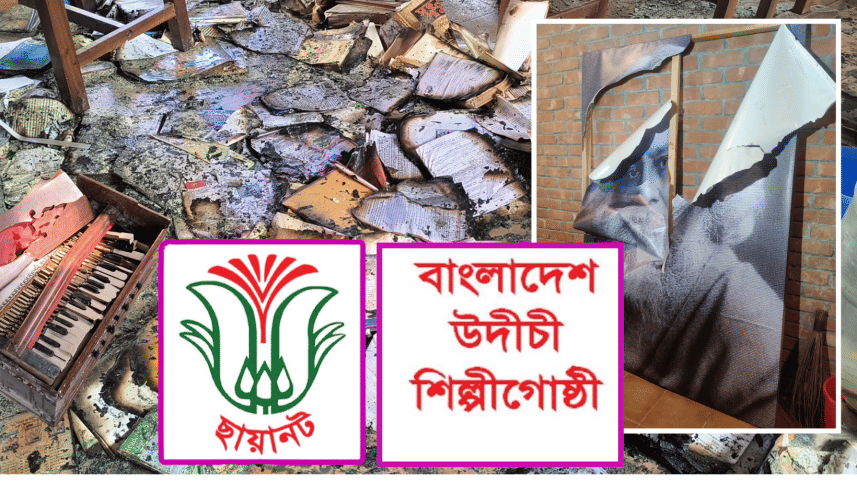
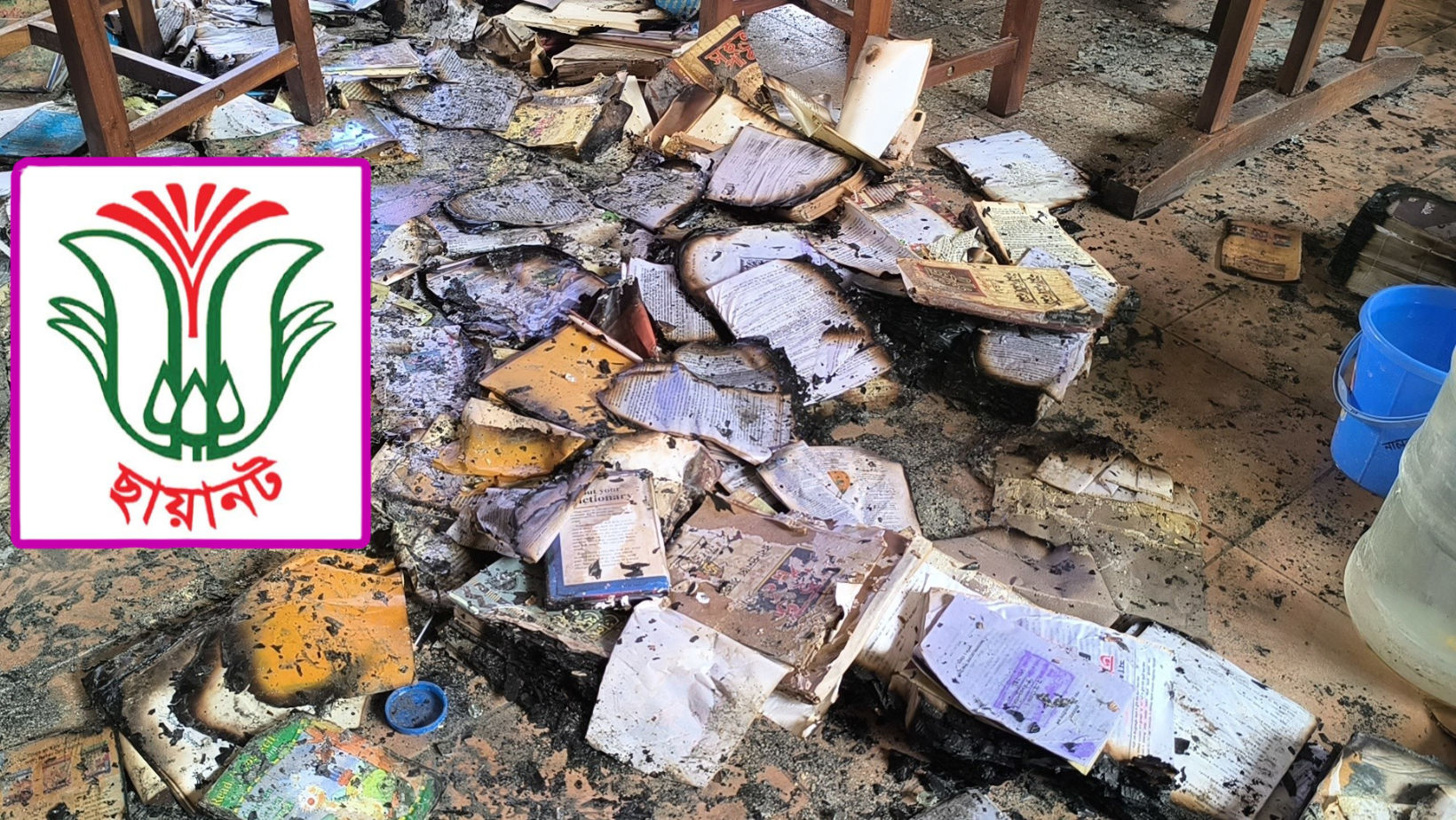
On December 18-19, 2025, the capital shuddered under such an assault. Two of the country's most venerable institutions, Chhayanaut and Udichi Shilpigoshthi, alongside prominent newspaper organisations Prothom Alo and The Daily Star, were deliberately targeted and attacked, vandalised and torched to ashes. Charred archives, broken instruments, and scattered teaching tools lay in their wake. This was not vandalism. It was an attempt to silence memory, interrupt pedagogy, and erode secular cultural continuity. Amit Ranjan Dey, General Secretary of Udichi, reflected, "Materials accumulated over the last 55 years—books, papers, documents—were burned. That is why it is difficult to assess the damage. We do not calculate these things through depreciation or accounting methods."
Udichi, born in 1968, and Chhayanaut, established in 1961, its long-standing counterpart, have always been more than organisations. They are schools of thought, guardians of oral tradition, and incubators of artistic freedom. They nurtured generations of musicians, actors, and cultural activists. Their archives held first-edition books, magazines, musical scores, photographs, and records of conferences—all chronicling the evolution of Bangladesh's progressive, secular identity. Mahmud Selim, acting president of Udichi, reflected on this irreplaceable legacy,"Prosperity is the coordination of both. If you destroy the fields of human enrichment—culture, education, history, and heritage—will we ever achieve a prosperous nation? The space for creating that prosperous nation is gradually shrinking."
Chhayanaut, in its official statement, termed the incident a "targeted and deliberate attack on cultural institutions," carried out by forces hostile to Bengali culture during a moment of instability. The organisation said the violence was not incidental, but calculated—an attempt to intimidate and undermine the practice of progressive, secular culture. Reaffirming its long-standing position, Chhayanaut emphasised that it has remained non-political and unaffiliated with any party since its inception. For more than six decades, it has worked solely to uphold music and cultural practice as pillars of Bengali identity, social harmony, and collective moral strength—values it said would not be silenced by intimidation.
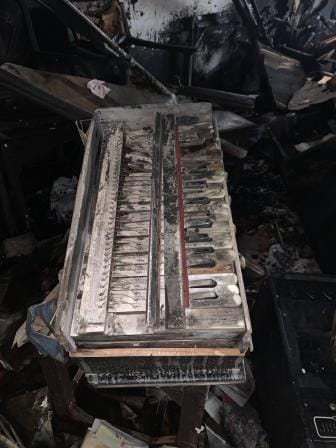
The destruction is as tangible as it is symbolic. Udichi's Dey enumerated the losses. "Some equipment, like stabilisers, was damaged. These are not very expensive. But many of our documentation books collapsed and burned inside the library…These were not just objects. They were learning tools—harmoniums, teaching instruments…How we will be impacted culturally is the real question. Udichi has existed since our birth, in a way. When these things disappear, how will we, as a people, as a nation, be affected?"

The wounds extend beyond matter. "Due to this incident, those who used to teach songs may not want to teach anymore, those who learned may not want to learn, and those who recited poetry may no longer want to do so. How we overcome this cultural impact is something we need to plan, but it is not yet clear at this moment," Dey warned. Fear now lurks in the hearts of teachers and students, shadowing curiosity, courage, and participation.
Masuda Anam Kolpona, singer, teacher and a vocal cultural activist, captured the human dimension, "Our greatest fear is that we have no protection. We all feel profoundly unsafe…Our students are afraid to even step outside. Where do we hide this shame? A mother of a student told me this morning, crying, 'How can I keep my children in this country?' I told them in my grief, 'Probably, we do not deserve you.'" In pedagogy lies trust, a covenant between teacher, learner, and society, now fractured.

These attacks are not sudden—they echo history. Dey recalled prior violence targeting Udichi. "Attacks on Udichi have happened before. In 1999, they bombed our national conference in Jessore. Ten of our artists and workers were killed…In Netrokona, a suicide bomb was planted in front of the Udichi office…Those who have held state power…have also tried to exert oppression upon Udichi." The assaults are deliberate, aimed at silencing the voices that anchor secular and progressive culture.
The attacks strike at Bangladesh's moral and civic narrative. Dey said, "Those who do this believe that if secular culture grows, a secular environment will remain in this country. That is why, to turn the country toward rigid thinking, the main attack is always on culture…Culture is the teacher of a nation's people. Attacking Bauls—who have taught non-communal values for generations—is the same kind of attack."

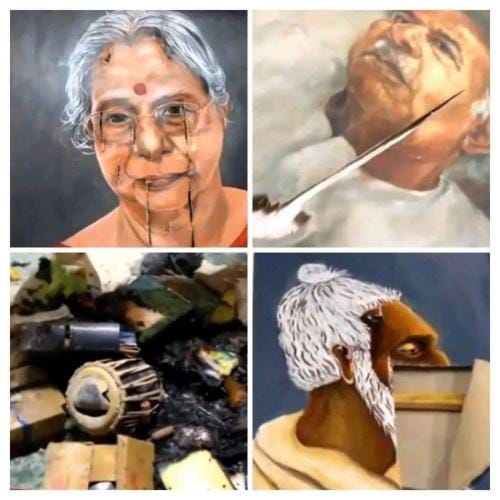
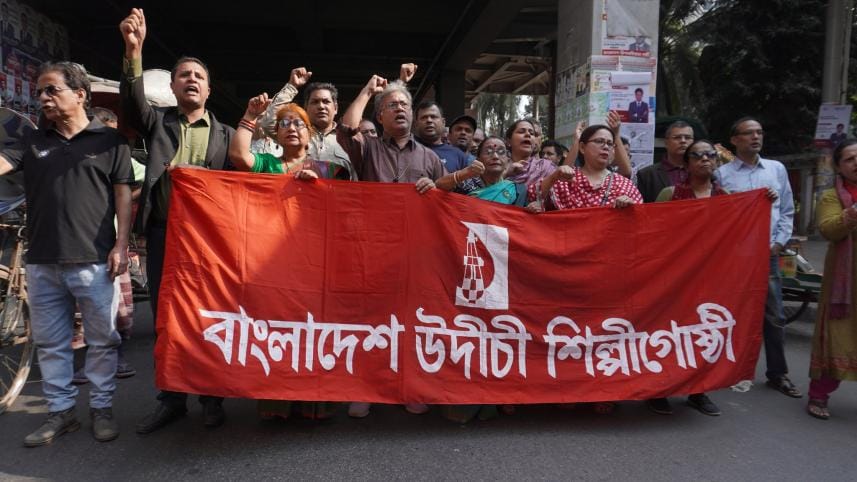
The obliteration of archives carries a weight no instrument can measure. First-edition books by Satyen Sen, original publications, magazines, and conference records, paintings—all gone. Dey noted, "Some people will remain active within the organisation despite the situation, but many will be demoralised. The attacks on the central office create fear across the country. Re-engaging members who drew courage from Udichi will take much more time and effort." Selim added, "We want to continue our movement to protect our culture. This requires broad, organised planning…Our protest programmes, songs, plays, and recitations will continue as much as possible."
Whilst cultural activist Kolpona urged solidarity, "We need to build a unified effort with all organisations…Perhaps a silent protest, standing for five minutes to express our condemnation, pain, and grief." Cultural practice itself becomes pedagogy and resistance, affirming human and moral values amid destruction.

The attacks also reveal structural forces shaping these tragedies. Dey observed. "Those who have been in power over the last 54 years—whether pro-Liberation forces or military governments—everyone provided patronage. It is through their patronage and by their hands that these communal forces…stand in this position today…If they can keep people in a bit of darkness, their self-interests can be better realised." Here, culture is both battlefield and beacon—a marker of identity under siege.
Pedagogically, the consequences are severe. Harmoniums, tablā, teaching tools, and decades of archives are gone. Dey reflected, "These were not just objects. They were learning tools…When these things disappear, how will we, as a people, as a nation, be affected?" National identity is inseparable from cultural infrastructure; its erosion threatens the moral and intellectual continuity of generations.

Ultimately, the attacks remind us that prosperity is not merely economic, but humanistic. Dey explained, "A nation or state does not become prosperous through economic development alone…A nation is prosperous only when human enrichment occurs alongside economic development. If you destroy the fields of human enrichment—culture, education, history, and heritage—will we ever achieve a prosperous nation?"
Yet culture endures, in memory, teaching, and practice. Dey affirmed, "It is impossible. It is impossible. They have burned our house; they have broken our instruments. But with what will they stifle my voice? The song that is within me, the melody within me, the artistic essence within me—they do not have the power to stop that. They cannot do it."
The extremists may break instruments, burn pages, and scatter archives, but they cannot touch the song in a teacher's heart, the memory of a student, or the quiet defiance of a nation. The more they try to erase Bangladesh's rich cultural tapestry, the more deeply its people cling to it. Broken paintings of Lalon, Rabindranath, Sanjida Khatun, Nazrul and charred pages ignite a fire within the national psyche—a fire that memory, melody, and teaching will keep alive.
Archives may burn, classrooms may fall silent, yet culture lives on. It thrives in every note sung, every verse recited, every lesson shared. Bangladesh's secular, progressive heritage will endure—not as relics of the past, but as a living force of moral courage and collective strength. It will rise, defiant and unbroken, a testament to resilience, courage, and the enduring strength of collective memory.
Comments