


How university administrative inefficiencies affect students


University administration: the phrase alone is enough to make students sigh, slump in their chairs, and wonder what they did to deserve it. I (Azra) remember being a fresher, wandering across campus with a stack of papers and stopping strangers to ask where I was supposed to go with them. Five years later, the process remains just as puzzling.
An example might help the reader understand the scenario if they are not familiar with it.
 For all latest news, follow The Daily Star's Google News channel.
 I had been awarded a scholarship for doing well in my classes, and all I had to do was collect the money. Simple enough, I thought. I showed up at my hall office – hopeful – only to be met with a shrug. The person who handled scholarship information was out that day. I came back another day. She was out then, too. By the third day, she appeared and raised an eyebrow at me. “Where’s your hall card?” she asked. I didn’t have one. No one had told me I needed one. Had I known, I would have made it over the course of my last two visits.
So, I set out to make the hall card, which required a payment at the bank, along with a fine for “not making it last year”, even though I had never needed it before. I returned, bank slip in hand, filled out the paperwork, and then waited for the provost’s signature. Only then did they agree to help me with the scholarship process. Papers in hand, I had to hunt down my course coordinator for a signature, then the chairperson for another, before finally submitting everything back at my hall office.
Then came another wait, two weeks for my name to snake its way through the registrar’s building, before I could collect a voucher number, which I would need to hand to an officer, who would then hand me a cheque. All to receive the scholarship I had already earned, if only I could survive the paperwork long enough to claim it.
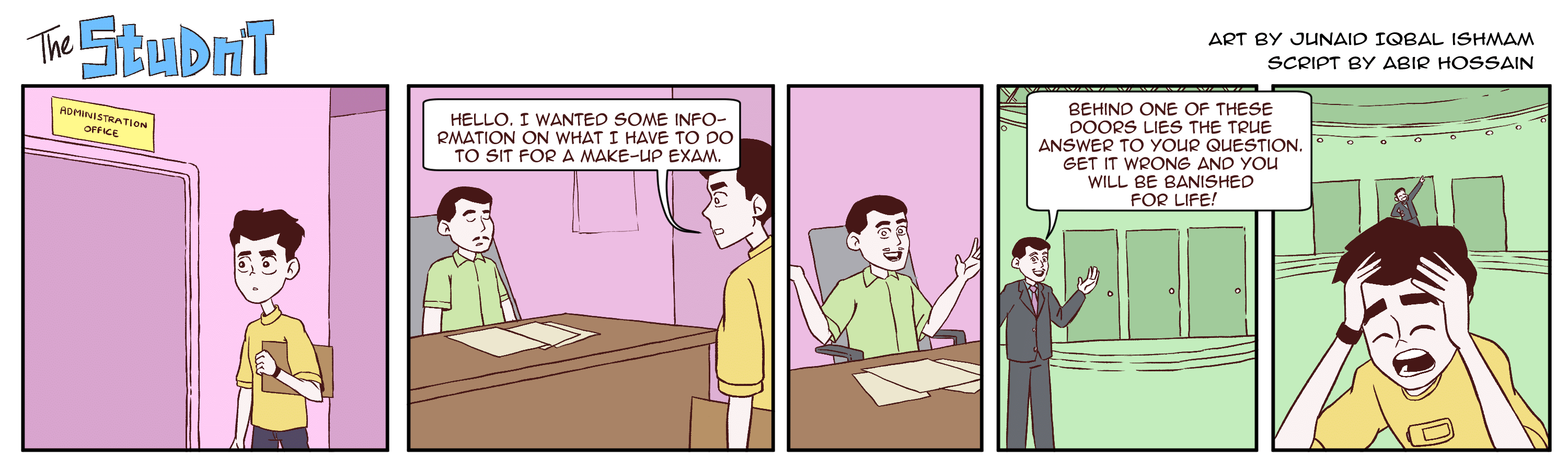
Speaking to students of Dhaka University (DU) and Jahangirnagar University (JU), the stress of navigating the administration is mostly due to the lack of available information. Noshin Nuha, a fourth-year Economics student at JU, says, “I wanted to sit for an improvement exam. Some said that there’s a chance I can sit for one, others said that I couldn’t, but I went to the exam controller’s office to learn about the process. They could not tell whether I’d be able to sit for the exam. They sent me to another room to get the information. When I went there, they sent me to another one, but the doors were locked, so I could not enter. The same thing repeated after I went another day.”
Noshin asked why clear information had not been available. Neither her department nor the exam controller’s office could provide the information she was looking for, which should be common knowledge among all.
Afrina Sultana Ariya, a postgraduate student in the Department of Mass Communication and Journalism at DU, says, “The hassle I faced during the admission process at my hall was unimaginable. On the last day of my admission process, I had to wait three hours because the librarian went to school to pick up her kids, and she came after lunch.”
Even after showing up on time, students are not offered the services they are entitled to. Many are advised to show up “after lunch”.
Afrina continues, “Why do we have to face this kind of trouble when we are non-resident students? As my hall was far from my department, I had to spend Tk 300 extra for rickshaw fare. Not only this, but my hall admission fee was much higher than that of other halls. Still, I’ll have to go to the hall to renew my hall card for two more days.”

The lack of uniformity in the processes of different halls adds to the hurdles faced by students. Jyoti*, a non-resident student at Shamsunnahar Hall (DU), speaks about her admission process. “I submitted my papers correctly at my hall, but the next day they sent my papers back, telling me that I needed my photo to be attested by the department chairperson. If that was necessary, why didn’t they tell me beforehand? My friends from other halls did not have to get their photos attested. One of my friends didn’t even have to make a hall card to get admitted. Why is there a lack of uniformity?”
Students have noted that the lack of clear communication often leaves them wandering the campus without direction, resulting in wasted time. They advocate for the effective implementation of online systems to reduce the burden of excessive paperwork and to ensure that relevant information is readily accessible for their specific needs.
Marzia Bhuiya Tabenda, a master’s student at DU, says, “Our university has a website, but it rarely offers anything useful. Whenever I try to find the information I need, I come up empty-handed. Instead, I have to go from office to office, in person, just to get basic details. We urgently need a functional website that can provide clear and accessible information, saving both time and energy.”
In her role as Pro-Vice-Chancellor (Administration) of DU, Professor Dr Sayema Haque Bidisha speaks candidly about the challenges the university administration faces that hinder its efficiency. She does not deny the gap in coordination among offices and opines that “There’s no alternative to digitalisation.”
“The biggest challenge is that we have a lot of data. A huge volume of it remains in hard copy and has to be manually processed to transform into digitised form,” she says.
Dr Bidisha draws comparisons with foreign universities. She says, “In foreign universities, you only need your registration number, and the information is given to you automatically. But our problem is that we do not yet have a central/master database of students, teachers, and staff, which can be used by different university entities for administrative purposes. As a result, students and other employees do not get the information easily.”

The administration is currently working to address this issue by manually updating data from the past 15 years to make it accessible in the online database. “It's complex given that clearances from halls, libraries, and departments are important,” she says. “But we are trying to integrate the processes so that the students do not have to roam around haplessly on campus. Within a few months’ time frame, several of the students' services will be digitalised.”
Speaking to students, it is clear that the administration needs to be well-equipped with relevant information. Marzia Bhuiya says, “The administrations of public universities tend to do everything the old-fashioned way, which, frankly, only hinders progress. We cannot afford to lag behind in this digital age. Yet I still have to present pay slips and other documents in person, even though all of this information already exists in the online database.”
Private universities, in contrast, are assumed to offer smoother administrative services. However, for many students and alumni, the reality seems to be different.
Jannatul Ferdous, a student at NSU, recalls an incident she faced in 2023 when she applied for financial aid. Upon receiving confirmation that her scholarship was approved, she visited the financial aid office to inquire about the percentage she had been awarded. Jannatul says, “I went to meet the then director of the financial aid office. To my surprise and exasperation, he made me wait for an entire hour just to inform me about that one thing.”

She adds, “I had a presentation and a project afterwards, and due to that, my entire schedule for the day was derailed. If this small information were accessible to me through the Student Portal platform online, then at least I wouldn't have to be physically present there and wait the long hours.”
The waiting queues seem to be never-ending, even for alumni, as noted by Munaem Mostofa, an NSU graduate. Munaem says, “I completed my undergrad a while back from NSU, but had to make a few runs to campus for some paperwork. Back then, I was also looking for graduate programmes, and wanted to inquire about the MBA programme, for which the Registrar's Office referred me to the MBA Office. When I went there, three representatives were not doing much.”
Munaem adds, “They dismissed me by saying that everything is available online. I expected better from them as an undergraduate alumnus, and wanted to ask about the possibility of waiving the admission test or receiving credit for relevant courses. But their approach discouraged me from reapplying to NSU.”
In response to these concerns, Dr Ahmed Tazmeen, Registrar at North South University, emphasises that the university has several administrative offices allocated with their individual responsibilities. Dr Ahmed says, “Students may need to visit multiple offices, but these visits are connected to provide the required services while maintaining confidentiality and transparency. There is room for improvement, and all offices are continually working to make the processes more streamlined and hassle-free.”
Dr Ahmed further adds, “The university has a comprehensive system in place to provide access to critical information. Information related to the curriculum for both undergraduate and graduate programmes can be found on the respective department pages of our official website.”
When asked about the administrative staff's professionalism in handling student cases, given that students have faced difficulties due to their half-hearted responses, Dr Ahmed reemphasises the idea of improvement and that NSU actively works on training its professionals.
He says, “Our staff receive ongoing training on IT, policy updates, and customer service. To provide the required training to various groups based on their needs, we have a specialised unit called the Institutional Quality Assurance Cell (IQAC). These trainings are always centred around student-friendly service. Each unit head assesses the service standards and works to improve through brief internal training and communications.”
Despite the availability of online portals and systematic processes, student experience tells a different tale and confirms that there remains a gap. Both public and private universities are falling short in handling minor issues, and action must be taken to reduce the red tape involved.
During a time when Bangladeshi universities are aspiring to hold themselves up to global standards, it must be realised that it is not the availability of modern, digitised systems that determines accessibility, but how these systems are designed to be more student-centric that matters more.
*Name has been changed upon request.
Azra Humayra is majoring in Mass Communication and Journalism at the University of Dhaka. Find her at: azrahumayra123@gmail.com
Afra is a student of English Literature at North South University. Write to her at afraankhan20@gmail.com
Comments