

Tk 6,000cr moves daily. But not every wallet is winning

At the beginning of every month, Farida Begum waits for a familiar phone call.
Her son works at a garment factory in Dhaka. Once he has sent money home to Morrelganj in Bagerhat, he calls.

“Ma, bKash korechi,” he tells her. “Check your phone.”
It has been her routine since 2019. Before mobile financial services, her son sent cash through courier services and other informal channels that worked well enough, but never as quickly as money that arrives in seconds.
Multiply this story by millions, and you get a sense of what is happening across Bangladesh. Workers send wages home, traders settle purchases, and families abroad transfer money within minutes.
Fifteen years after Bangladesh formally launched mobile financial services, the industry now moves nearly Tk 6,000 crore a day and has more registered accounts than the country’s population.
But that success story is only part of the picture.
As many as 14 providers now operate in the market, yet ask almost anyone to name one, and you are likely to hear just two answers: bKash and, more recently, Nagad.
Meanwhile, millions of low-income users continue to pay some of the highest cash-out fees in South Asia.
How did a service designed to expand financial inclusion come to be dominated by just two companies? Timing explains part of it. Strategy explains the rest.
After similar platforms gained traction in Kenya and the Philippines, Bangladeshi-American entrepreneur Kamal Quadir believed the model could succeed in Bangladesh in the late 2000s, when mobile phone ownership was rising rapidly despite low banking penetration.
In 2008, Kamal approached Sir Fazle Hasan Abed, founder of BRAC, in search of a local partner. After two years of discussions, US-based Money in Motion and BRAC Bank formed a joint venture in 2010.
In 2011, Bangladesh Bank (BB) issued its first Guidelines on Mobile Financial Services for Banks, and bKash launched soon afterwards.
It was not the first entrant, however. Dutch-Bangla Bank had beaten it by a few months, launching DBBL Mobile Banking in March 2011, which was later rebranded as Rocket.
Being first ultimately mattered little.
Initially, Rocket was designed primarily to serve Dutch-Bangla Bank’s existing customers. As a start-up, bKash took a different approach.
Rather than targeting people who already had bank accounts, it focused on the millions of workers migrating from villages to cities for work -- people who had never opened a bank account but had access to a mobile phone.
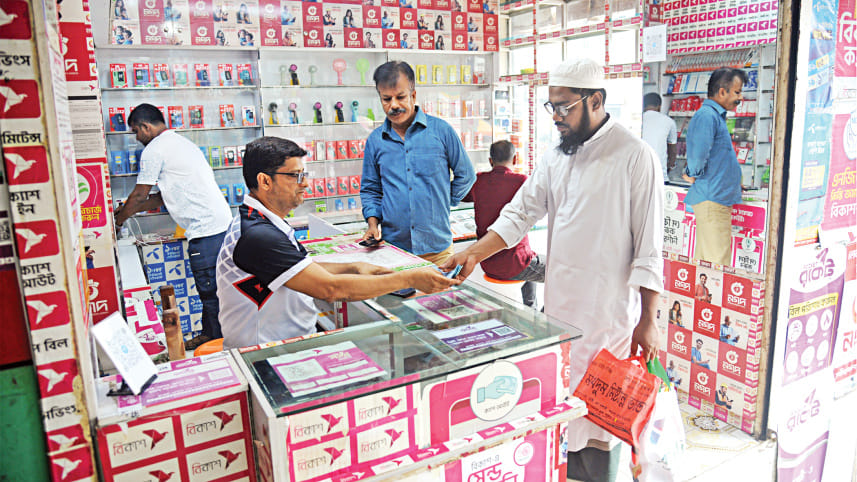
bKash invested heavily in building a vast agent network. Small mobile recharge shops and photocopy stalls in remote village bazaars became bKash outlets. In cities, agents appeared across neighbourhoods and markets, bringing cash-in and cash-out services within walking distance for most users.
It was expensive. It was also effective -- convenience became habit, and habit became market dominance.
By November 2021, bKash had become Bangladesh’s first unicorn, with a valuation exceeding $1 billion.
 For all latest news, follow The Daily Star's Google News channel.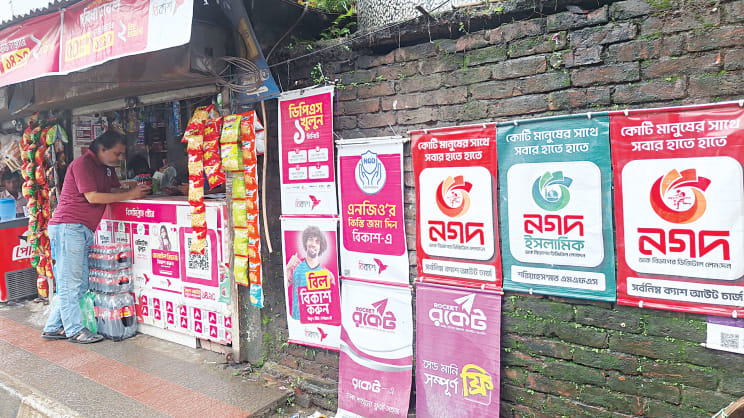
FROM SIMPLE TRANSFERS TO EVERYDAY FINANCE
bKash may be the name everyone knows, but its rise is only one part of a much bigger transformation.
When Bangladesh rolled out mobile financial services in 2011, the idea was simple: enable people to send and receive money through their phones, particularly those whom conventional banks had never reached.
Two years later, the market was still small. By December 2013, Bangladesh had around 1.3 crore registered MFS accounts, processing roughly Tk 6,500 crore a month.
Then it took off.
By February 2025, registered MFS accounts had climbed to 24 crore -- more than the country’s population of about 18 crore, largely because many users hold multiple wallets and inactive accounts remain.
The value of transactions grew just as rapidly. In 2025, mobile financial services processed an average of Tk 5,883 crore a day, according to central bank data. For comparison, the Dhaka Stock Exchange averaged just Tk 722 crore in daily turnover last fiscal year -- around one-eighth of the value processed by MFS platforms each day.
Between 2018 and 2025, transaction volume grew at a compound annual rate of 26 percent, reflecting both rapid expansion and broader everyday use.
Initially, mobile wallets mainly handled cash-in, cash-out and person-to-person transfers, allowing workers to send money home without couriers or intermediaries.
Today, however, people use MFS to pay utility bills, buy groceries, cover transport fares, pay school fees and hospital bills, and shop both online and in stores. A service built to move money between individuals has evolved into an everyday payments network, bringing millions into the formal financial system for the first time.
Yet none of that growth made the market more competitive. As mobile money became woven into everyday life, the industry increasingly came to be dominated by two familiar names.
A MARKET OF MANY, BUT LED BY ONLY TWO
Currently, 14 providers are licensed to operate mobile financial services in Bangladesh. Yet two of them dominate the market -- bKash and Nagad.
bKash says it has 4.20 crore active users. Nagad claims 2.82 crore. Rocket, operated by Dutch-Bangla Bank, remains in the market, drawing largely on the bank’s existing customer base of about 4 crore.
Each arrived there by a very different route.
For bKash, being first to launch was never the decisive factor -- Rocket had already beaten it to market. A central bank official overseeing mobile financial services said bKash stayed ahead through consistent innovation and disciplined execution.
“bKash captured the market mostly through innovation,” the official said.
The company says it has spent more than a decade investing in technology, service infrastructure and digital literacy, while steadily expanding its merchant network.
Around 10 lakh merchants now accept bKash payments, with the network growing at a compound annual rate of 41 percent between 2018 and 2025.
Moinuddin Mohammed Rahgir, chief financial officer of bKash, attributed the company’s success to sustained investment in technology, regulatory compliance and cybersecurity, which, he said, helped build customer trust over time. More users now transact regularly, driving recent growth in both revenue and profitability.
Nagad’s story is more unusual. Launched in 2019 under the Bangladesh Post Office, it expanded rapidly despite never obtaining a full licence from Bangladesh Bank. Although marketed as a postal service initiative, the Post Office never actually owned the company.
The Bangladesh Bank official said Nagad’s previous management accelerated its growth by routing government payments through the platform.
Whatever the mechanics, the strategy worked. Nagad became the market’s second-largest player, with transactions reaching a record Tk 111,355 crore in the first quarter of this year, up 21 percent year-on-year and 8.77 percent from the previous quarter.
Since the political changeover in 2024, the company has been run by an administrator and a management team appointed by the central bank.
Administrator Md Motasem Billah attributed the growth to simpler onboarding, lower-cost services, broader offerings and industry-leading cash-out charges.
Rocket, meanwhile, serves as a cautionary tale, although that has begun to change.
Md Ahteshamul Haque Khan, managing director and CEO of DBBL, said Dutch-Bangla Bank is now focusing on merchant payments through Bangla QR.
“We are investing in agent network activation, strengthening our merchant acquisition efforts under the national Bangla QR rollout, and enhancing our digital onboarding and customer experience,” he said.
WHY THE REST HAVEN’T CAUGHT UP YET
bKash and Nagad’s dominance has left everyone else with a more modest goal than catching up: survival.
Many banks and financial institutions have launched mobile financial services over the past decade. Few, however, were prepared for the cost of competing with the market leaders.
An MFS platform requires nationwide distribution, technology, cybersecurity, regulatory compliance and continuous investment well beyond launch.
Smaller banks have found it difficult to sustain.
Take Meghna Bank, which operates Meghna Pay. Syed Mizanur Rahman, its managing director, said technology and capital remain the biggest constraints.
“As a small-sized bank, it was difficult to invest heavily in the MFS wing,” he said.
Mercantile Bank operates MYCash. Its Managing Director Mati Ul Hasan said most banks never treated mobile financial services as a serious business, viewing them instead as a complementary product.
“Not only our bank, but most banks introduced MFS merely as an ornamental feature,” he said.
THE PRICE OF CONVENIENCE
For Farida Begum, that monthly phone call from her son brings relief. But it also comes at a cost.
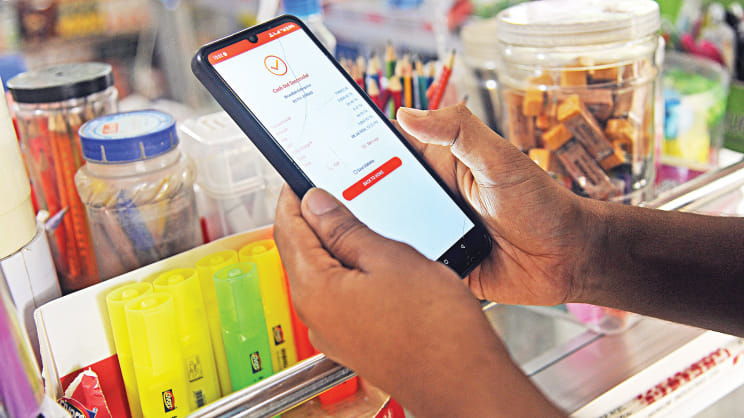
Every time he sends Tk 10,000 home from Dhaka, she pays nearly Tk 200 to cash the money out of her mobile wallet. She has little choice. Like millions of other low-income Bangladeshis, daily life in Morrelganj upazila still depends largely on cash.
That fee remains one of the biggest sore points in Bangladesh’s mobile financial services industry.
Cash-out charges range from Tk 12.99 to Tk 18.50 per Tk 1,000, depending on the provider, and despite 15 years of growth, they have changed little.
The fees weigh most heavily on garment workers, day labourers, rickshaw pullers and migrants sending money home -- the very users the system was designed to serve.
Compared with banks, the difference is stark. Receiving Tk 10,000 through a bank costs around Tk 29.
A similar MFS transaction costs about Tk 92 in Myanmar and around Tk 142 in Pakistan. In Bangladesh, cashing out Tk 10,000 through an MFS platform costs nearly Tk 200 -- almost seven times the bank charge.
Industry executives argue that reducing fees is difficult. The charges are shared among agents, distributors, mobile network operators, MFS providers and the government, leaving little room for further cuts.
Not everyone accepts that explanation. Critics argue that the real problem is the lack of competition needed to drive prices down.
“It is a burden for general users,” said Muhit Rahman, managing director of One Bank, which operates OK Wallet. “If the government takes the initiative to reduce the charges, it would encourage everyone, including smaller banks, to invest in MFS.”
Bangladesh Bank says it has not pushed providers to lower cash-out charges because doing so could discourage cashless transactions.
“We have promoted digital payments. That is why we did not force the providers to reduce cash-out fees because if the fees were reduced, users would be encouraged to cash out,” BB Spokesperson Arief Hossain Khan told The Daily Star.
That argument holds only if people can avoid using cash. Most cannot. Digital payments have grown rapidly, but cash still dominates much of the country. Many shops outside major cities do not accept digital payments, wages are often paid in cash, and everyday transactions still depend on banknotes.
So, every month, when Farida hears that familiar voice on the phone, she knows the money has already arrived.
She also knows that before she can buy groceries or pay a single household bill, she must first pay nearly Tk 200 for the convenience of accessing it.



Comments