


From lost homes to life in Dhaka’s slums
“We have no place to live in our homeland. The island where I was born and raised has abandoned us. River erosion has come very close to our home. We are leaving the island with all our belongings. We don’t know where our final destination is,” said Sathi Begum, 25, as her family prepared to leave Dhalchar Island.
After losing their home to river erosion, the Akter-Sathi family were forced to leave the area. However, they did not know where they would spend the rest of their lives. They were born on Dhalchar Island in Charfession Upazila of the coastal district of Bhola. Over the previous ten years, many more families had been displaced from the island and moved elsewhere. Akter Hossain and Sathi Begum were among them.

Mosharraf Hossain Gazi, 48, of Pratapnagar Union in Assasuni Upazila of Satkhira, lost everything. He had nothing left: no employment and no place to live. He was forced to leave the area along with the other five members of his family. Mujibur Rahman, 52, who lost 12 family members in Cyclone Aila, moved to the city from Gabura in Shyamnagar Upazila of Satkhira district. Many families from Dakop in Khulna district were also displaced by the impact of Cyclone Aila. Iskander Ali, 72, and many others took refuge in Dhaka’s slums after fleeing Khulna because of other natural disasters.
Tough life in the city
It is a room measuring just 15 feet by 15 feet. Five or six members of a family struggle to live within this confined space. Another room stands beside it, while yet another has been built above. The atmosphere is suffocating and the air difficult to breathe. The tin structures become unbearably hot. Water, electricity, and gas are all in short supply. Cooking, bathing, and other essential facilities, including washrooms, are severely limited. Reaching the settlement means navigating narrow lanes lined with makeshift shops, piles of rubbish, and dense crowds of people. For many climate migrants, this is where their long journey ends.
This is Kalyanpur slum in Dhaka, one of the settlements where climate-displaced people seek refuge. Homeless families from climate-vulnerable parts of the country arrive here in search of employment, food, and shelter. Established in 1998 with only five houses, Kalyanpur slum is now home to around 30,000 people. Some came from Dhalchar in Bhola, others from Charmontaj in Patuakhali, Charmonai in Barishal, or Kamalnagar in Lakshmipur. Many more have arrived from different parts of the country. All of them once had homes. They owned agricultural land, cattle, and other property, earning their livelihoods through farming or small businesses. Today, rivers flow where many of their homes once stood.
After losing everything, they came to Dhaka because they had no other option but to leave their communities behind. Beginning a new life in the city brought fresh hardships. Fires and eviction drives remain recurring threats in the slums, and residents have faced repeated attempts to remove them.
“We are citizens of this country. We are voters of this country. And we do not have a piece of land beneath our feet. The right to have a place to lay our heads is our rightful due. The government must make this arrangement,” said Abdul Quader, 72, a resident of Kalyanpur slum.
“The Constitution mentions rehabilitation. The government has also assured us of rehabilitation. Why won’t we receive rehabilitation assistance?” asked slum resident Aklima Begum, 53.
The demands voiced by Abdul Quader and Aklima Begum echo those of thousands of climate-displaced families. Above all, they seek justice, dignity, and the right to rehabilitation.
Impact of the climate crisis
Bangladesh is already experiencing increasingly extreme weather. Frequent cyclones, tidal surges, rising sea levels, and other climate-related hazards have forced large numbers of people to relocate over the last two decades. Most have migrated to the country’s major cities, where they face new vulnerabilities.
According to researchers, between 400,000 and 500,000 climate-displaced people take shelter in Dhaka’s slums every year. Dhaka has long struggled with severe overcrowding, and according to the Global Liveability Index 2019, it remains among the least liveable cities in the world. For climate-displaced families, the risks only multiply upon arrival.
A study conducted jointly by the Bangladesh Women Workers Center and Change Initiative found that about 50% of people living in Dhaka’s slums had taken refuge there after losing their homes and livelihoods in the climate-vulnerable, cyclone-prone districts of Barisal, Noakhali, Bhola, Khulna, and Satkhira. About 93% of these people have lost their livelihoods, while 52% have lost their homes and taken refuge in Dhaka’s slums. The number of climate-displaced people seeking shelter in the capital continues to increase at an alarming rate.
The study found that only 10% of those who migrate to Dhaka secure formal employment. The rest survive in precarious conditions. This not only places them at greater risk, but also adds to the pressure on an already overcrowded city. The study further found that 86% of displaced people would return to their home districts if they were assured of safe housing and sustainable employment opportunities.
M. Zakir Hossain Khan, Executive Director of Change Initiative and Climate Finance Analyst, said, “For the welfare and rehabilitation of people displaced by climate change, compact townships should be established in coastal cities in a planned manner. To achieve this, a strategy should be formulated quickly and an area-based plan should be implemented. Capacity-based training should be provided under this plan, taking into account the capabilities and needs of the vulnerable population. Funding should be mobilised from domestic and international sources, including the Green Climate Fund, to help create small entrepreneurs.”
Displaced people are increasing
Climate change is displacing more people every year. Cyclone Sidr in 2007, Cyclone Aila in 2009, and Cyclone Amphan in 2020 forced thousands of families from their homes. Alongside these disasters, coastal communities have also endured recurrent river erosion, tidal surges, rising sea levels, and other climate-related hazards. As a result, displacement has continued to rise and is expected to increase significantly in the coming decades.
The World Bank has warned that 216 million people could be internally displaced across six regions of the world by 2050 if adequate action is not taken to address climate change. Of these, around 40 million are expected to be displaced in South Asia. In Bangladesh alone, 19.9 million people are projected to be displaced.
The Global Report on Internal Displacement 2021 by the Switzerland-based organisation Internal Displacement Monitoring Centre (IDMC) reported that 4.443 million people were displaced in Bangladesh in 2020, almost all of them because of natural disasters. During the first six months of that year, the organisation ranked Bangladesh as the world’s second most displacement-affected country, with 2.5 million people displaced by natural disasters. Because of inadequate planning and limited rehabilitation measures, many of those displaced continue to live in inhumane conditions.
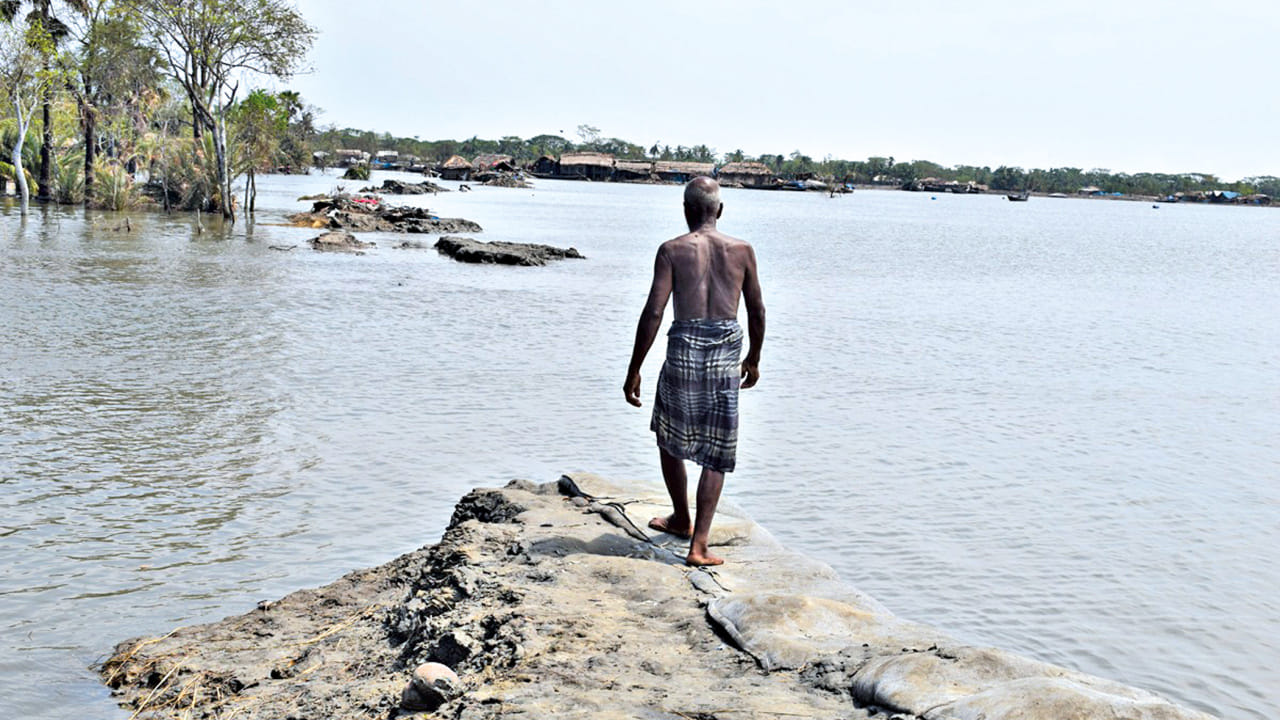
Many eventually move to cities in search of employment, housing, and security. One of them was Iskandar Ali. Twenty years ago, he arrived at Kalyanpur slum in Dhaka after leaving Naihati village in Rupsha Upazila of Khulna. He recently died in the slum after a lifetime of struggle. His wife, Sahida Begum, said, “We came here in search of life and livelihood after losing everything to river erosion. This slum is no longer habitable. Even so, this may be our last destination.”
Rafiqul Islam Montu is an independent journalist focusing on environmental issues, climate change, and coastal communities.
Send your articles for Slow Reads to slowreads@thedailystar.net. Check out our submission guidelines for details.

Buried by development: The human cost of river dredging in Dumuria

Char contracts: Surviving river erosion without the state

When extreme heat becomes a death trap for Bangladesh’s workers
The slow disappearance of Kuakata’s Rakhines
The cost of conservation in the Sundarbans
A 300-year-old shrine and the legend of Oggean Thakur

My father retired. Why can't my mother?
Why extreme heat hits girls hardest in Dhaka’s informal settlements
The killing of Sonadia’s mangroves: An eyewitness account
