


Governor confident of achieving $35 billion reserve target without IMF aid
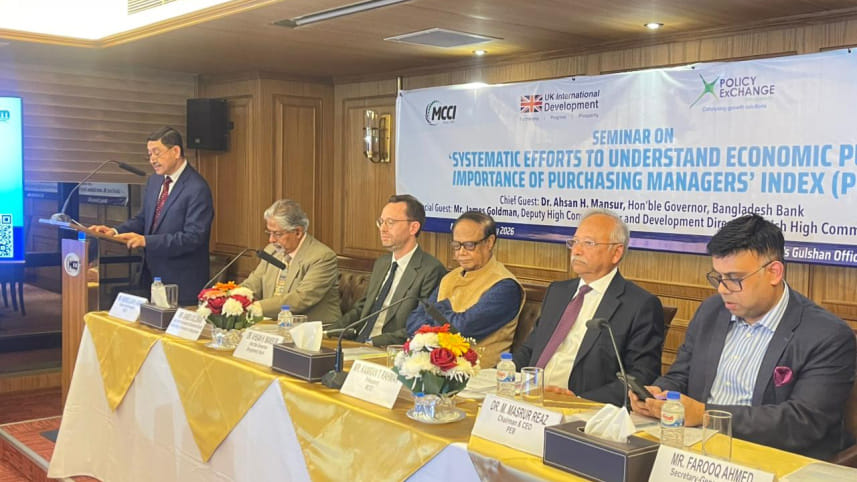
Bangladesh Bank Governor Ahsan H Mansur has expressed strong confidence in the country’s ability to meet or exceed its $35 billion foreign exchange reserve target for the current fiscal year—without depending on International Monetary Fund (IMF) disbursements.
He made the remarks while addressing a seminar titled “Understanding the Pulse of the Economy Through the Purchasing Managers Index (PMI)” jointly organised by the Metropolitan Chamber of Commerce and Industry (MCCI) and Policy Exchange Bangladesh at the MCCI office in Dhaka this evening.
 For all latest news, follow The Daily Star's Google News channel.
 “This will be a very comfortable level of reserve—and that too, without the IMF money,” Mansur said. “If anything comes from the IMF, it will be icing on the cake, not a necessity.”
Mansur said the macroeconomic consolidation process is ongoing and significant improvements have been made on the balance of payments and reserve fronts.
Despite challenges in exports, he highlighted gains in terms of trade due to declining global energy prices. “Import volume has increased even though payment has risen only 5-6 percent. This reflects a 30 percent drop in petroleum prices, which has translated into strength on our external side,” he added.
Chattogram Port data also show a substantial rise in import volumes—both in tonnage and container traffic—indicating robust trade activity.
The governor emphasised that Bangladesh Bank is closely monitoring a range of high-frequency indicators, such as daily exchange rates, remittance flows, interest rates, and reserve levels.
He also acknowledged the importance of newly introduced tools such as the Purchasing Managers Index (PMI), calling it a “welcome addition” to the country’s economic monitoring arsenal.
Touching on domestic liquidity conditions, Mansur pointed out that deposit growth rose from 6.4 percent in December 2022 to 11 percent in December 2023, with total deposits reaching Tk 20 trillion.
“This translates to an additional Tk 2.2 trillion in liquidity. After accounting for government borrowing, over Tk 1.2 trillion is now available for private sector credit,” he said.
He expects deposit growth to rise further to 14 percent, backed by a surplus in the balance of payments and buildup of net foreign assets—further easing liquidity pressures in the banking sector.
Mansur signaled that the lending rate to prime borrowers has already dropped by nearly 2 percentage points, ranging between 11-12 percent.
He reiterated that sustained improvement in inflation, currently above 8 percent, is critical before policy rates can be relaxed further.
“As soon as inflation drops by over 1 percentage point, we will begin rolling back the policy rate,” he stated.
Highlighting past support to the private sector amid multiple shocks—including COVID-19, exchange rate volatility, and political transitions—the governor said 1,500 out of 3,300 applications for loan restructuring have already been processed.
He warned against “shortcuts” in monetary policy that could jeopardise hard-earned stability, particularly in the foreign exchange market.
“We must not abandon a working strategy due to impatience,” he said.
The governor also emphasised Bangladesh Bank’s ongoing efforts to liberalise the foreign exchange market, including facilitating the international expansion of Bangladeshi businesses.
Comments