


Foreign loan commitments rise, but disbursal slows


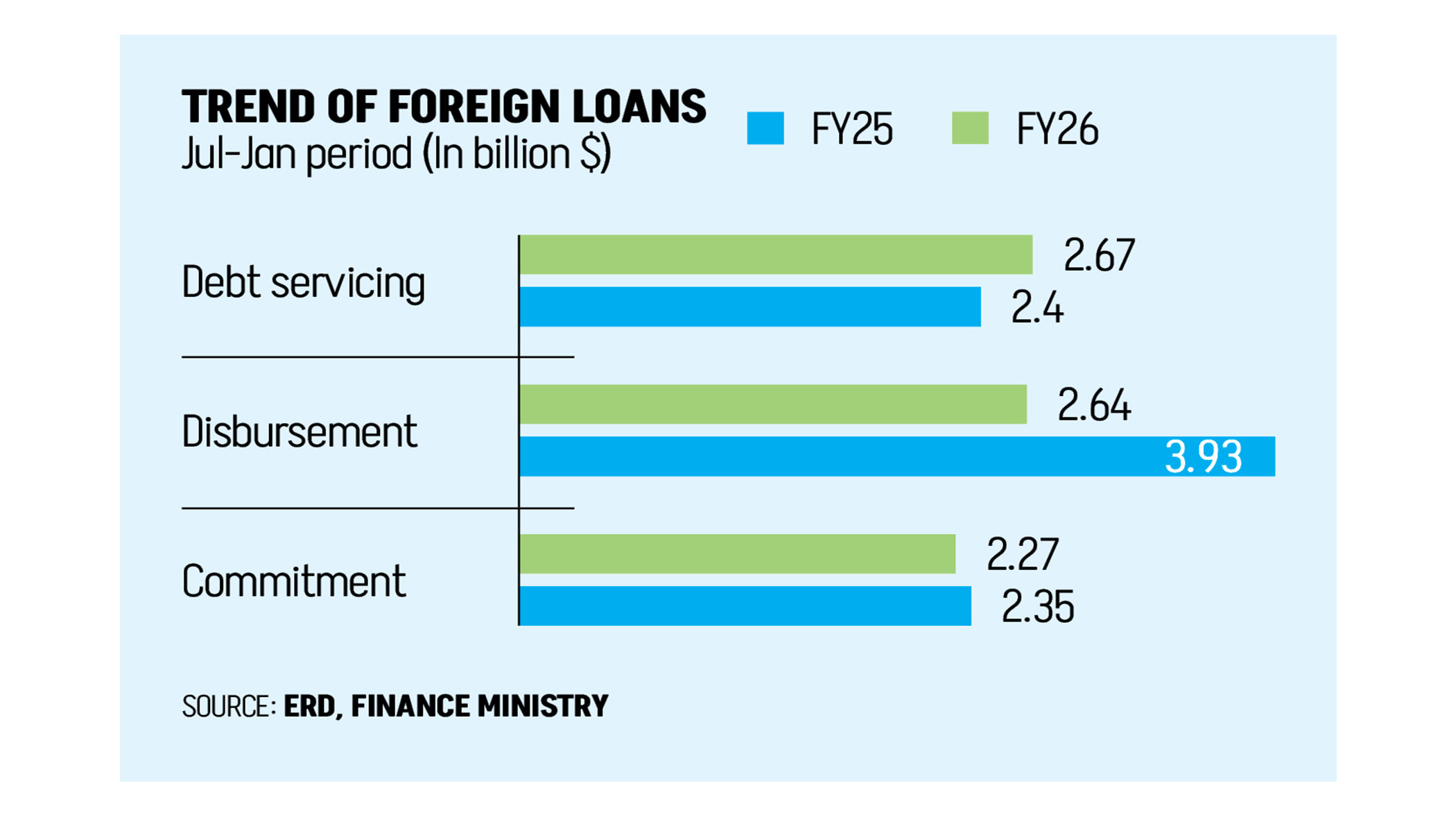
Bangladesh secured higher foreign loan commitments in the first eight months of the current fiscal year, yet actual disbursement fell by 26 percent compared with the same period last year, raising concerns about the country’s ability to use external funds effectively.
Between the July-February period, foreign loan disbursement dropped to $3.05 billion, down from $4.13 billion a year earlier, according to data released by the Economic Relations Division (ERD) today.

The decline was driven largely by slower project aid, the primary channel for financing infrastructure and development projects.
Disbursement under project assistance fell to just above $3 billion in the first eight months of this fiscal year, compared with over $4.1 billion during the same period last year.
This slowdown comes despite nearly $40 billion in financing commitments from foreign lenders.
Analysts say the widening gap between pledged funds and actual disbursement reflects Bangladesh’s limited capacity to use external resources on time.
Foreign aid is crucial for roads, power plants, and social sector projects, but delays can reduce project benefits and increase costs.
The trend is particularly concerning as Bangladesh’s external debt servicing rises. During the July-February period, the country paid $2.9 billion in principal and interest, up from $2.63 billion a year earlier.
Deen Islam, professor of economics at Dhaka University, said the figures indicate a gradual shift from development financing to debt rollover.
“When a large portion of new external borrowing is used to service existing debt rather than finance productive investment, the net inflow of resources into the economy declines,” he said.
“Infrastructure and development spending may slow, while rising debt servicing puts additional pressure on foreign exchange reserves and the exchange rate,” Islam said.
He added that the situation could also fuel imported inflation. While not yet a crisis, he described it as a “warning sign”.
“If this trend persists, policymakers will face difficult trade-offs between taking on more debt and reallocating domestic resources away from development spending,” he said.
Meanwhile, Monzur Hossain, member (secretary) of the General Economics Division (GED) under the Planning Commission, said, “Loan disbursement is directly tied to project progress. When implementation slows, disbursement inevitably falls.”
He pointed to structural bottlenecks, particularly in investment projects.
“Many projects involve complex conditions, and meeting those requirements takes time. Land acquisition remains a major challenge in many cases,” Hossain said.
He also noted weaknesses in the execution of the Annual Development Programme (ADP) as a key factor. “Since most of these loans are linked to ADP projects, delays in overall project execution translate into slower disbursement,” he added.
During the period of the interim government, many projects were almost stagnant. However, Hossain expressed optimism about improvement in the coming months.
“Now, with a political government in place, monitoring has increased, projects are being prioritised, and delays are being scrutinised more closely,” he said.
 For all latest news, follow The Daily Star's Google News channel.
 “I expect the situation to improve soon, particularly in the final months of the fiscal year as measures taken by the Planning Commission begin to take effect,” he added.


Comments