


Farmers count losses as Aman prices fall


 For all latest news, follow The Daily Star's Google News channel.
 - Farmers struggle as Aman paddy prices drop
- Rising imports blamed for market disruption
- Production costs climb, deepening farmer losses
- Economists cite government mismanagement of policy
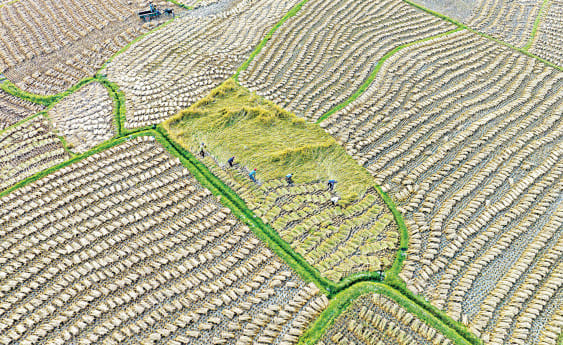
As the Aman paddy harvesting reaches its peak across the country, farmers are expressing frustration over falling prices, with rates dropping by Tk 100-150 per maund compared with last year.
The Daily Star correspondents from more than 13 districts found that paddy prices have declined over the past two weeks, leaving many farmers struggling to cover costs.
Traders and rice importers point to record and untimely rice imports as a key factor pushing down paddy prices.
Shakiul Islam, a farmer from Puhurampur village in Gaibandha's Gobindaganj upazila, said he cultivated Aman on about nine bighas this year. His total cost, including the leased land price, was Tk 1.68 lakh.
"I harvested 170 maunds from the nine bighas. Fifteen days ago, I sold 50 maunds at Tk 1,300 per maund. Currently, the same paddy is selling for Tk 1,180. If I sell at this price, I will incur a loss," he added.
Abdur Rouf, a farmer at Rajash village in Bogura, said, "The price of Swarna paddy [an Aman variety] dropped from Tk 1,380 per maund last year to Tk 1,180 currently."
He alleged that prices fall when farmers sell but rise again once the paddy reaches mill owners and traders.
Sarwar Alam, a farmer at Paschim Palsha village in Dinajpur's Ghoraghat upazila, said selling paddy at this price means a loss of Tk 2,000 to Tk 3,000 per bigha as production costs increased due to high prices of pesticides and fertilisers.
Compared to last year, production costs for one kilogram of Aman paddy increased by Tk 1 to Tk 31, equivalent to Tk 1,240 per maund, according to the Bogura DAE.
Lutfar Rahman, another Aman farmer in Joypurhat's Kalai upazila, said, "We have incurred heavy losses in potatoes this year; now we are not making any profit from paddy. How do we survive?"
Aman paddy was cultivated on more than 59 lakh hectares this fiscal year, around 3 lakh hectares higher than last year, according to the Department of Agricultural Extension (DAE).
As of November 30, nearly 56 percent of the food staple has been harvested, equivalent to 1.05 crore tonnes of rice.
By contrast, in the previous fiscal year, Aman paddy was planted on 56.10 lakh hectares, producing 1.65 crore tonnes of rice.
In Khulna, farmer Bivash Mondol of Brittisholua village, Gangarampur union, said this year's paddy has grown better than last year, but the price is very low.
Mikhail Hasda, from Godagari upazila in Rajshahi, said he harvested 14-16 maunds per bigha, similar to last year. "Last year, the season began with Tk 1,400-1,500 per maund, but this year it is only Tk 1,200, and now Tk 1,150. We will incur losses."
Traders also reported similar concerns.
Md Nurul Amin, a paddy trader at Dashuria in Ishwardi upazila of Pabna, said each maund of dry, good-quality paddy sold for Tk 1,200-1,250 last week. Currently, the best quality paddy is at Tk 1,180-1,200.
The government has set a procurement target of 50,000 tonnes of Aman at Tk 34 per kilogramme. According to this estimate, per maund will fetch Tk 1,360. Traders attribute the declining paddy prices to rising imports.
Barek Uddin, a trader in Bogura's Nandigram upazila, said, "A lot of rice is being imported, so prices are dropping."
Mizanur Rahman, a trader in Gaibandha, said, "With imports increasing supplies, prices will likely remain low for the next month, then rise again."
Bangladesh imported no rice in FY 2023-24. But FY 2024-25 saw over 14.36 lakh tonnes, the highest in a decade, according to the Ministry of Food.
On November 2, the ministry authorised 222 importers to bring in 100,000 tonnes of boiled rice, instructing them to market it by November 30.
Chitta Majumder, managing director of Majumder Groups of Industries, a leading rice miller and importer, said, "Eight months ago, we imported rice worth Tk 90 crore at Tk 57 per kilogram. We haven't finished selling that rice, even at Tk 47 per kilogram. The international price of rice is currently low, which is why imports continue."
According to a recent World Bank report, global rice prices have dropped to their lowest level since 2017. The decline is attributed to higher production and reduced import demand in key importing countries.
The report also said that in 2025, average global rice prices have already fallen by 31 percent, with a further 1 percent decrease projected for 2026.
Majumder said extending the government deadline for imports could harm farmers and those who purchased rice at higher prices earlier.
"Currently, there is plenty of paddy in the local market, but few buyers. Every year, we buy 600,000-700,000 sacks from the domestic market, but this Aman season, we have not bought a single kilogram," Majumder added.
Ali Imam Majumder, adviser at the Ministry of Food, said balancing farmer prices with market stability for consumers is essential.
"If imports stop, rice prices could jump to Tk 80 per kilogram," he said, adding that farmers can sell directly to government silos if their grain meets quality standards.
As of December 1, food grain stocks total 14.75 lakh tonnes, up from 11.02 lakh tonnes the previous year, show government data.
In the retail market, fine rice is now at Tk 72-85 per kilogram, medium grain at Tk 58-68, and coarse grain at Tk 54-60. Over the past year, prices increased by 6.08 percent for fine rice, 1.61 percent for medium grain, and 8.57 percent for coarse rice.
Jahangir Alam Khan, a renowned agri economist, said the government's approach to managing the Aman paddy reflects a serious management failure.
He said that delaying imports when prices were high and then rushing to import during the harvest has disrupted the market and artificially pushed down paddy prices.
He added that the government's minimal procurement plan offers little protection for farmers, while allowing traders to purchase paddy at low rates.
He said imports should be suspended for now, domestic procurement should be increased, and policies must be revised to prevent further harm to farmers and ensure fair prices during the harvest season.
[Our district correspondents from Pabna, Lalmonirhat, Thakurgaon, Narsingdi, Jamalpur, Rajshahi, Mymensingh, and Khulna contributed to this report.]
Comments