


Private aviation sends SOS amid policy turbulence



Over the past three and a half decades, Bangladesh has seen the entry of several dozen private airlines and helicopter operators, driven by the ambition to capture a share of the country’s growing passenger and cargo market.
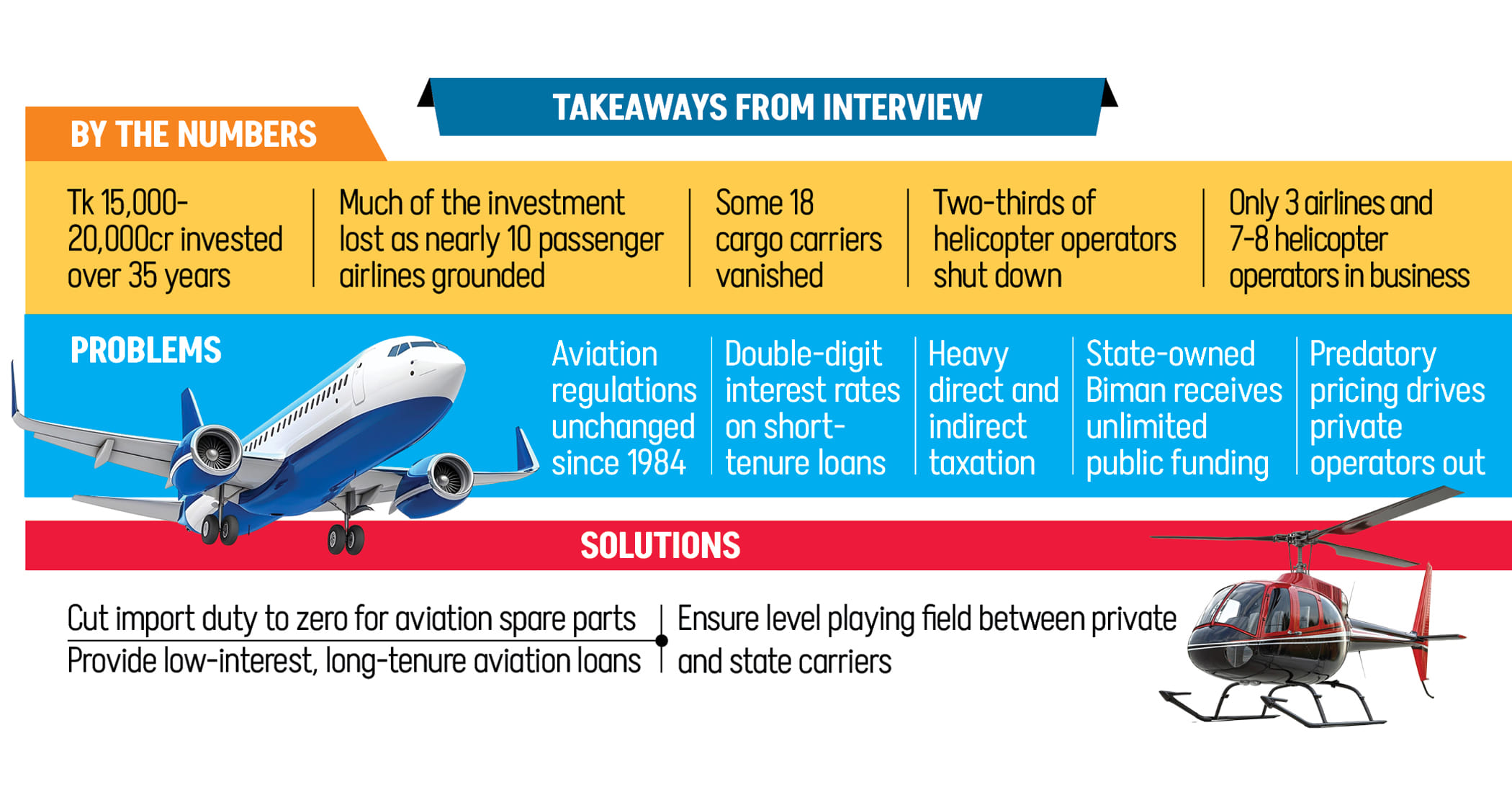
Cumulative investment by entrepreneurs is estimated at Tk 15,000 crore to Tk 20,000 crore, with the airline industry alone accounting for more than Tk 10,000 crore. Much of this investment was eventually lost as nearly 10 passenger airlines were grounded, while cargo carriers and around two-thirds of private helicopter operators were forced to shut down after failing to absorb sustained losses.
 For all latest news, follow The Daily Star's Google News channel.
 Today, only three private passenger airlines and seven to eight helicopter operators remain in operation.
As things stand, according to industry insiders, private operators risk further decline and may fail to tap the country’s large diaspora-driven aviation demand. Policy support, particularly a favourable tax regime and a level playing field, is imperative for revival.
In the words of Mofizur Rahman, secretary general of the Aviation Operators Association of Bangladesh (AOAB), which represents 17 local aviation operators, the industry is both at a crossroads and at a cliff. “And it depends on how we take the industry forward.”
Speaking to The Daily Star in an interview recently, he said, “If we take the right steps, we can move away from the cliff and go on to develop a viable aviation industry. If we do not take the right steps, it is bound to fail.”
Since private aviation began in the early 1990s, the sector has consistently underperformed despite heavy investment. While passenger airlines at least left some imprint, cargo operations largely disappeared without notice.
“Passenger airlines at least made some impact on the national spectrum, but silently, we have seen almost one and a half dozen cargo airlines come and vanish. We do not even know them,” said Rahman.
The helicopter segment also once showed promise, with nearly 12 companies operating about 36 helicopters. Several firms maintained fleets of six to eight aircraft. Over time, however, operations dwindled as companies shut down or suspended services. “They are no longer functioning. That is a big concern.”
These aviation segments contributed quietly to the economy, but their decline exposed deeper structural weaknesses, particularly in human resource development.
Bangladesh once had three vibrant flying training schools, but output is now negligible. As a result, pilots increasingly seek training abroad, while the domestic supply of qualified technical manpower remains thin.
Rahman also questioned the quality of local technical institutions, noting that many aviation engineering graduates leave the sector altogether.
He noted that more than 30 years after private aviation took off, Bangladesh still lacks a mature and sustainable aviation ecosystem. “The question is: who failed, where we failed, and why we failed? These are the questions we need to address. Unless we address them, we will fall off the cliff.”
The AOAB secretary general said there was no shortage of entrepreneurial effort or investment. Instead, he blamed what he described as a longstanding anti-aviation mindset within regulatory and policy circles.
“I am not saying entrepreneurs did not make mistakes. Some who failed did make mistakes, but those mistakes were not of a magnitude that justified failure. We failed mainly because of a general anti-aviation mindset,” he said.
At the policy level, he said aviation is often perceived as an elite industry with deep pockets, prompting authorities to impose heavy direct and indirect taxes. “Where a fledgling industry needs support, we see the opposite -- a mentality that says: ‘You are an elite business, you have money, so give money.’”
He criticised the National Board of Revenue for aggressively taxing the sector, pointing out that aviation spare parts are largely zero-rated globally due to high capital costs and thin margins.
Even 55 years after independence, Bangladesh lacks a business-friendly aviation policy, he lamented. Existing regulations date back to 1984 and remain fragmented, while global aviation rules are updated every two to five years.
Rahman also criticised the Civil Aviation Authority of Bangladesh for failing to formulate industry-oriented policies. “We had the intention, but our hands were tied due to a lack of policy support. We never asked for financial incentives. We asked only for genuine policy support.”
He further alleged that successive governments poured public money into state-owned Biman Bangladesh Airlines, which “benefited certain politicians and bureaucrats” through aircraft leasing and procurement arrangements.
Weak tax policy, limited access to financing, and inadequate human resource development undermined private aviation, he argued. Aviation requires specialised skills, including finance professionals trained specifically for the sector, yet professionals often learn through trial and error -- a risky approach in a safety-sensitive industry.
Financing constraints further compound the problem, as operators borrow at double-digit interest rates for short tenures, unlike in Europe, where aviation loans carry rates of 1-2 percent over 10-15 years.
Citing GMG Airlines, Bangladesh’s first private passenger carrier, Rahman said unfair competition from the national airline played a decisive role in its failure.
“When Biman reduced Dhaka-Dubai fares from $300 to $250, that $50 difference was fatal for GMG. So, it was not only the operator’s mistake; it was unfair competition. When the national carrier becomes an unreasonable competitor, private aviation cannot survive.”
Comments