


Allergy drugs emerge as Bangladesh's fastest-growing pharma category

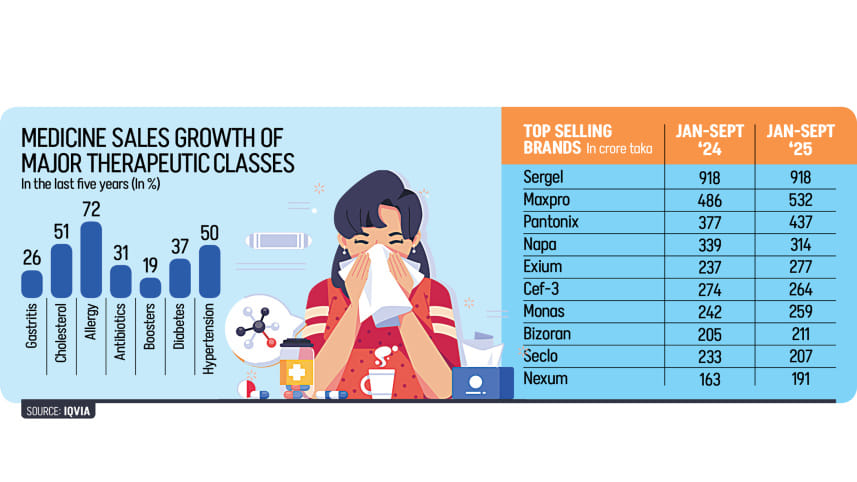
Sales of prescription allergy drugs have surged more than any other types of medicine since the Covid-19 pandemic.
Revenues from these drugs climbed to around Tk 1,200 crore in the first nine months of last year, a 72 percent rise from the same period of 2021, according to IQVIA.
 For all latest news, follow The Daily Star's Google News channel.
 Growth peaked in 2024, when sales jumped 30 percent, shows data from IQVIA, a firm that tracks pharmaceutical sales covering 93 percent of outpatient prescriptions.
M Mohibuz Zaman, chief operating officer of ACI PLC, noted that the growing use of such medicines is closely linked to environmental degradation, particularly severe air pollution, which has increased the prevalence of allergic, lung, and skin diseases.
Meanwhile, Dr Gazi Md Salahuddin Mamun of health research institute icddr,b, noted that skin ailments have proliferated across South Asia since the pandemic.
“Although many people believe Covid-19 vaccines caused the rise in skin diseases, there is no evidence to support this,” he added.
Studies in several countries did report temporary upticks in inflammatory skin conditions after vaccination, but these resolved as immune systems recovered.
Bangladesh, however, faces a different threat of pathogen-related skin diseases.
A fungal infection called tinea, caused by Trichophyton indotineae, has been spreading across South Asia since before the pandemic, said Dr Mamun.
High hygiene standards during lockdowns temporarily slowed its advance. Now detected in Bangladesh, it resists standard antifungal treatments.
Overall, skin diseases have increased across the subcontinent over the last four to five years.
“Dust-laden air has triggered a surge in allergies across the country,” said Muhammad Halimuzzaman, deputy managing director and CEO of Healthcare Pharmaceuticals Limited.
“People are increasingly seeking quick relief from allergic discomfort, leading to frequent use of such medicines,” he said, adding that many patients also take overdoses or switch medicines without proper guidance, further boosting sales.
This pattern of self-medication, he noted, reflects growing public concern over air quality and its impact on health.
Other lifestyle drugs are booming too. During the January-September 2025 period, sales of cholesterol and hypertension medicines grew by more than 50 percent, while diabetic medicines rose by 37 percent.
ACI’s Zaman pointed out that while cholesterol-lowering drugs are used globally, the high incidence of hypertension and heart disease in Bangladesh is largely influenced by dietary habits alongside genetic factors.
“Increased protein intake over the past 10 to 20 years has contributed to rising cases of hypercholesterolemia and other cardiovascular conditions,” he said.
He cautioned that without greater public awareness about fatty food consumption and improved health education, these trends are likely to worsen in the future
Yet none match the dominance of gastric and ulcer treatments, which reached Tk 5,444 crore in the first nine months of last year, an 8 percent increase from the same period in 2024.
These account for roughly 15 percent of total pharmaceutical sales, a figure that says much about Bangladeshi eating habits.
The top three acid-suppressing medicines – Healthcare’s Sergel, Renata PLC’s Maxpro and Incepta Pharmaceutical’s Pantonix – together generated nearly Tk 1,900 crore in sales.
Sergel alone notched Tk 918 crore.
The trio has held the top spots for at least four years. Other leading names in the top 10, including Radiant Pharmaceutical’s Exium and Square Pharmaceutical’s Seclo and Nexum, also saw strong demand for similar conditions.
Beximco Pharmaceutical’s Napa and Bizoran, Square’s Sef-3, and ACME Laboratories’ Monas were additional top performers, each recording sales exceeding Tk 200 crore during this period.
“People’s eating habits are the main reason for the high demand for gastric and ulcer medicines,” said AM Shamim, founder and managing director of Labaid Group.
“Here, people prefer very spicy foods, which often cause gastric problems. Their meal routines are also irregular, so sales of gastric medicines are the highest in the country. We also see this trend in diagnostic centres.”
He added that people have become more health-conscious and now get tested whenever they feel unwell, which has led to more diagnoses of cholesterol problems.
Meanwhile, ACI’s Zaman noted that the unusually high consumption of hyper-acidity medicines is largely driven by food adulteration and the widespread intake of spicy and compromised food ingredients.
“These factors have made acidity-related conditions extremely common, leading to routine prescription and over-the-counter use of medicines such as ranitidine, omeprazole and esomeprazole for decades,” he said.
He recalls that even in the 1990s, international pharmaceutical companies were surprised by the volume of these drugs consumed locally.
After gastric medicines, antibiotics ranked second, with sales reaching Tk 2,255 crore, up 7 percent year-on-year.
Comments