


Zia Haider Rahman on his award-winning novel at NSU’s Colloquium series
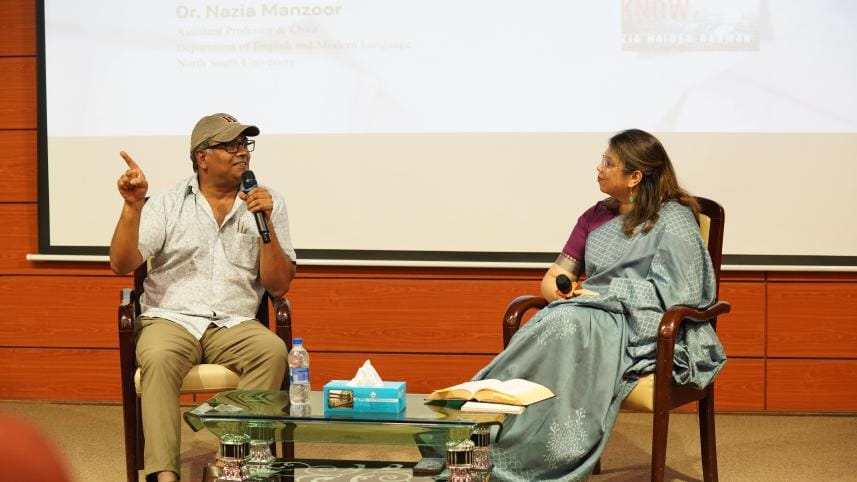
The Department of English and Modern Languages (DEML) at North South University hosted a session of its Colloquium series titled "Zia Haider Rahman in Conversation with Dr Nazia Manzoor" on Tuesday, November 4, from 2:30 to 4:00 PM at their AUDI801 auditorium. The event drew an engaged audience of students, faculty, and literature enthusiasts eager to hear the celebrated author discuss his work, ideas, and approach to storytelling.
The discussion featured Zia Haider Rahman, acclaimed British-Bangladeshi novelist and author of the award-winning In the Light of What We Know (Picador, 2014), in conversation with Dr Nazia Manzoor, Assistant Professor at and Chair of DEML.
Rahman's debut novel, which won the James Tait Black Memorial Prize for Fiction, is a bold and intricate narrative set against the backdrop of war, migration, and the 2008 global financial crisis. It traces the friendship between two men—an investment banker on the brink of collapse and a once-promising mathematics prodigy—whose lives, separated by class and history, intersect through fragmented storytelling and layered introspection.
 For all latest news, follow The Daily Star's Google News channel.
 The conversation opened with Dr. Manzoor asking a question central to the novel's ethical and emotional core: "How do you view class?" In response, Rahman described class as "extremely pernicious", noting how it infiltrates every aspect of identity and human relationships. He reflected on the cost of class migration—the rupture it creates within families, the psychic distance it imposes, and the invisible hierarchies it exposes. "Class," he remarked, "is something we rarely notice when we're inside it, but once displaced, it becomes the architecture of our lives." Comparing class structures across contexts, Rahman reflected that transcending one's class is far more difficult in South Asia than in the West, where education and social mobility can create the illusion of permeability. "In Bangladesh," he observed, "class difference is embedded in daily life, it's not merely about wealth, but about who gets to speak, who gets to be heard."
Next, the conversation shifted to form. Discussing the novel's structure, Rahman described In the Light of What We Know as a "frame story built from digressions," comparing it to a tree "that seems complex from afar but is, up close, simply the letter Y repeated." The novel's digressions, he explained, are not diversions but acts of epistemic enquiry—meditations on how we perceive truth, time, and memory.
"All novels are autobiographical," he mused. "All novels are memoirs. The question is how honest we are about what we reveal—and what we hide." Dr Manzoor compared the character of Zafar from the novel to Coleridge's Rime of the Ancient Mariner (1798), burdened with a need to tell his story, to which Rahman agreed, noting that the novel operates on both a personal and historical plane, revealing itself through pivotal global moments such as Partition, 9/11, and 1971.
Throughout the discussion, Rahman expressed discomfort with being labeled a 'South Asian writer', cautioning against confining literature to geography or identity. "Good writing," he said, "begins not with message, but with curiosity." Writing, for him, is less about asserting belief than about interrogating uncertainty.
The session ended with Rahman reading an excerpt from In the Light of What We Know, touching on alienation, belonging, and the complexities of South Asian writers addressing Western audiences. His quiet, resonant reading reminded listeners that literature's true power lies not in certainty, but in its capacity to provoke thought—asking difficult questions rather than offering easy answers.
Sara Kabir is a dreamer, writer, and literature lover who's constantly juggling academia and her many creative hobbies. She currently teaches English at North South University. Find her musings on Instagram @scarletfangirl.
Comments