


The manifesto of laughter
The afternoon sun presses down on Dhaka like a heavy hand. Heat rises from the asphalt in shimmers; buses wheeze as though gasping for breath. Rickshaw bells jangle against each other in the thick, damp air.
In front of the National Press Club, a crowd gathers. Reporters with notepads, Camerapersons hoisting tripods. Curious passersby wiping sweat from their temples.
 For all latest news, follow The Daily Star's Google News channel.
 At the center of it all stands Abdul Karim—Karim Bhai to almost everyone who knows him. Not a politician, not an activist, not even a wealthy man. Just a tea-seller from Motijheel, sleeves always stained with milk and tea leaves. But his laugh—it booms like a dhol in an empty courtyard. His moustache curls with mischief, and his eyes glint as if he's carrying a private joke about the whole world.
Today he has put on a long white panjabi, though tea stains still mark the cuffs. He clambers onto a plastic chair, clears his throat, and announces: "Brothers and sisters, today I reveal my Election Manifesto—for the People!"
The crowd breaks into laughter. Everyone knows Karim: the joker, the street philosopher, the tea-seller who shouts across the road to ministers as if calling after rickshaw-pullers. Yet the journalists hold out microphones. They know what others know too: Karim draws bigger crowds than many real candidates.
"First promise," Karim declares, holding up a finger. "Free rickshaw rides for all politicians. Why? Because if they suffer once in traffic, they'll fix it in a week!" Laughter ripples outward. A woman fans her child with her dupatta; the policemen stationed nearby try to hide their grins. Karim drinks in the heat, the sweat, the roar of voices.
"Second promise: every MP will live in a tin-shed house six months of the year. Let rain drip on their heads, let mosquitoes sing in their ears. Then they will know what real Bangladeshis live with before signing our fates!"
Pens scratch furiously. Cameras click. Karim wipes nothing, not even the sweat rolling down his jaw.
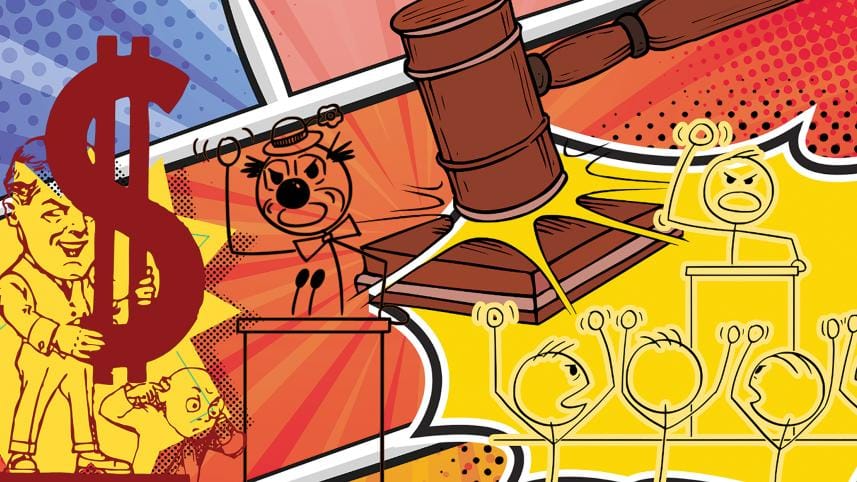
"Third promise: if a minister lies, he must wear a clown's nose in parliament for seven days. We'll call it the Lal Nak Policy."
The crowd roars. A boy perched on a rickshaw starts chanting: "Lal Nak! Lal Nak!" Soon, voices echo the chant up and down the street.
Karim bows with both arms wide, as though hosting a circus. "I don't seek power. I only remind you: power is a joke. And you are the punchline only if you forget to laugh."
To most, he is only a fool with clever words. But those who sit at his tea stall know differently. He once studied literature at Dhaka University—until clashes left him beaten and disillusioned. He dropped out, turned to tea-selling for survival, yet never stopped observing.
Every evening, clerks, workers, rickshawpullers, even an occasional official stop at his stall. Between steaming cups of dudh cha and clinking saucers, Karim spins stories. He takes tragedies from the day's headlines and reshapes them into comedies. His laughter, rough and contagious, doesn't just entertain. It gives relief. Sometimes, it gives courage.
"Laughter is like a mirror," he tells his customers one rainy night. The tin-roof rattles above them. "Hold it up, and the king will see his own crooked teeth."
One evening, a sleek black Prado stops by his stall. Out steps a man in a crisp sherwani, wrist heavy with gold—Farid Khan, the special advisor to the government.
"Karim Bhai," Farid says, his voice smooth, "your jokes are famous. Our party needs voices like yours. Why not come and work with us? Write speeches. Make people laugh for us."
Karim studies him over the rim of his tea glass. His eyes flicker—not anger, not temptation, just weary amusement. "So you want me to be your jester in the king's court?"
"Not a jester—strategist," Farid corrects. "Think of the money, the safety."
Karim throws back his head and laughs, a laugh so loud heads turn from across the street. "My parliament is the footpath, bhai. Here, nobody can cut my microphone."
Farid leaves, his smile stiff as starch. Karim watches the taillights fade. Something unsettles him—danger, yes, but also opportunity.
A week later, Karim stages another "press conference." This time he arrives with props: empty rice sacks, fake currency notes, even a rubber chicken. He declares the founding of Hashi Shangha—the People's Party of Laughter (PPL).
He names a rickshawpuller as finance minister, a garment worker as foreign minister, and a street dog as home minister. The dog barks on cue, and the crowd erupts.
But amid the laughter, sharp truths cut through. Karim shakes the empty rice sack: "This is our reserve, brothers. Always empty—except in the minister's godown." He waves the fake notes: "Inflation! Looks like money, buys nothing. Just like their promises."
The next morning, headlines carry his antics. Memes flood Facebook, WhatsApp, TikTok. Students chant his slogans at tea stalls. Garment workers repeat his jokes in crowded buses. The ruling party grows nervous. Jokes, they know, travel faster than manifestos.
One humid night, plainclothes officers appear at Karim's stall. Their boots crush cigarette butts on the ground.
"You talk too much, Karim Bhai," one mutters. "Careful, or you'll laugh yourself into jail."
Karim serves them tea anyway, smiling. "Tell your masters—even in jail, I'll laugh. And my laughter will reach farther than their speeches."
His customers glance nervously, but Karim winks. "Don't fear. A trickster survives because power cannot predict laughter."
Two weeks later, at Suhrawardy Udyan, a ruling party rally thunders with speeches about 'development'. Suddenly, the sound system crackles—and Karim's voice booms through every loudspeaker: "Brothers and sisters! I, your humble candidate from PPL, announce my first act: replace ministerial convoys with rickshaws. Honking will be replaced with harmoniums!"
The crowd explodes in laughter. The minister flails angrily, but Karim's voice continues: "Second act: every MP will sleep at Kamalapur station one night a year. Then they'll know the state of our shelters."
Phones record. Livestreams spread. People cheer more for the unseen joker than the sweating minister. Later, security learns: Karim had bribed the sound technician with nothing but tea and laughter.
As elections near, posters bloom across Dhaka. A cartoon of Karim's smiling face, moustache twirled, with the words: Vote for the Lal Nak Policy!
People laugh, assuming it's a prank—until the Election Commission confirms Karim has officially filed as an independent candidate for Dhaka-7. His paperwork is flawless.
On election day, queues stretch outside polling centers. To everyone's astonishment, Karim secures nearly fifty thousand votes. He doesn't win, but his name eclipses seasoned politicians. Journalists call it a political earthquake.
That night, when results flash on television, reporters rush to his tea stall. But the shutters are down. A scrap of paper flutters on the wall. In neat handwriting, it reads: "The real victory is not the seat. The real victory is when people laugh at power instead of fearing it. Don't look for me—I'm already among you, in your jokes, your tea, your courage."
No one sees him again.
Weeks later, in parliament, during a heated debate, an MP stumbles. A red clown's nose rolls onto his desk. Cameras catch it. The chamber bursts into laughter.
Somewhere in Dhaka, perhaps in another tea stall, perhaps in disguise, Abdul Karim is surely laughing too.
Haroonuzzaman is a translator, novelist, poet, researcher, and essayist. Besides teaching English in Libya and Qatar for about 12 years, he has had 20 years of teaching experience in English Language and Literature at Independent University, Bangladesh (IUB).
Comments