


Reforms must to protect women and children from violence, trafficking: Speakers
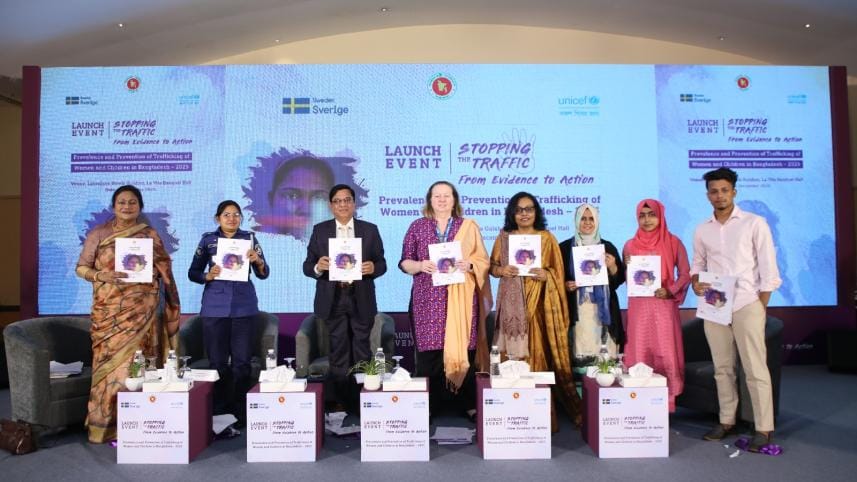
Speakers at a national event today urged Bangladesh to act urgently with coordinated reforms -- strengthening child protection, social services, justice, and wide-reaching prevention -- to safeguard women and children from rising violence and trafficking.
The remarks were made at a Dhaka hotel during the launch of the report "Stopping the Traffic: Prevalence and Prevention of Trafficking of Women and Children in Bangladesh (2025)", jointly conducted by the Government of Sweden and Unicef Bangladesh.
 For all latest news, follow The Daily Star's Google News channel.
 Speakers highlighted pressing concerns over the need for systemic action by the Ministry of Women and Children Affairs to prevent trafficking, additional initiatives by the Department of Social Services to protect street-connected children, and the most urgent evidence-based policy measures required in the country.
Launched by leading child protection advocates, government officials, and civil society representatives, the report provides critical evidence and analysis to inform policy and coordinated action for the protection of vulnerable groups.
It recommends scaling a universal child protection system through a national case management framework, Child Protection Community Hubs (CPCH), functional Child Welfare Boards, Protection Committees, and Counter Trafficking Committees across all districts. It also calls for linking birth registration with access to health, education, and social services.
Other recommendations include expanding the social service workforce, deploying mobile teams to reach street-connected and climate-affected children, and integrating child protection into climate action through Disaster Risk Reduction strategies, early warning systems, shock-responsive social protection, and urban slum service packages.
The report further highlights the need to strengthen justice and accountability by resourcing Anti-Trafficking Tribunals, providing child-sensitive training for law enforcement and the judiciary, fully implementing the National Referral Mechanism, and introducing survivor compensation schemes. Prevention strategies at scale were also emphasised, including norms change, safe migration education, digital safety, regulation of community recruiters, and expanded reporting hotlines.
The event featured a moderated discussion led by Natalie McCauley, Chief of Child Protection at Unicef. Distinguished panellists included Fahima Kader, Additional Superintendent of Police at Police Headquarters; Mohd Sadiqul Haque, National Project Director of the CSPB Project, Department of Social Services; Advocate Salma Ali, lawyer and human rights activist; and Dr Sanzida Akhter, Professor of Women and Gender Studies at the University of Dhaka.


Comments