


Before Ice and Fire: The stories that forged George R R Martin
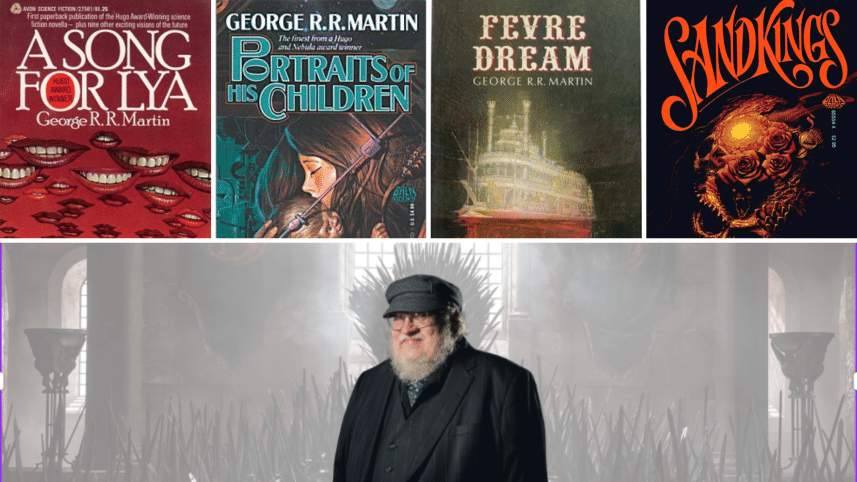
The world has been waiting 15 years for The Winds of Winter—the sixth book of George R R Martin’s epic fantasy series A Song of Ice and Fire, which inspired the acclaimed television series Game of Thrones. For 15 years, Jon Snow has been lying dead on the Wall, Daenerys Targaryen has been stranded in the Dothraki Sea, and Jaime Lannister has been marching toward comeuppance from the vengeful Lady Stoneheart (if that last one doesn’t ring a bell, pick up the books to see what you’re missing!).
A Song of Ice and Fire may be Martin's magnum opus, but it's just one achievement in a prolific 50-year career filled with short stories, novellas, and novels across multiple genres—science fiction, horror, and fantasy.
 For all latest news, follow The Daily Star's Google News channel.
 Here are some of his best works.
Short stories
Portraits of His Children (1985)
Where is the line between fiction’s licence to borrow from life and violating people’s autonomy over their own stories? What if a writer’s characters become dearer than actual loved ones? Stories have long interrogated the flaws and parasitic nature of storytellers, but seldom so brutally as Portraits of His Children.
When a novelist receives portraits of his characters from his estranged daughter that come alive, he must confront the darkest corners of himself and his profession. Martin tackles the danger of using real people and trauma as fodder for art.
With Morning Comes Mistfall (1973)
On Wraithworld, mesmerising mists rise at every sunset, cloaking the planet. Underneath lurk the Wraiths, mythic beasts blamed for tourist disappearances. A journalist is caught between a pragmatic scientist arriving to prove the wraiths do not exist and a romantic hotelier who treasures the mystery.
The story is a commentary on sci-fi and fantasy, where Martin questions what should drive scientific inquiry and whether the relentless pursuit of knowledge without reverence for beauty and colonising the stars is worth the loss of our humanity.
In the Lost Lands (1982)
“You can buy anything you might desire from Gray Alys. But it is better not to.”
Grabbing hold with this cryptic first line, this “deal-with-a-witch” story is told subversively from the witch’s perspective, exploring the danger of unchecked infatuation and the projections born from it.
The Lonely Songs of Laren Dorr (1976)
More a lyrical mood piece than a traditional narrative, it follows Sharra, a "girl who goes between the worlds", searching for her lost lover, and Laren Dorr, a melancholic sorcerer trapped in solitude, guarding the world-gates. As Laren falls for Sharra, the story explores the bittersweetness of being a brief chapter in someone’s life who has become your whole existence.
The Ice Dragon (1980)
A coming-of-age fairy tale of an avoidant child and her secret bond with a mythic dragon breathing icy death.
The Way of Cross and Dragon (1979)
Imagines Christianity in the far future spread across the stars, where a priest’s faith is challenged as he investigates a heretical sect glorifying Judas.
Unsound Variations (1982)
Combines Martin's chess background with sci-fi in a narrative about obsession and outgrowing past failures.
Novellas and novelettes
Before writing the Tales of Dunk and Egg—his richest novellas—Martin had penned a few others.
A Song for Lya (1974)
Telepathic lovers Robb and Lyanna investigate an alien religion centred on a parasitic organism that consumes its hosts. People willingly merge with it to die, receiving overwhelming emotional unity in return.
The pair, who believed their telepathic bond made their love deeper than ordinary intimacy, slowly unravel as Martin uses sci-fi to push human ideas of love, individuality and connection to their limits, meditating on existential loneliness and the dread of never truly knowing another person.
Sandkings (1979)
When a wealthy collector acquires a terrarium of intelligent ant-like aliens called Sandkings, they worship him as God. But as he indulges in sadism for entertainment, their devotion devolves into something terrifying.
Martin crafts a chilling allegory about hubris, abuse of power, and the terrifying consequences of toying with living beings. This was his most famous, seminal work, until Martin started publishing his novels.
Novels
Fevre Dream (1982)
Set along the 1850s Mississippi River, this vampire novel follows steamboat captain Abner Marsh as he partners with the enigmatic Joshua York to build the grandest riverboat ever seen. Through the ideological conflict of two vampires, it draws harrowing parallels between vampirism and American slavery, testing the limits of human empathy. Amidst it is a profound friendship bearing dreams too beautiful to survive the world around them, yet worth chasing into the very heart of darkness.
Fevre Dream was Martin at his best, with evocative prose digging out every ounce of thematic depth from its subject and imagery.
Then he wrote A Game of Thrones and changed epic fantasy forever.
Martin’s stories often take us to the deepest pits of bleakness, not to affirm nihilism, but to unflinchingly examine the human condition and show what forges true light, all while breaking boundaries of genres and tropes. He is a romantic with a wild imagination who mined his heartbreaks, disillusionments, and hopes to tell stories of dreamers trying to better the world. And regardless of their results, it’s the pursuit and the heart in conflict with itself that makes their tales worth telling.
Ice and Fire is the zenith of it all, but these threads run through his bibliography. And as winter comes and goes without The Winds of Winter, and A Dream of Spring remains a dream, what may help you through the wait is a dive into the writer’s work, who is much more than Westeros.
Miazee Abrar drowns in daydreams and writes stories for worms.
Comments