


'Assuming political power to reform state was an overwhelming burden for student leaders'
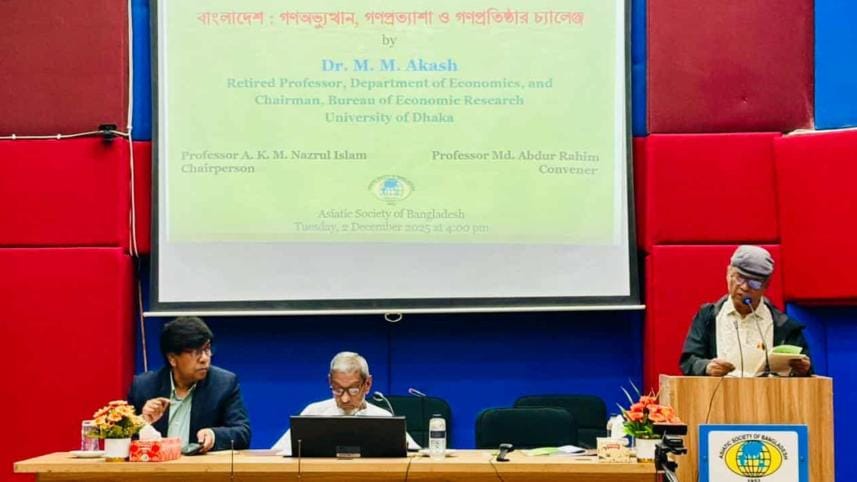
Retired Dhaka University economics professor MM Akash has said that assuming political power to reform the state was an "overwhelmingly large burden" for the student leaders of the July uprising.
Speaking on Tuesday at a seminar held at the Asiatic Society Auditorium during the Prof Dr Fazlul Halim Chowdhury Memorial Lecture, Prof Akash, also chairman of the Bureau of Economic Research at Dhaka University, said, "Student leaders had major disagreements on how the country should be reformed. There were major ideological fights, including the conflict between secularism and religious politics, socialism versus capitalism, and differences over cultural identity."
 For all latest news, follow The Daily Star's Google News channel.
 He added that the leaders failed to distinguish which conflicts truly harmed the public, leading to a breakdown of unity and plunging the country into a "vortex of division and chaos."
Prof Akash argued that student leaders became disconnected from non-political mass students and educational institutions as they assumed state power with the motivation of forming a political party.
"Accusations of extortion, mobocracy, and abuse of power were leveled against them by both allies and critics," he said.
The professor further criticised attempts by some leaders to elevate the July uprising above the Liberation War of 1971, saying such actions allowed "old, reactionary, religious-fascist political forces to re-emerge."
At the event, Prof Sadeka Halim, former vice-chancellor of Jagannath University and founder of the Prof Fazlul Halim Chowdhury Trust Fund, delivered remarks and shared personal memories of her father. The programme was presided over by Prof AKM Nazrul Islam, with Prof Md Abdur Rahim serving as convenor.
Comments