


On the banks of Titas, a palace fading into memory
HOW TO GET THERE
Although the palace sits in Brahmanbaria, it lies close to Madhabpur upazila in Habiganj. Travellers from Dhaka can take a Sylhet-bound bus and get off at Madhabpur Bus Stand, then take a CNG-run auto-rickshaw to Haripur Borobari. Alternatively, visitors can take the Parabat Express train to Nayapara Station in Habiganj and travel to Haripur via Madhabpur.
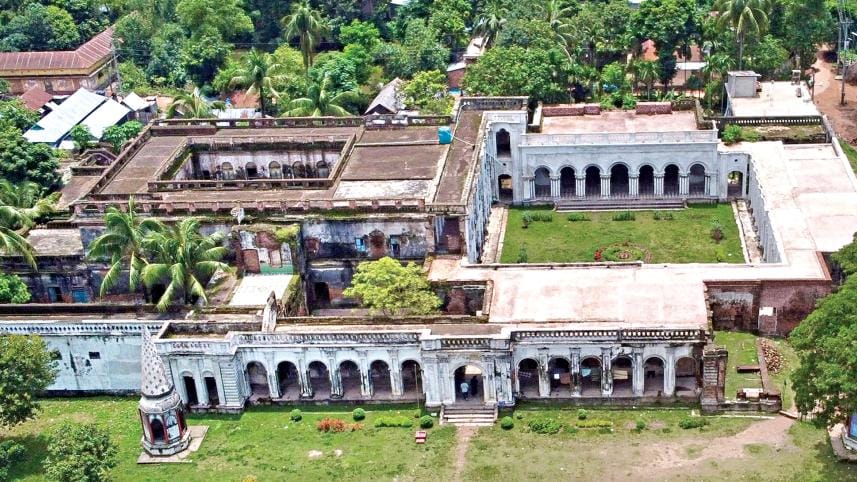
The Haripur Zamindar Bari in Brahmanbaria's Nasirnagar upazila stands in quiet resignation, its ageing walls holding the weight of a world long gone.
 For all latest news, follow The Daily Star's Google News channel.
 Once a proud seat of power and artistry, the mansion now sits on the eastern bank of the Titas river like a fading memory -- beautiful from afar, fragile up close.
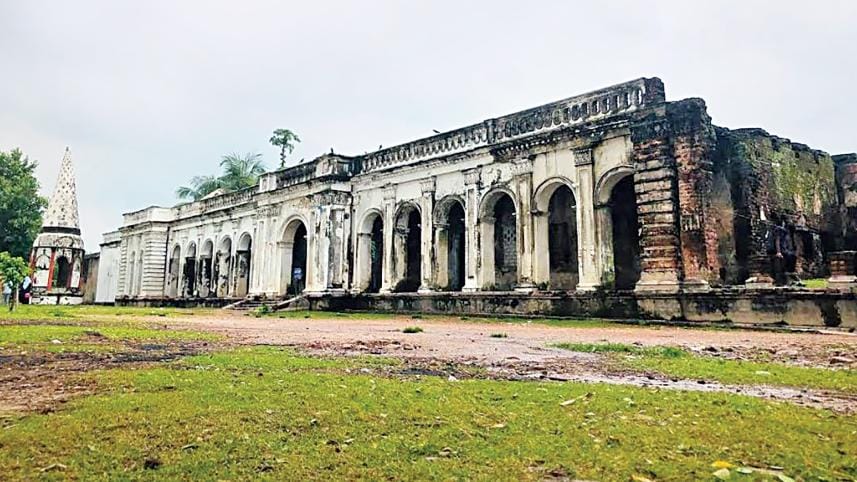
Its once-grand gateways are worn and moss-covered, the carved cornices chipped, and the long verandas cracked by time. The palace, known locally as the Borobari or Rajbari, remains one of the region's most striking Mughal-era structures, drawing the attention of anyone who passes by.
"This is not just a mansion, it is a perfect poem in brick and silence," said Joydul Hossain, poet and president of Brahmanbaria Sahitya Academy. "Each arch is a forgotten verse, each corridor a fading stanza of a Bengal that no longer exists."
According to the Department of Archaeology's Cumilla office, the palace was built between 1843 and 1850 by zamindars Gouriprasad and Krishnaprasad Roy Chowdhury. It once spanned over five acres and featured nearly 60 rooms, including a music hall, dance chamber, court hall, treasury, bathing ghat and gaming room -- all constructed without a single rod of iron.
In 2018, the government declared the palace an archaeological heritage site.

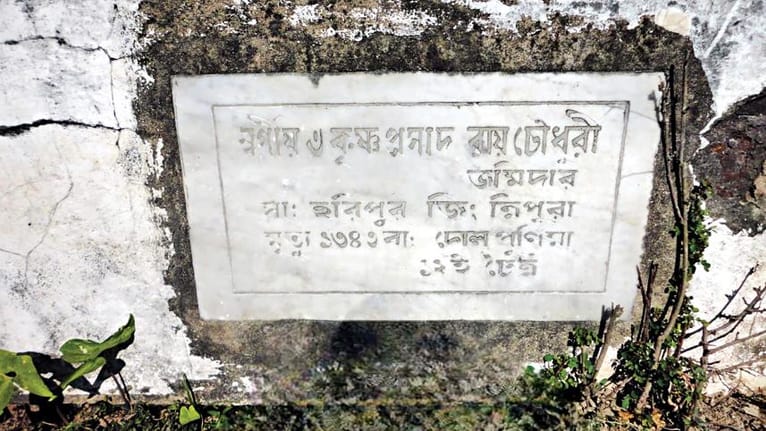
It is believed that the zamindars of Haripur descended from a wealthy landlord family in Tripura. Restoration work began in 2016 and remains ongoing. Parts of the veranda, temples, roof and ghat have already been repaired, and officials expect the project to be completed within the next couple of years.
"This is a rare specimen of non-metallic architecture in eastern Bengal," said Md Saeed Inam Tanvirul, field officer at the Department of Archaeology's Cumilla office.
"Structures like this, made entirely of brick, lime and local materials, show a unique fusion of Mughal symmetry and colonial aesthetics."
Just west of the mansion, along the banks of the Titas, stands the stone-paved ghat built in memory of Uma Rani Roy Chowdhury, the zamindar's wife. Beside it are two temples that once welcomed guests arriving by boat.
Today, they stand silent, their reflections trembling in the river's flow.

"I've seen how the palace breathes during the monsoon," said Zahirul Islam Chowdhury Swapan, founder of the Brahmanbaria Museum. "When the river overflows and mirrors the house, it feels as if the mansion is trying to remember itself -- trying to exist again, if only in shadow."
The palace's decline began with the partition of 1947, when the zamindar family left for Kolkata. The estate later fell under the Vested Property Act.
Locals said when the family departed, a few Hindu priests stayed behind to maintain the property. Over decades, their descendants, along with several local households, occupied the estate informally as the structure slipped into neglect.
The situation changed in 2023 when, following a resolution from a district development coordination meeting, then deputy commissioner Shahgir Alam relocated the families to government-built shelters under the Ashrayan Project and formally reclaimed the palace.
Most of the descendants left voluntarily, and the Department of Archaeology began fresh restoration work, including a lime wash on the exterior.
"I've heard from elders that this zamindar house stands on wooden beams, so it could collapse anytime," said Jamal Mia, former chairman of Haripur Union Parishad.
"We urge the government to renovate the entire structure as soon as possible. If that happens, visitors will surely increase."
The mansion briefly returned to the spotlight when renowned writer and filmmaker Humayun Ahmed shot "Ghetuputro Komola" here in 2012. Earlier, the film "Madhu Malati" was filmed in 1991, followed by "Naiyori" in 2001 and the UK–Bangladesh production "The Last Thakur" in 2008. But beyond these moments, decay has continued to outpace memory.
"During the monsoon, many tourists come to see this palace, mesmerised by its beauty -- but they leave with a heavy heart," said Swapan. "Behind the façade are broken doors, eroded carvings and a courtyard left in sheer neglect."
According to him, many elements of Brahmanbaria's cultural heritage have already disappeared. "It is our collective responsibility to preserve what remains. Once these treasures are lost, they cannot be regained."
Local residents and cultural activists have long called for proper preservation. Many envision turning the estate into a museum or a cultural retreat.
Ansar members assigned to guard the property said it remains open for visitors from 10:00am to 5:00pm, and until 6:00pm during the monsoon when many arrive by boat and enjoy picnics along the river.
However, the lack of local accommodation remains a challenge. People travel from far away to see the palace, but since there are no residential hotels or restaurants nearby, visitors suffer, said several locals. They believe the area could thrive as a tourism spot if facilities were developed.
College student Tabassum Akter said, "The ornamentation is beautiful, but the interior is in poor condition. If the authorities renovate it, many more tourists and students will come to learn about its history."
Visitors Samsuzzaman Chowdhury Sujon and Morad Mia said they often return during the monsoon when "the mansion's charm multiplies".
Sanjay Deb, a local schoolteacher, said the palace is a symbol of Nasirnagar's history. "It must be preserved through government initiative. Such efforts will help the younger generation connect with our past."
Nasirnagar UNO Shahina Nasrin said the administration will continue working with the Department of Archaeology. "We reclaimed the estate from illegal occupation, and now we plan to move forward with restoration."
Brahmanbaria Deputy Commissioner Mohammad Didarul Alam said the palace has "immense potential," adding that the administration is considering proposals to restore and protect it.
Contacted, Dr Nahid Sultana, regional director of the Department of Archaeology's Cumilla office, said the complete restoration of Haripur Zamindar Bari has been included in the 2025-26 fiscal year's work plan.
"The extent of restoration will depend on the allocated budget," she said.
Comments