


Jahangirnagar University: A campus awash with colour and life


Every morning, after getting out of bed, Siyam Nazmul, a residential student at Jatiya Kabi Kazi Nazrul Islam Hall at Jahangirnagar University, steps onto the veranda of his room to breathe in the day’s first light. Usually, the air carries the familiar stillness of campus dawn, but today feels different.
The breeze is softer, almost tender. It brushes past his face with a sweetness he cannot quite name. In the southern wind floats the scent of fresh blossoms. Winter’s stiffness has quietly retreated, and nature seems to have stretched itself awake. Tender green leaves unfurl on every branch, and clusters of vibrant flowers sway gently, as if celebrating their own return. From somewhere beyond the trees, the melodious call of the cuckoo spills into the morning, turning silence into music.
 For all latest news, follow The Daily Star's Google News channel.
Yes, you guessed it right -- spring has sprung. Not just across the fields and gardens, but in the restless corners of every campus resident’s heart. With its colours, fragrance, and quiet longing, spring carries a gentle urgency, a reminder that after every season of stillness, life finds a way to bloom again.
Although winter in JU ends a little later than in many other parts of the country, nature never fails to decorate the campus in its full glory. The dry, leafless trees of winter are now covered with fresh green leaves. Colourful flowers have bloomed, and new fruits have started to grow. Mango trees are filled with tender buds on every branch. The soft, sweet fragrance of these new buds spreads through the air as bees busily collect nectar. Under the touch of spring, many small but beautiful changes are taking place across JU.
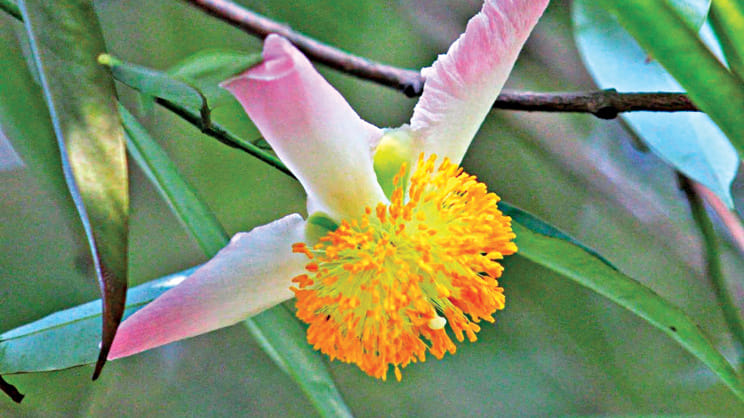
Flowers like palash and shimul, along with the soft green of fresh leaves, have given nature a new look and new energy. In front of the newly built Faculty of Arts building, the mahua tree at Mahua Tola has also bloomed with fresh flowers.
Under its shade stands Aminur, a student of International Relations at the Faculty of Arts. “The harshness of winter is gone. The campus has regained its life, and so have I,” he says with a smile. “The colourful flowers have not only decorated the campus; they have coloured our minds too. That’s why I’m wearing something bright today.”
Aminur is right. Just as the palash trees wake up in the golden sunlight, and the buzzing of bees mixes with the playful wind, the young people of JU also celebrate the spirit of spring. Young men come out wearing basanti panjabis or fatuas. Many female students wear basanti-coloured sarees, tuck flowers into their hair, and wear glass bangles on their hands.
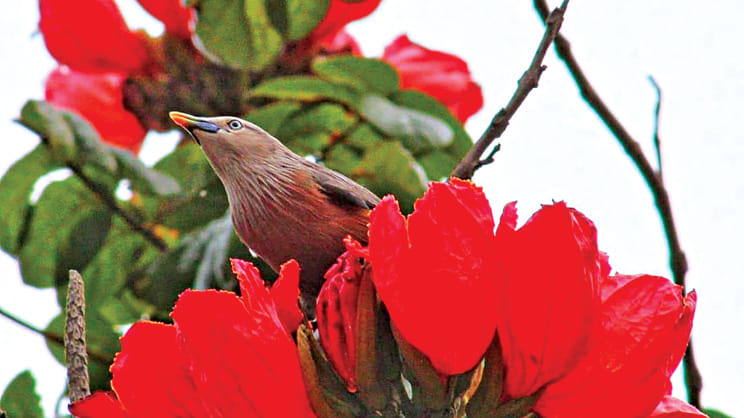
On this campus, spring is not just a season. It is a feeling -- simple, bright, and full of life. A closer look across campus only enriches the picture. On the southwest side of the Botanical Garden, clusters of shimul flowers have bloomed. Their bright red petals catch the eye from afar. As soon as one looks up, a squirrel can be seen jumping from branch to branch. The scene feels almost magical -- nature in its purest form.
“I came with my friends to collect shimul flowers,” says Shifa, a student of Journalism, gently placing a petal behind her ear. “Aren’t they beautiful? We will make garlands with some of them and decorate our room with the rest.”
Walking further towards the eastern side of the Botanical Garden, another squirrel appears -- this time resting comfortably on branches full of palash blossoms. The fiery flowers and the tiny creature together create a picture that feels like a painting.
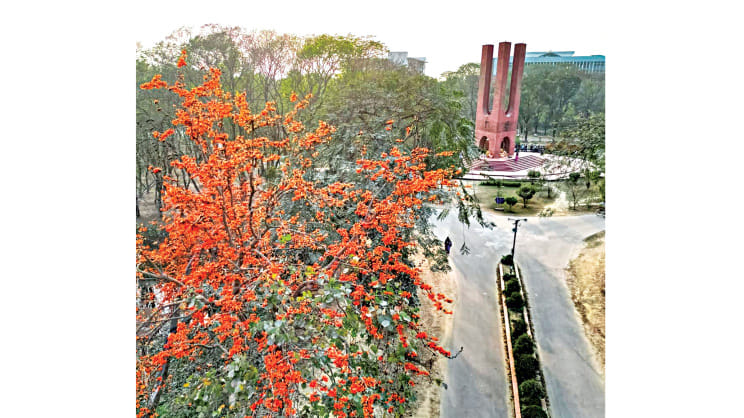
Naim, who has come from Dhaka University to visit JU, cannot hide his feelings. “Ah, why didn’t I get admitted here? That will remain my lifelong regret,” he says with a smile. “The fragrance in the air, the beautiful flowers, the life and nature -- it’s impossible to experience such a spring in the city.”
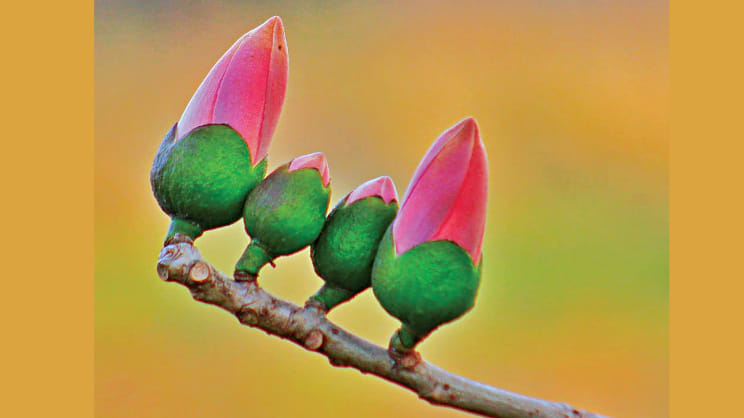
To the south of the Botanical Garden, small wildflowers peek out from tree branches. Breaking through layers of green leaves, pink buds appear at first glance to be forest blooms. But on closer look, they turn out to be young shimul buds preparing to open.
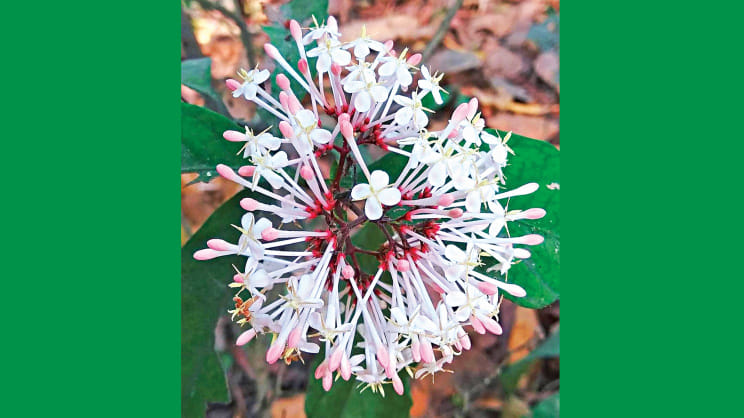
Still, many wildflowers have truly bloomed with the arrival of spring. Behind the Social Sciences building, hundreds of Golapi (pink) amrul flowers can be found scattered across the greenery. Near the Prantik Mosque, a tree shines with star-like blossoms in soft shades of yellow and light orange -- locally known as udal.
In the woods behind the old Registrar Building, hundreds of tiny white flowers (shet rongon) quietly bloom. Near the new Arts Building, gamari flowers add their own subtle charm. And of course, beside the Botanical Garden, delicate sharango flowers complete this living canvas of colours.
However, as the years pass, a quiet change can also be noticed in JU’s spring. “The number of shimul trees on campus has decreased,” says Prof Mir Masudul Alam of the International Relations department. “Shimul trees usually grow naturally; they do not need to be planted. Perhaps due to deforestation on campus, their numbers have declined.”
Prof Alam, who has long been involved in wildlife photography around the university, also points out another shift. While shimul and some wildflowers have declined, the number of palash trees has noticeably increased. “Among wildflowers, the number of udal has also dropped significantly,” he adds.
Still, spring colours continue to brighten many corners of the campus. In front of the Social Sciences faculty and opposite the Zahir Raihan Auditorium, kosmos, shimul, and palash bloom side by side. “I can’t walk this path without taking pictures. It has become my daily habit,” says Juthi, a student of Economics.
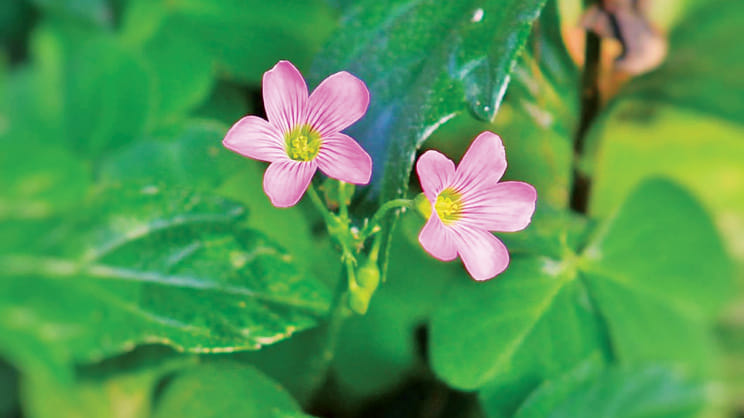
Near the TSC garden, petunias are in full bloom. Besides the Bachelor’s Quarters, clusters of rudra palash catch the eye. Around the Medical Centre area, gunwood (nagkeshar chaapa) flowers blossom along the pond’s edge. A little further ahead, in front of Al Beruni Hall, a garden of sunflowers stands tall, where parrots and other small birds often come to rest.
Prof Amir Hossain Bhuiyan of the Environmental Science Department said Jahangirnagar offers exactly the kind of environment plants need to thrive. He explains that many high-quality trees were planted in a planned way, arranged in rows so that different species bloom in different seasons. That is why the campus remains colourful throughout the year. He also mentions plans to plant even more flowering trees in the future.
Yet, while flowers continue to bloom, a quiet sadness lingers in the background. Bit by bit, JU is losing parts of its natural beauty. Over the years, thousands of trees have been cut down. Several lakes have disappeared, filled in to make space for new buildings and roads. The campus is expanding. New structures rise, facilities improve, and development moves forward. But with every tree that falls and every lake that vanishes, something gentle fades away. The birds seem fewer. The shade feels thinner.
“JU is still beautiful, no doubt. But twenty years ago, it was different -- more flowers, more colours, more lakes. Even the air felt different. I still carry those memories. And yes, I miss it,” says Mohiudduin, an alumnus of the Government and Politics department who graduated about 25 years ago.
For now, JU still blooms. The trees continue to flower, and petals still fall softly along quiet paths. Students still pause to take photos, to breathe in the fragrance, to feel the season. But those who have watched the campus for years notice the slow changes -- quieter lakes, shrinking shade, and empty spaces where old trees once stood.
Comments