


In Adui Para, hope climbs uphill to school


In Adui Para, a remote village in Alikadam upazila in Bandarban, the road to school is a hill path of stone, dust and patience.
Every morning, children climb it to reach “Owangnim Kiyang”, a Mro-language school known as “School in the Clouds”. Some come barefoot. Others wear thin sandals, nearly worn through by the rough ground. They arrive with dust on their legs, and in winter the cold leaves them trembling on the morning walk.

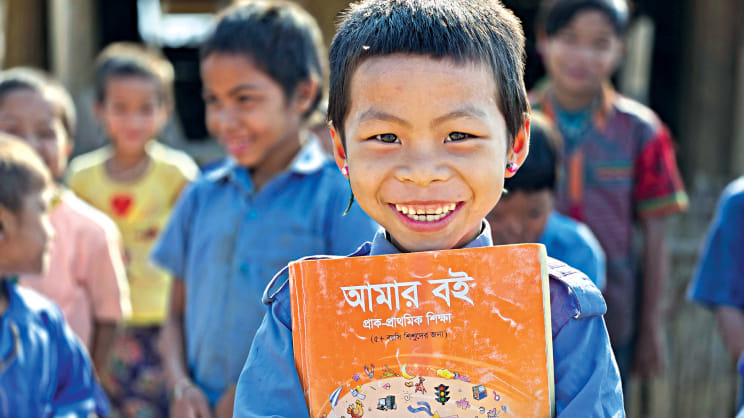
Most carry their books pressed tightly against their chests because they do not have school bags. A few have bags, but most hold their books steady with both forearms and hands as they move along the narrow hill tracks.
Their clothes tell their story: torn school uniforms, worn and stained, often too large for their small bodies, and faded blue shirts whose colour has long been drained by sun, dust and time.
“We got these shoes and this uniform two years ago. Sometimes my friends wear them too because we do not have another one,” said five-year-old Long Rau Mro, a student in the pre-primary section.

Yet the children arrive. They line up for assembly, attend lessons, and smile easily.
For families in Adui Para, a village about eight kilometres from the Myanmar border, this daily journey is part of life. More than two dozen families here are raising their children under the same harsh conditions. Still, each morning begins with the same quiet determination: to send their children to school.
The village falls under ward-4 of Kurukpata union. The school rests on the slope of a hill, around 198 metres above sea level. To reach it, one must leave the main road and walk for about four hours.
Locals said the nearest alternative school is more than two hours away on foot. For a small child, it is almost impossible, with steep climbs, stream crossings and hours of walking along the way.
DAY BEGINS WITH ‘AMAR SHONAR BANGLA’
Every morning, children gather in a small clearing on the hillside. At the edge of the yard, parents and older siblings stand silently, keeping their distance as the children take their places.
Thongpray Mro, a village chief and temporary teacher, steps forward as the school struggles to hire qualified teachers because of a lack of funding.
He calls the children into rows. They shuffle into position, brushing dust from their clothes and wiping their hands on their sides. A short parade follows, with small, careful steps over uneven ground. Then they stand still.

The anthem begins. “Amar shonar Bangla, ami tomay bhalobashi.”
The children sing together, their voices rising in one steady tone and carrying across the hillside, through trees and homes.
The school has 11 children in the pre-primary section, where classes run from 8:30am to 9:30am. There are four students each in Class I and Class II, and two in Class III, with each class lasting one hour.
The school was set up by villagers with the help of several travellers, as there were no government-appointed teachers, no regular supply of books, and no infrastructure.
“We did not want our children to grow up without learning,” said Thongpray. “Even if it is small, this is something.”
Owangnim Kiyang School is being run almost entirely through community effort. Local indigenous residents remain at the centre of its operation, while four privately employed supporters from Dhaka help fund the initiative and look after its needs.
Together, they manage the school’s limited finances, maintain basic facilities, and try to ensure that classes continue. With little outside support, the school survives on personal contributions and voluntary labour.
 For all latest news, follow The Daily Star's Google News channel.
 Residents said they had struggled for years to establish a school for local children. The turning point came around five years ago, when a group of travellers from Dhaka visited the village. After hearing about the long-standing need for a school, they decided to help.
One of the travellers, Mohiuddin Al Muhit, said, “We thought we needed to do something for the hills. We are trying our best to do everything we can.”
‘LIKE A DREAM’
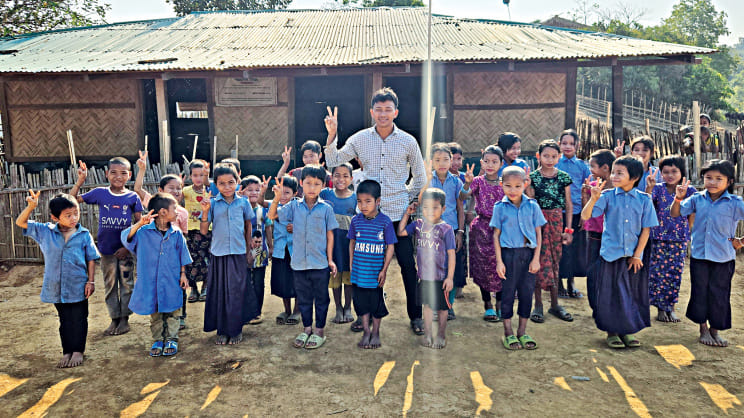
The school was founded by a group of friends who believed education could change a community from within.
Muhit described the school as a dream he is trying to make real.
“Owangnim Kiyang feels like a dream to me, and I am slowly trying to make it real. From a wish to give something back to the hills, I started this journey together with the most left-behind Mro community.”
“I am hopeful that with everyone’s joint effort, one day the school will spread the light of education to every corner of the hills.”
Tanvir Saita, another founder, said, “We believe that education can change a society. From that belief, we set up this free school for the children.”
Sifat Amin Adil, another founder, said the school was inspired by the children themselves.
“We started this school so that geographical hardship or economic limits do not stand in the way of these children dreaming… When we see a child writing their name for the first time, all our hard work feels worth it.”
“We need support from everyone, and we also need a sustainable plan.”
A SCHOOL WITHOUT BASICS
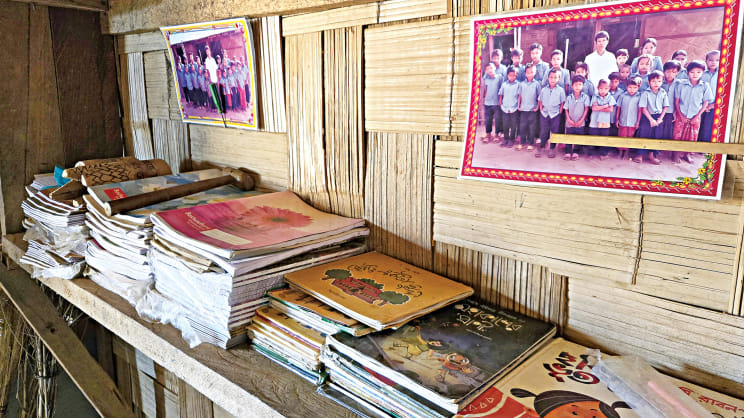
A visit to the school last month found there is no school vehicle, no smart board, no painted corridor, no fan turning above benches in the heat, and no steady supply of learning materials.
Two small classrooms and one office room are built of tin and wood on a hillside, and in front of the schoolyard stands a wooden Shaheed Minar, also built by locals.
Inside the classrooms, the lessons are basic but meaningful: Mro language, Bangla, English, and mathematics. The school teaches from pre-school to Class III.
Despite these limitations, four students from the school have gone on to continue their education in town. One of them is Mang Chang Mro, now a Class VI student at a school in Alikadam.
“Without this school we would not get the opportunity,” he said.
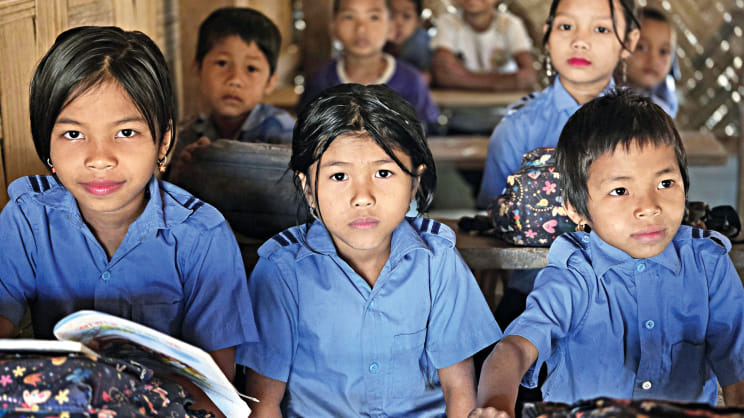
For children who want to continue their education, however, the real difficulty begins once they have to leave for town.
Sending a child beyond the village means transport, cost, lodging, and uncertainty. For many, the burden is simply too heavy.
Quoting locals, Man Wai Mro, a member of the school committee, said the school needs proper classrooms, a well-structured establishment, trained teachers, learning materials, and basic facilities.
Even in all this hardship, hope remains.
Parents in Adui Para know their children walk barefoot to a small school on a distant hill, yet they continue to send them with the hope that it can be the first step towards change.


Comments