


Business leaders call on Tarique
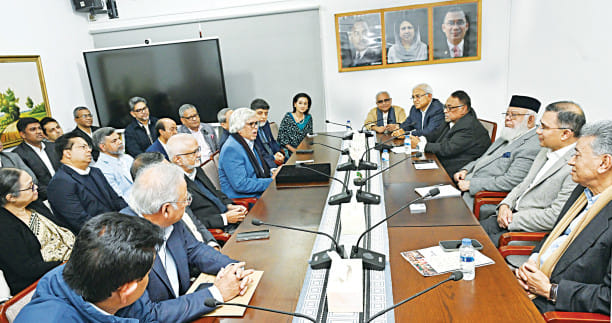
Top industrialists and business leaders expressed concerns over Bangladesh's deteriorating law and order situation during a meeting with BNP acting chairman Tarique Rahman at the party's Gulshan office yesterday.
From gas and electricity shortages to instability in law and order, rising interest rates, and unpredictable tax policies -- business leaders said these persistent challenges are stifling investment and threatening economic growth.
 For all latest news, follow The Daily Star's Google News channel.
 In response, the BNP assured them that if voted to power, the party will address these matters.
Ahsan Khan Chowdhury, chairman of Pran-RFL Group, said that Tarique Rahman gave significant time and attention to the concerns raised by the business community during the meeting.
"He listened to us for two and a half hours and took note of everything we said. It gives us hope that the future of business in Bangladesh will improve," Ahsan told reporters after the meeting.
He said the discussion covered a wide range of issues -- from law and order to banking challenges -- and that no major concern was left unaddressed.
"Our fellow business leaders were able to present the problems faced in the country very clearly, and he was patient throughout," he added.
He expressed optimism that the BNP leader would take necessary steps to address the issues if the party returns to power.
Abdul Muktadir, president of the Bangladesh Association of Pharmaceutical Industries, said, "...some business leaders raised common issues -- lack of gas supply, deteriorating law and order, inconsistent NBR policies, infrastructure problems, high bank interest rates, and high VAT."
The BAPI president quoted Tarique as saying that BNP aims to develop the capital market to reduce the cost of funds for businesses.
"Tarique Rahman told us clearly: 'You are the manufacturers; you generate employment and drive prosperity. We will only provide an enabling environment."
Mohammad Hatem, president of the Bangladesh Knitwear Manufacturers and Exporters Association, said he highlighted concerns around Bangladesh's upcoming graduation from Least Developed Country (LDC) status.
"I told Tarique Rahman that the government's current approach to LDC graduation is self-destructive. He agreed with my view."
Hatem also expressed deep concern about the recently proposed labour law reforms, warning that they could severely impact the readymade garment (RMG) sector -- much like how the once-thriving jute sector declined.
"Tarique Rahman acknowledged the concerns and said he had already spoken to the current government, urging them not to implement the law at this stage."
According to Hatem, the discussion also covered issues such as the ongoing gas and electricity crisis, corruption, instability in law and order, and frequent policy changes by the National Board of Revenue.
"Everyone present echoed concerns over deteriorating law and order, along with the broader impact of corruption and inconsistent tax policies."
Banking sector problems were also raised, with several participants, including some bank owners, addressing policy shortcomings and the growing number of struggling industries.
"In total, the core issues discussed were labour law reforms, LDC graduation, law and order, tax policy, corruption, infrastructure, and banking sector instability."
Talking to reporters after the meeting, BNP Standing Committee member Amir Khosru Mahmud Chowdhury said business leaders have trust in the party, adding that if voted to power, BNP will address their expectations and problems.
He said that Tarique listened to the major problems business leaders are facing, which is why investment is not happening in the country.
"Our employment is declining. We discussed the problems in the banking sector, the stock exchange, the capital market, and other related issues. They hope that if BNP is voted to power, it will be able to address the expectations.
"There are problems with bureaucrats, problems with extortionists, and high bank interest rates. Because of corruption, the cost of doing business is increasing, and people have to pay more. As a result, prices of essential goods are rising."
He said business leaders are unable to run their businesses in an unfavourable situation. "... If Bangladeshi business leaders cannot invest, how will foreign businesspeople invest?" he asked.
"Tarique Rahman has promised businesspeople that these problems will be solved."
Among others present at the meeting were, Mahbubur Rahman, president International Chamber of Commerce; Simeen Rahman, group CEO of Transcom and vice president of Metropolitan Chamber of Commerce and Industry (MCCI); Anwar ul Alam Chowdhury Parvez, president of Bangladesh Chamber of Industries (BCI); AK Azad, managing director of Ha-Meem Group; Tapan Chowdhury, managing director of Square Pharmaceuticals; Mir Nasir Hossain, former president of Federation of Bangladesh Chambers of Commerce and Industry; Matiur Rahman, chairman and managing director of Uttara Group of Companies; Ali Akbar, chairman of Bangladesh Steel Re-rolling Mills; Ahsan Khan Chowdhury, chairman of Pran-RFL Group; Taskeen Ahmed, president of Dhaka Chamber of Commerce and Industry (DCCI); Md Jahangir Alam, president of Bangladesh Steel Manufacturers Association; Mohammad Hatem, president of Bangladesh Knitwear Manufacturers and Exporters Association (BKMEA); Mostafa Kamal, chairman and managing director of Meghna Group of Industries; Matiur Rahman, chairman of Uttara Motors; Kamran T Rahman, president of MCCI; Kutubuddin Ahmed, former president of the Bangladesh Garment Manufacturers and Exporters Association (BGMEA); Fazlul Hoque, former president of the BKMEA; Nihad Kabir, former president of the MCCI; Mahmud Hasan Khan, president of BGMEA; and Shawkat Aziz, president of the Bangladesh Textile Mills Association.
In addition, Azizul Kayser of Partex Group; Hossain Khaled, former president of DCCI; Md Shahriar, president of the Bangladesh Plastic Goods Manufacturers & Exporters Association; Moynul Islam, president of the Bangladesh Ceramic Manufacturers & Exporters Association; Abdul Muktadir, president of the Bangladesh Association of Pharmaceutical Industries (BAPI); Abdul Hai Sarkar, president of the Bangladesh Association of Banks; Amirul Haque, managing director of Seacom Group; Preeti Chakraborty, senior vice president of BCI; Fazle Shamim Ehsan, president of the Bangladesh Employers' Federation; and Sharif Zahir, chairman of United Commercial Bank were also present.
Comments