


Our picks for top 5 gadgets from 2025

2025 delivered some of the most meaningful advances in everyday tech in years. Across phones, wearables, and gaming hardwares, manufacturers leaned into better engineering, more thoughtful design and increasingly practical uses of AI. Not every standout product was flashy. Some of the biggest shifts came from refinements that made technology easier to live with. Here are 5 gadgets that were in the global conversations this year.
1. Samsung Galaxy Z Fold 7
 For all latest news, follow The Daily Star's Google News channel.
 For years, foldable phones were pitched as impressive but impractical experiments, often expensive and delicate. In 2025, Samsung's Galaxy Z Fold 7 made a stronger case for the category by feeling closer to an everyday flagship than a showpiece.
A lighter build, a sturdier hinge and a cover screen that works comfortably as a normal phone made the Fold 7 easier to use in routine situations. Its significance was not the novelty of a folding screen, but how unremarkable it began to feel. More people treated it as a primary device, not a luxury extra. For some, it reduced the need to carry both a phone and a tablet. For others, it made multitasking feel less cramped.
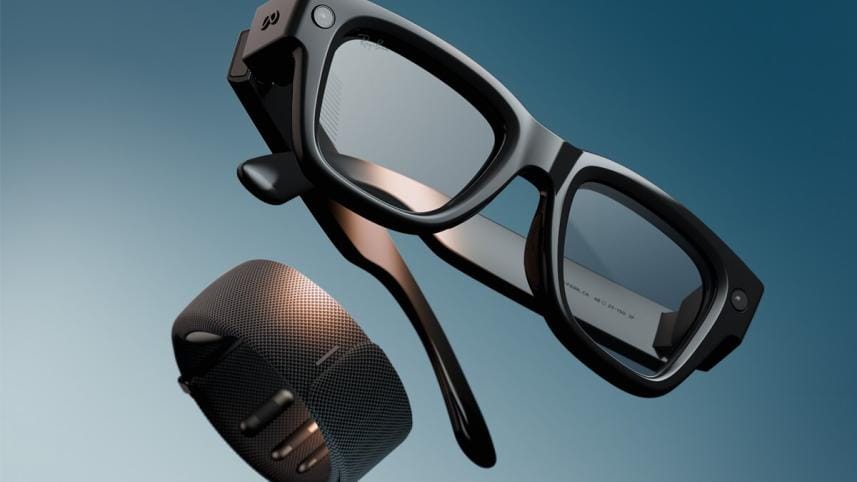
2. Meta Ray-Ban display glasses with Neural Band
Smart glasses have a history of overpromising and underdelivering. Meta's Ray-Ban display glasses, paired with the Neural Band, brought the category back into serious conversation by taking a more restrained approach.
Rather than trying to replace the smartphone, the system focused on light-touch assistance: navigation cues, short notifications and hands-free AI features designed for quick, practical use. The design mattered, too. Prioritising comfort and style helped position them as eyewear first, technology second. They are still far from mainstream, but they suggested a more realistic path for wearable computing that does not demand social trade-offs.
3. Nintendo Switch 2
In an industry fixated on raw performance and cloud infrastructure, the Nintendo Switch 2 stood out by improving a proven idea rather than chasing a different one. Better hardware, a larger and brighter display and smoother performance made the experience feel more polished, while keeping portability at the centre.
The Switch 2 became a cultural staple because it continued to prioritise playability. Families, commuters and casual players embraced it alongside enthusiasts, reinforcing Nintendo's long-held view that good design and accessible games matter as much as power. In a fragmented gaming landscape, it also worked as common ground.
4. Light Phone III
Not every influential gadget in 2025 added features. The Light Phone III attracted attention by removing them. Built around essentials such as calling, messaging, navigation and music, it deliberately left out social media and the constant stream of notifications that define modern smartphone use.
It was never aimed at mass adoption, yet it resonated beyond its niche. For some, it worked as a secondary device. For others, it replaced a smartphone entirely. More than anything, it became a symbol in wider conversations about digital fatigue, attention and control at a time when connectivity and AI are increasingly ever-present.
5. Nothing Ear 3 earbuds
In a market crowded with near-identical wireless earbuds, Nothing's Ear 3 stood out by making design part of the appeal. Its transparent casing, backed by strong everyday audio performance and a competitive price, turned a functional accessory into something with personality.
The Ear 3's popularity also signalled a small shift in consumer taste. While many gadgets aim to disappear into the background, these earbuds showed there is still appetite for products that look distinctive, provided they do not compromise on the basics.
Comments