


Goethe-Institut Bangladesh
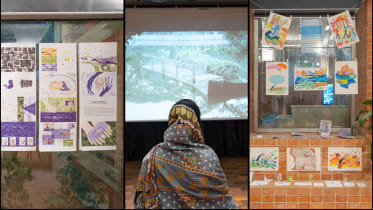
Preserving what flows: Dhanmondi Lake at the Goethe-Institut
Dhanmondi Lake began as part of a natural water system before being reshaped through planning decisions that accompanied the growth of the neighbourhood. Over the decades, it has absorbed new roles as a recreational space, ecological corridor, and social meeting ground. The exhibition traced these shifts with care, presenting the lake as an accumulation of layers formed through use, intervention, neglect, and attachment.
3 February 2026, 10:45 AM
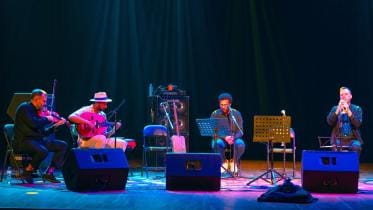
Where the Isar meets Buriganga: JISR’s soundscape captivates Dhaka
Held on December 5, the event marked the group’s return to Dhaka after three years and drew an enthusiastic audience.
6 December 2025, 06:11 AM

‘AI Mafia Boyfriend’: Can technology fix what humans break?
The auditorium at Goethe-Institut Bangladesh turns into an unconventional stage on November 29 as “AI Mafia Boyfriend”, an experimental performance created by Katerina Don for Sister Library, unfolds before a packed audience. Instead of a conventional play, the production operates as a participatory social experiment examining loneliness, emotional labour, and the growing role of artificial intelligence in intimate life.
1 December 2025, 17:51 PM
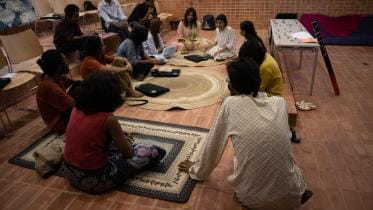
‘Reimagining Waste’: Exhibition exploring art of reuse opens tomorrow
Urukku Bangladesh, in partnership with the Goethe-Institut Bangladesh and the University of Liberal Arts Bangladesh (ULAB), presents “Reimagining Waste”. It is a free-of-cost, open-to-all exhibition born from a three-month-long workshop exploring the possibilities hidden in discarded materials.
7 August 2025, 11:49 AM
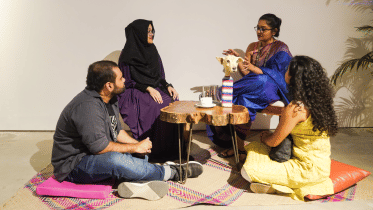
7 Sisters in the library: Interpersonal conversations and catharsis found
The event switched gears soon enough, and the final hour saw Shala Gallery turned into a rave.
21 November 2024, 13:44 PM
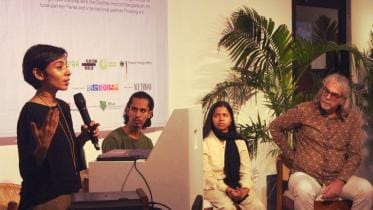
‘Moja-Kori’ design festival to inaugurate Dhaka’s first community-driven cultural hub
Featuring more than 50 events, the festival will showcase architectural designs, artworks, photography, installation pieces, and performing arts, hosted in multiple venues around Korail as well as at Shala Neighbourhood Art Space, Gallery 101, and Alliance Française de Dhaka.
4 November 2024, 14:18 PM
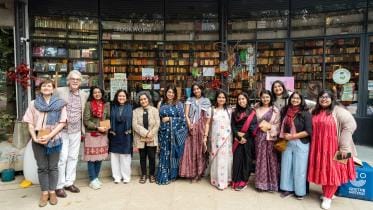
Creating sisterhood through Literature
Even the chilly Friday morning did not dampen the excitement as the audience came to support the writers who narrated parts of their works at the event.
28 January 2024, 15:45 PM
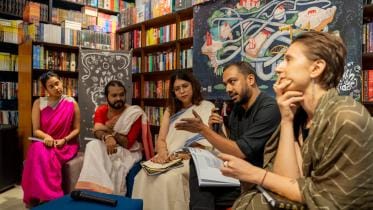
Into the unknown: Fairytale retellings in ‘The Myth Bridge’
The creators discussed the thought process that led to the creation of the characters' journey, the challenges they encountered during the writing and editing process, and the inspiration behind the narrative choices.
11 September 2023, 13:55 PM

The perks of being a reader in residence
The goal of this project is to bring together readers to explore literary contributions, showcase artistic quality and celebrate women in the creative world as well as to foster interests and understanding of the accomplishments of female writers and artists.
4 September 2023, 15:56 PM
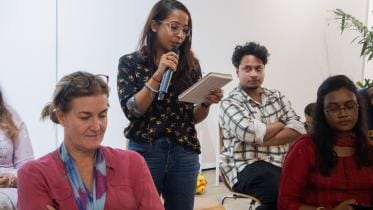
“Fragile Things”: How ghosts and spirituality make it into writing
Participants, including the show’s hosts and guests, picked up discarded pebbles, photo frames, children’s artwork, and other knick knacks—all fragile things collected and displayed by the author.
7 July 2023, 04:00 AM
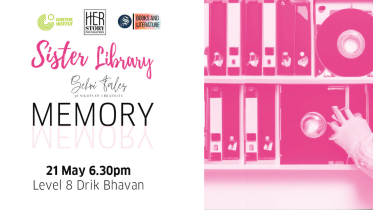
Sehri Tales in person—with Sister Library this time
An evening storytelling and writing around the "chimera that is memory", organized by Sister Library and Sehri Tales.
18 May 2023, 11:07 AM
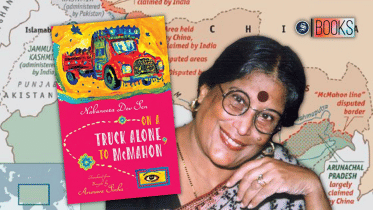
Sister Library discusses book on travelling as a woman
Still today, we are plagued by the most intrusive, and least sensical question asked of female solo travellers is “Are you travelling alone?”
20 February 2023, 13:36 PM
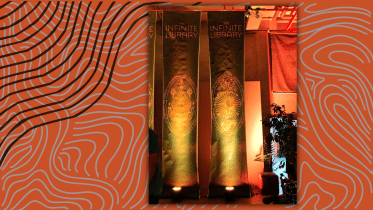
'Infinite Library': An immersive experience of civilisation at Goethe Dhaka
The Infinite Library did not have books. It consisted of virtual spaces, a set of "eight jars" or volumes that—using a VR journey through the users' phones—told the story of our planet's evolution, starting from the beginning of cosmic dust to human consciousness.
14 September 2022, 06:46 AM
Lese Literati: Goethe-Institut Bangladesh starts German literature reading series
Goethe-Institut Bangladesh, in collaboration with Dhaka Lit Fest, North South University, and University of Liberal Arts, Bangladesh, are hosting a series of author talks and readings from August to November 2021, with the aim of bringing German literature to Bangladeshi readers.
21 August 2021, 07:53 AM
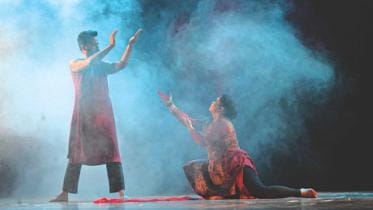
An evening of contemporary dance
Goethe-Institut Bangladesh, in association with Bangladesh Shilpakala Academy, recently organised an evening of contemporary dance, under the Young Choreographers' Platform 2019.
13 April 2019, 18:00 PM
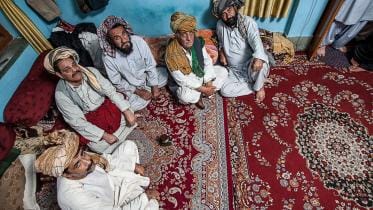
“From Kabul to Kolkata” opens at Drik Galley
Goethe-Institut Bangladesh, in partnership with Drik, is holding a photography exhibition, “From Kabul to Kolkata: of Belonging, Memories and Identity”, at Drik Gallery in the capital.
24 April 2015, 18:00 PM