


Democratising Cancer Care in Bangladesh
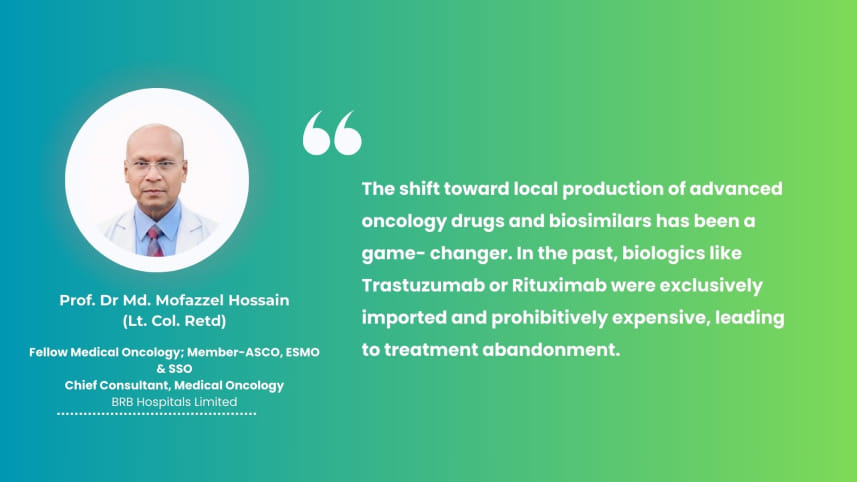
As Bangladesh grapples with a rising tide of cancer cases, the dual challenges of affordability and late-stage diagnosis remain significant hurdles. In this insightful Q&A, Professor Dr Md. Mofazzel Hossain (Lt. Col. Retd), Chief Consultant of Medical Oncology at BRB Hospitals Limited, explores the shifting landscape of oncology in the country.
The Daily Star (TDS): What is the current cancer burden and growth trend in Bangladesh, and which types are most prevalent among men versus women?
 For all latest news, follow The Daily Star's Google News channel.
 Md. Mofazzel Hossain(MMH): Bangladesh is already facing a substantial cancer burden, and it is rising mainly due to population growth, ageing, and persistent risk factors (tobacco, betel nut, infections, lifestyle changes). According to IARC–GLOBOCAN 2022 estimates, Bangladesh has around 167,256 new cancer cases and 116,598 cancer deaths in a year (both sexes, all ages). In terms of the most common cancers, the pattern differs by sex. Among men, the leading cancers by new cases include oesophagus, lip/oral cavity, and lung. Among women, breast cancer is the most common, followed by cervix uteri, then oesophagus (with gallbladder and lip/oral cavity also high). One important point is: because we still lack a fully robust nationwide registry, different sources can show variation, so strengthening cancer surveillance is crucial for planning.
TDS: How has the shift to locally-made advanced cancer drugs (like biosimilars) improved patient survival in Bangladesh compared to the past?
MMH: The shift toward local production of advanced oncology drugs and biosimilars has been a game- changer. In the past, biologics like Trastuzumab or Rituximab were exclusively imported and prohibitively expensive, leading to treatment abandonment. Today, local biosimilars are roughly 40% to 60% cheaper than their originator counterparts. This has improved accessibility by: 1. Completing Treatment Cycles: Patients no longer stop mid-way due to costs. 2. Earlier Intervention: We can now offer cost-effective targeted therapies manufactured by the local companies in earlier stages of cancer rather than reserving them as a last resort. Local manufacturing has essentially democratised high-end oncology, turning a 'death sentence' into a manageable chronic condition for many patients.
TDS: Cancer treatment often leads to "financial bankruptcy." What specific models or partnerships can make expensive drugs truly affordable for the common man?
MMH: Cancer's financial toxicity’ is real. The solutions must be system-level, not charity-only. I would suggest a blended approach:
1. Risk pooling/health insurance: expand financial protection so families don’t pay everything out-of-pocket.
2. Government–industry price agreements: negotiated pricing for high-impact cancer drugs, with transparent criteria.
3. Pooled procurement + tendering (public + private hospitals) to bring down unit price.
4. Patient Assistance Programs (PAPs) with clear eligibility + shared funding (pharma + foundations + CSR).
5. Outcome-linked access pilots for selected high-cost biologics (pay-for-value style) where feasible.
6. Hospital social funds + NGO partnerships to cover diagnostics and travel costs, not just drugs. The key is to design these as predictable programs, not occasional support.
TDS: What must the government and pharma companies do to ensure that essential cancer medicines are always available and never out of stock?
MMH: Government Role: Streamline the Fast-Track API (Active Pharmaceutical Ingredient) import process for oncology and maintain a 'National Essential Cancer Drug List' with mandatory buffer stocks.
• Pharma Role: Local companies must diversify their supply chains so they aren't reliant on a single source for raw materials. Pharmaceutical companies should immediately take necessary actions to manufacture the API of oncology drug that substantially curtails the costs and pave the way forward for Bangladesh to become the hub of low-cost cancer treatment.
• Digital Inventory Tracking: We need a centralised, real-time dashboard connecting major hospitals and pharmacies to the Directorate General of Drug Administration (DGDA) to predict and prevent shortages before they happen." TDS: Since most patients arrive at a late stage, how can the industry help bring cancer screening and diagnostics directly to rural communities? MMH: As most patients arrive late, we must shift left, toward early detection. The industry can support, under ethical rules
• Mobile screening and diagnostic outreach: district-level camps linked to referral hospitals, not one-off events.
• Scale evidence-based screening methods: cervical screening (VIA/HPV pathways) and breast early detection with structured referral.
• Sample logistics: partner to strengthen specimen transport (biopsy/cytology) from upazila to tertiary labs.
• Telepathology / tele-oncology support so rural clinicians can triage faster.
• Awareness + navigation: trained community health workers and patient navigators to reduce delay from symptom to diagnosis. Most importantly, screening must connect to treatment capacity, otherwise we detect but cannot treat.
TDS: For World Cancer Day 2026, what is your one "Action Point" for policymakers, the pharmaceutical industry, and the general public?
MMH: World Cancer Day 2026 sits under the ‘United by Unique’ campaign, meaning we must design care around people, not just the disease. My one action point is: ‘Stop late diagnosis, make early detection and timely treatment the default.’
• Policymakers: fund and scale district-level early detection with referral pathways, and protect families with financial risk coverage.
• Pharmaceutical industry: support ethical, guideline-based programs that improve access, continuity, and quality, including responsible pricing and uninterrupted supply.
• General public: act early, don’t ignore symptoms, avoid tobacco/betel nut, and participate in recommended screening when available. If we reduce late presentation, we will save more lives than any single medicine can.”
Comments