


The Next 25 Years: Where Bangladesh’s Motorcycle Industry Is Headed

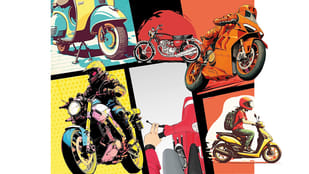
The numbers tell a sobering story of Bangladesh's motorcycle industry. After reaching 640,000 units in 2022, sales fell to 384,000 in 2024, a six-year low. Inflation eroded purchasing power, the taka weakened sharply, and political upheaval worsened an already fragile market. Yet manufacturers had invested Tk 6,000 crore in production capacity, betting on growth that has yet to materialise.
Industry leaders still speak of reaching one million units by 2027, but that sounds less like forecasting and more like optimism. Strip away the marketing language, and three threads emerge: the electric question, safety technology and our export ambitions.
 For all latest news, follow The Daily Star's Google News channel.
 Electric Two-Wheelers: Hype vs Reality
The electric motorcycle story in Bangladesh is unfolding unevenly. Optimists point to a fourfold rise in EV bike imports, from 2,446 units in 2022–23 to 10,053 units in 2024–25. Realists note that of Bangladesh's 6.5 million registered vehicles, only 261 are officially listed as electric two-wheelers. Pragmatists add that thousands more operate unregistered, in the familiar grey zone.
This is not the exponential curve of true disruption.
Globally, the contrast is stark. China sold 4.81 million electric motorcycles in 2023, reaching 28% market penetration. India's electric two-wheeler sales surged under government subsidies. Indonesia targets a 25% market share by 2030, while Vietnam's EV sales jumped 98% in early 2025.
Bangladesh's own pledge under the Paris Agreement targets 30% electric vehicle adoption by 2030, implying roughly two million electric two-wheelers within five years. At the current pace, that target will be missed by a wide margin.
The constraints are structural. Charging infrastructure is limited outside Dhaka, and the policy framework remains economically unconvincing for ordinary buyers. Duty cuts and incentives are repeatedly promised "from the next fiscal year." Chinese imports dominate, mostly fully assembled, while local manufacturing remains limited.
What is happening is narrower. Young urban professionals, particularly women, are adopting electric bikes for short commutes. Parents value controlled speeds. Running costs matter: charging a REVOO A01 for 75 km costs Tk 9.07, compared to several hundred taka for petrol. These are pockets of adoption, not a market shift.
The electric future will arrive, but slowly. Walton's Takyon, Komaki's Dhaka outlets, and offerings from Runner, Green Tiger and Akij signal intent. Yet without major advances in battery technology, wider charging networks and stable electricity pricing, electric two-wheelers will remain a premium urban option. By 2030, an 8–12% market share appears more realistic than official targets; by 2050, 40–50% is possible if regional trends hold.

Export Potential: Facing the Hard Math
In 2019, industry leaders predicted Bangladesh would export motorcycles to India's northeast, Nepal and Africa. Runner Automobiles began small-scale exports. Honda shipped 14 XBlade 160 motorcycles to Guatemala in 2024, generating headlines but little volume.
The economics are unforgiving. Manufacturing costs in Bangladesh run about 10% higher than in India, Thailand or Vietnam, even before duties. Import duties on components remain high, while duty drawback procedures can take over five years, tying up large amounts of working capital. Without duty-free imports against guarantees, Bangladeshi manufacturers struggle to compete globally.
Production capacity reached 800,000–1,000,000 units annually by 2024, while domestic demand fell to around 380,000 units. Excess capacity sits idle because export markets can source motorcycles from India or China for 20–30% less.
Meaningful exports require three things Bangladesh lacks: streamlined duty drawback systems, a developed component base (over 700 parts are imported per bike, with only chains, seats, stands and batteries made locally), and brand recognition abroad.
Could Bangladesh become a motorcycle export hub by 2050? Theoretically, yes. Vietnam managed it, aided by infrastructure, industrial policy and ASEAN access. Bangladesh has potential but lacks execution. More realistically, exports may reach 50,000–100,000 units annually by 2035–2040, serving price-sensitive niche markets.
Financing, Insurance and Digital Services
Motorcycles in Bangladesh cost Tk 80,000 to Tk 5 lacs, equivalent to 4–25 months of average income. Most purchases require financing, yet dedicated motorcycle loans remain limited.
City Bank's "City Bike Loan," launched in 2024, offers up to 80% financing, while Uttara Bank provides smaller loans. Penetration remains low. Banks classify two-wheeler loans as high-risk, requiring stable employment and income levels that exclude gig workers, small traders and ride-hailing drivers. Informal financing fills the gap, often at interest rates of 15–25%.
Insurance adoption is similarly weak. Although mandatory under the Road Transport Act 2018, enforcement is minimal. Most riders carry only basic third-party coverage, if any. Comprehensive insurance is rare, claims processing is cumbersome, and cashless repair networks are limited outside Dhaka.
Digital tools could ease these constraints. Alternative credit scoring, microfinance integration, mandatory insurance verification, and cashless repair networks are all feasible. Bangladesh has 120 million mobile financial service users and near-universal mobile penetration.
What's missing is institutional reform. Bangladesh Bank, IDRA and BRTA have yet to align regulation with digital capability. These are not technological barriers but governance ones.
Bangladesh has the market size and manufacturing base to sustain its motorcycle industry through 2050. But the next 25 years are more likely to be defined by gradual adjustment than dramatic disruption.
Comments