


Carbon to conservation: The Promise of Green Construction
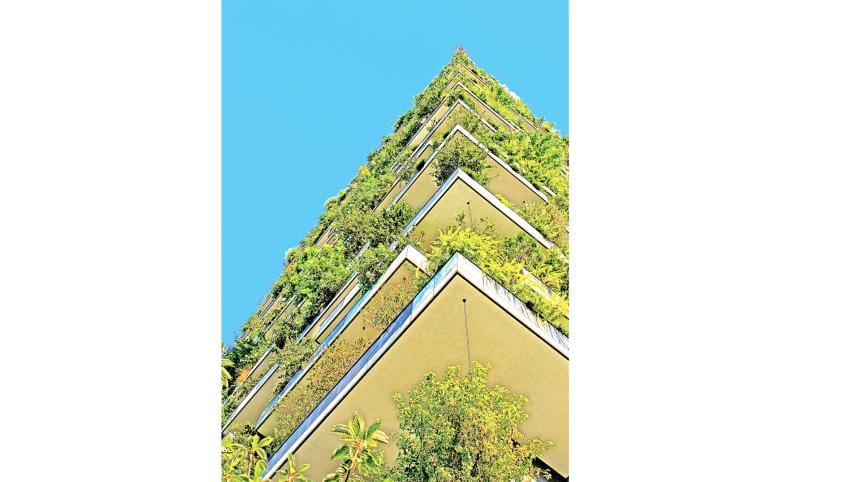
Cities are expanding rapidly, transforming skylines and reshaping the way people live, work, and connect. Yet the very structures that define modern life are also among the biggest contributors to climate change. According to the United Nations Environment Programme (UNEP), the buildings and construction sector accounts for roughly one-third of global energy demand. Around 37% of energy- and process-related CO₂ emissions when materials are included. As the world confronts escalating climate pressures and dwindling resources, the construction industry stands at a pivotal crossroads. Here, the concept of green construction, which is also known as sustainable or "green building," emerges as both a challenge and an opportunity.
What "green construction" really means
 For all latest news, follow The Daily Star's Google News channel.
 Green construction encompasses design and delivery approaches that reduce environmental impact throughout a building's lifecycle. This includes site selection that protects ecosystems, low-embodied-carbon materials, efficient HVAC systems, water-saving measures, and on-site waste reduction. According to the U.S. Green Building Council, it is not a single technology but a whole-system mindset focused on durability, reuse, low operating costs, and occupant health.
The numbers that matter
Operationally, buildings consume about 30% of the world's final energy and produce roughly a quarter of energy-related emissions. When emissions from materials such as cement and steel are included, the sector's share rises toward the high-30s percent range. Those figures underline why decarbonising both new construction and the existing stock is essential to meet climate targets.
Proven tactics with measurable returns
Many green measures deliver rapid, verifiable returns. High-performance insulation, improved glazing and efficient heating, ventilation and cooling can cut energy use dramatically; renewable energy integration further reduces operating emissions. On water, low-flow fixtures, greywater reuse, and rainwater harvesting are standard, measurable approaches. Evidence from certified projects shows meaningful performance gains — for instance, large samples of LEED-certified buildings report average energy reductions and water savings compared with conventional peers. Still, results vary by climate, operation and certification rigor, so careful measurement is essential.
Why green buildings make economic sense
Beyond environmental benefits, green buildings often outperform conventional ones financially over the medium term. Savings on energy and water lower operating costs; healthier indoor environments can raise productivity and lower absenteeism; and market demand increasingly premiums sustainably built assets. While some green technologies add modest upfront cost, many interventions, particularly when integrated early, pay back through lower bills and higher asset value. According to the World Green Building Council, survey data and market studies have repeatedly shown positive business cases for green retrofits and new green projects.
The big challenge
A stubborn reality is that most buildings that will exist in 2050 already stand today. Retrofitting these assets — often built with carbon-intensive materials like conventional cement and steel — is therefore mission-critical. Innovations in low-carbon materials, circular-economy reuse, and phased retrofit strategies are scaling up, but policy support, skilled labour and financing mechanisms must catch up to unlock the full potential.
Local relevance: opportunities for Bangladesh
For rapidly urbanizing countries like Bangladesh, green construction is both a resilience and affordability strategy. Bangladesh is also embracing green construction and sustainable technologies in the building sector. One example is InnStar Limited, a real estate and construction company that focuses on green-certified, technologically advanced projects. Their developments prioritize sustainability through initiatives such as rainwater harvesting, recycling wastewater from toilets, tree plantation, pavements equipped with motion-sensor lights that only activate when vehicles are present, and garages with electric vehicle charging stations.
Pratik Sengupta, AGM of InnStar, stated, "If you only think 2–4 years ahead, green construction may seem more expensive than traditional methods. But when you consider the future, what we are leaving for the next generation, how sustainable the project is, and how it contributes to the environment, green construction makes complete sense. It no longer appears costly when you view it as an investment in the future."
A Practical Roadmap Forward
Policymakers, developers, and building owners can accelerate green construction by requiring or incentivizing energy performance disclosure, prioritizing retrofits of high-use buildings, supporting low-carbon materials and whole-life accounting, and expanding skills training for sustainable practices. Combining clear regulations with financial incentives and technical assistance will make green construction the norm rather than the exception. Beyond lowering emissions and operating costs, sustainable buildings create healthier, more resilient communities. With the right strategies, the construction sector can transform from a major carbon contributor into a key driver of climate solutions, one building at a time.
Comments