


Maria’s mission to bring seaweed to dinner tables across Bangladesh

[Special supplement]
In many parts of East and Southeast Asian countries such as China, Indonesia, and South Korea, seaweed is an everyday ingredient - woven seamlessly into meals for its taste, nutrition, and versatility. In Bangladesh, however, this nutrient-rich marine plant remains largely unfamiliar. From the shores of Cox's Bazar, one woman is quietly working to change that.
 For all latest news, follow The Daily Star's Google News channel.
 Maria Ray, an entrepreneur based in the coastal town, believes seaweed can play a meaningful role in improving nutrition particularly for women, while creating new livelihoods along the coast. What began as culinary curiosity has now evolved into a growing business that blends tradition, innovation, and community empowerment.
Seaweed, abundant along coastline in Bangladesh, is seasonal by nature. To overcome this limitation, Maria began producing dried seaweed, ensuring year-round availability. Building on that success, she has recently introduced dried seaweed powder, expanding both shelf life and application. Today, her products reach customers far beyond Cox's Bazar, with online orders through Facebook page and website coming in regularly from Dhaka and Chattogram through her brand, Sea Forest BD.
Beyond packaging, Maria has woven seaweed into the heart of her restaurant, Starina's Kitchen. By adapting it to familiar Bengali dishes, she has helped diners embrace an ingredient they once viewed with hesitation. The response, she says, has been overwhelmingly positive.
Seaweed's appeal lies not only in its culinary versatility but also in its nutritional power. Rich in vitamins, minerals, antioxidants, and anti-aging properties, it is increasingly recognised worldwide as a superfood. It also has applications in cosmetics, pharmaceuticals, organic fertilisers, and animal feed - opening doors to broader industrial use. For a country like Bangladesh, Maria believes seaweed could address nutritional gaps while generating employment, particularly in coastal communities.
Her ambitions now extend to cultivation. This winter, Maria aims to produce nearly two tonnes of dried seaweed. Women from six fishing families are already engaged in the farming process. She chose to launch cultivation independently, she explains, to maintain quality as demand continues to rise.

A journey that began far from the sea
Maria's entrepreneurial journey began in 2008, far from the waves of Cox's Bazar. She started her career at a call centre in Dhaka, earning Tk 15,000 a month. Determined to fund her own ventures, she worked night shifts while running a beauty parlour and a small clothing business. Later, she spent two years as a marketing manager at an antivirus company.
Marriage brought a turning point. In 2018, she moved to Cox's Bazar following her husband's posting. The long, quiet days at home left her feeling isolated, but they also reignited a lifelong passion. Her father had worked as a chef on foreign ships, and cooking had always been close to her heart.
"I started experimenting in the kitchen," Maria recalls. "My neighbours loved the food and kept encouraging me to start something of my own." Occasional lunch orders soon followed, and in 2019, she formally opened Starina's Kitchen on a quieter road leading to Laboni Beach in Cox's Bazar City.
From the outset, her philosophy was simple: wholesome, home-style food prepared with care. "I want every customer to feel safe and nourished," she says. "No one should ever fall ill after eating at my restaurant."

How seaweed made it to Starina's Kitchen
Seaweed entered Maria's kitchen in 2022, when a relative brought dried seaweed from abroad. Unsure how to prepare it, she turned to online research and was soon captivated by its nutritional depth and culinary flexibility.
Her familiarity deepened through her connection with the Rakhine community, among whom eating Gracilaria seaweed is a long-standing tradition. One of Maria's grandmothers belonged to the community, giving her rare insight into their preparation methods. She found that the Ulva variety, in particular, adapted well to Bengali tastes.
She began modestly - adding seaweed to pakoras and soups. Customer enthusiasm confirmed her belief: seaweed could find a place on Bangladeshi plates after all.
Today, Maria Ray stands at the intersection of nutrition, entrepreneurship, and coastal community development. With seaweed as her medium, she is not only reshaping menus but also reimagining what sustainable, inclusive business can look like - one harvest, one meal, and one community at a time.
Scaling Production to Ensure Quality
The dense forest of Moheshkhali is located just opposite the Nuniarchora sea beach, one of the most secluded beaches in Cox's Bazar. Although separated by the Bay of Bengal, the mangrove forests on both sides hint at a shared ecosystem. It is here, along the shores of Nuniarchora, that seaweed is being cultivated in harmony with nature.
To reach the farms, one must navigate a narrow road through a traditional fishing village. In areas where water remains even at low tide, black Gracilaria is cultivated using the long line method. Additionally, the green Ulva species is grown on floating bamboo rafts.
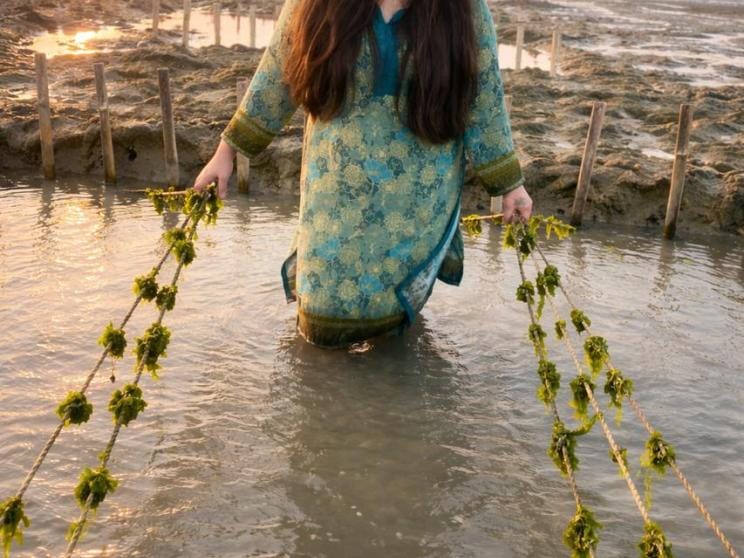
Maria said that Gracilaria seaweed is found naturally on the seashore in winter. They can be used as seeds for cultivation. Ulva algae seeds are collected from the Cox's Bazar Agricultural Research Center. The female members of six fishing families take care of these cultivations.
Since seawater salinity and weather conditions are critical to growth, the cultivation season runs from November to April, with harvests occurring nearly every month.
"We are aiming to produce 24 tons of wet Ulva this season, which should yield about 2 tons of dried product. Additionally, we expect to produce 500 kg of Gracilaria." Maria says.
Transitioning to commercial-scale production required more than just farming skills; it required a market strategy.
"If I cannot sell what I produce, all the effort is in vain," Maria admits.
Despite her background in marketing, she credits the 'Amrai TARA' training she received from BRAC Bank in October for refining her approach.
"I have participated in many training programmes, but BRAC Bank's curriculum taught me how to view marketing from a 360-degree angle. Applying these insights has already yielded a much stronger market impact."
BRAC Bank's 'Amrai TARA' program provides women entrepreneurs with practical guidance on business management, digital skills, financial literacy, and market access. To date, the program has empowered over 3,000 women across 20 districts, with plans to expand nationwide.
"I want to bring seaweed to everyone in our country, especially to women. After seeing my own child suffer from malnutrition, I realized just how vital proper nutrition is," Maria said.
"I invested in seaweed farming by mortgaging my gold jewelry, and this year, I hope to achieve sales of BDT 3 million." she added.
Comments