


The last roar of Diego Maradona

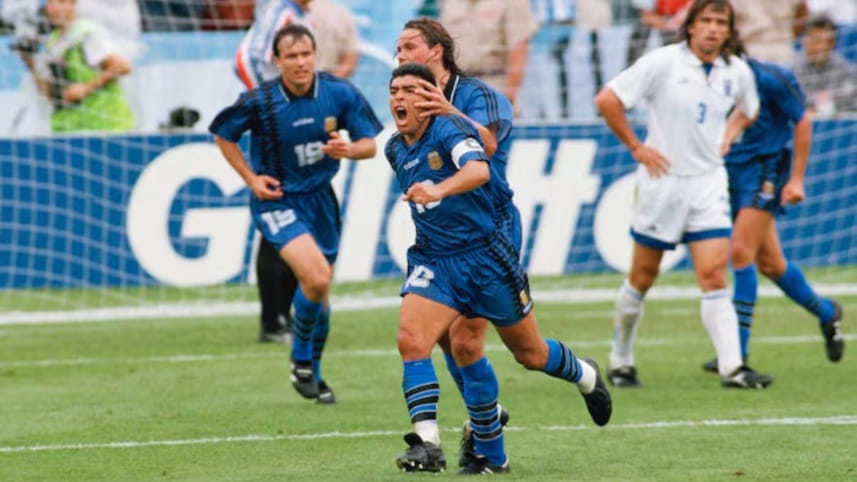
The glass lens no longer seemed like an ordinary piece of equipment. It felt like the frozen gaze of the entire world -- and staring directly into it was a fallen god reciting the mantra of his own resurrection.
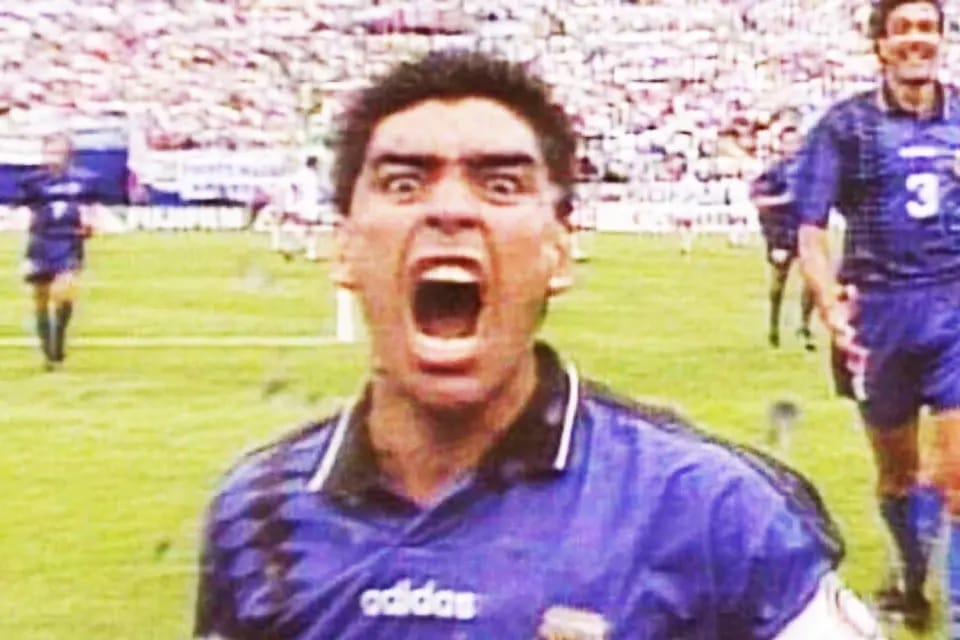
Veins bulged across his forehead, primordial fury burned in his eyes, and from deep within his throat erupted a wild, untamed roar. Like a wounded lion moments before losing his kingdom, he seemed determined to remind the world one last time that the jungle still belonged to him, that he had not yet thrown away the crown.
 For all latest news, follow The Daily Star's Google News channel.
 Before the 1994 World Cup, the world’s feelings towards Diego Maradona were tangled in strange uncertainty. Some still worshipped him like a deity; others believed he was finished. The glorious Napoli years were over. The tearful farewell of Italia ’90 was over. Suspensions, weight gain, cocaine scandals -- Maradona seemed to be fighting against the shadow of his own legend.
But the problem with Maradona was that he never knew how to disappear like ordinary men.
He always returned dramatically.
The date was 21 June 1994.
Foxborough Stadium in Boston stood ready to host the final chapter of an epic. The opponents were Greece. Yet the eleven Greek players on the pitch hardly seemed to be Maradona’s real adversaries that day. His battle was with himself, with cruel time, and with the entire footballing world that had already discarded him.
The decline had begun after the 1990 World Cup. Drugs, controversy, a humiliating departure from Napoli and a 15-month suspension had pushed him to the very edge of the abyss. This comeback, therefore, was not just another return. It was a desperate fight to reclaim mountains of lost dignity buried beneath years of accusation and disgrace.
Before the tournament, few believed he could even play. His body had swollen with excess weight and he tired easily. Yet his determination was extraordinary. Through relentless effort and brutal training, he shed the weight and once again pulled on Argentina’s sky-blue and white shirt, the captain’s armband wrapped around his arm. There was a quiet tension in the air at Foxborough. Everyone wanted to know whether the magician still had any magic left.
An hour had passed in the match. Argentina were already leading through a Gabriel Batistuta brace. But the crowd were waiting for something else.
Just outside the penalty area began a breathtaking exhibition of footballing art. The ball moved like an artist’s brush through a maze of feet. Fernando Redondo to Claudio Caniggia, Caniggia back to Redondo. One-touch passes stitched together a hypnotic web while the Greek defenders watched like men under a spell.
And then the ball arrived at Maradona’s left foot at the very centre of that web.
For a brief instant, time seemed to stop.
There was no space. A wall of defenders stood before him. But that divine left foot had never obeyed earthly rules.
His left leg rose.
In a flash, with the perfect twist of his body, he struck the ball. It bent impossibly through the air before crashing into the top corner of the net. Greek goalkeeper Antonis Minou could do nothing but dive helplessly into empty space.
Then came the explosion.
The stadium erupted, but the real drama was still to come. After scoring, Maradona sprinted towards the touchline. He ignored his team-mates. This was not aimless celebration; it was as though he were searching for an invisible enemy. Within seconds he found it --- the television camera waiting beside the pitch.
It felt as though he wanted to burst through the lens itself and enter the living rooms of every critic who had declared him finished, every FIFA official who had judged him.
Then he roared.
His face twisted violently, eyes bulging with raw intensity. He moved so close to the lens that it seemed he might swallow the camera whole. But what was that scream? Was it merely the joy of scoring a beautiful goal?
No.
It was the volcanic eruption of years of rage finally bursting free.
In that single roar, he answered every insult ever thrown at him. It was his way of pointing at the world and screaming: I am not finished. I am Diego. I am football.
Those few seconds captured on camera became the ultimate symbol of a rebellious hero’s final resistance.
But nobody knew then that the roar in Boston’s fading afternoon light would become his final roar in Argentina colours.
Only days later, after the match against Nigeria, a nurse took him by the hand and led him off the pitch. Soon came the crushing news: ephedrine.
“They cut off my legs,” Maradona cried -- and with that heartbreaking sentence, the international career of a magician came to an end forever.
Maradona is gone now. Yet that moment charging towards the camera remains immortal within football’s memory.
Because in those few seconds, it felt as though his entire life was captured.
The slums of his childhood. The madness of Naples. The glory of 1986. The darkness of cocaine. The criticism. The arrogance. The love. The destruction. Everything.
And perhaps that is why the celebration still feels so hauntingly beautiful today. Because there was no perfect hero in that frame. There was only a broken genius, burning the last of his light in one final attempt to shake the world again.
And truth be told, he succeeded.
Comments