


Messi: Unburdened and in full flight


Lionel Messi is now a free man. He has been ever since he inspired Argentina to lift their third World Cup four years back in Qatar in 2022, completing the one missing piece of a career that already stood at the summit of football.
 For all latest news, follow The Daily Star's Google News channel.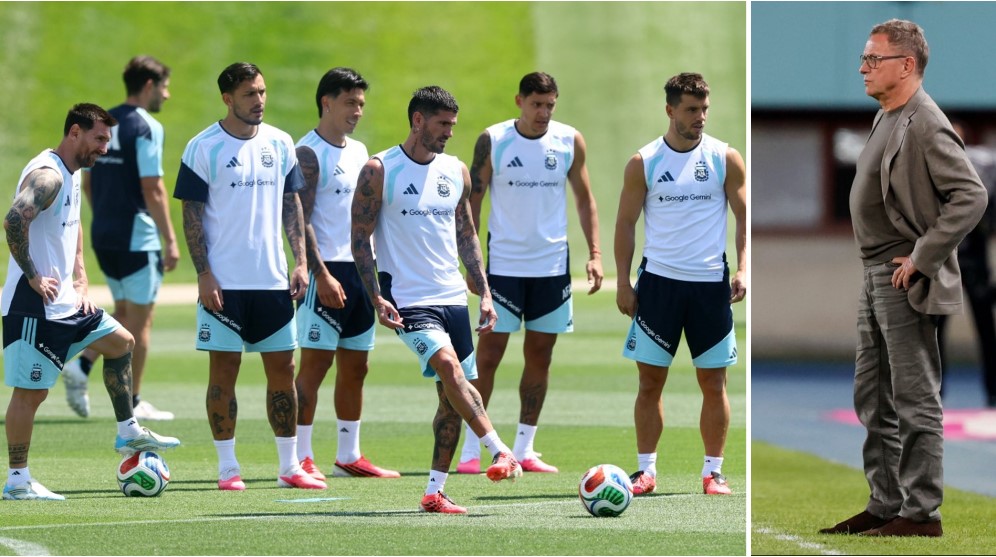
For a player widely regarded as one of the most humble personalities in a sport defined by ego and intensity, the phrase “free man” might at first sound misleading. But its true meaning reveals itself only when one understands the weight he once carried.
For much of his career, Messi played with an invisible burden -- that of having won almost everything possible in football, except the biggest prize: the World Cup. He had already redefined greatness itself, yet the World Cup always stood just beyond reach. Heartbreaks in the 2014 World Cup final, the 2015 and 2016 Copa America finals -- the latter even pushing him briefly toward international retirement -- only deepened that sense of an unfinished destiny.
He eventually returned to national colours and went on to win the 2021 Copa America, his first major international trophy that marked the initial release of that pressure. Yet, to his native Argentines, Messi -- already regarded as the greatest of the game by most, especially in Barcelona -- still remained a figure measured against Diego Maradona. And the reason was the golden trophy that is the most revered in football.
It was in 2022, in Qatar, that everything finally fell into place. With that World Cup victory, Messi didn’t just win football’s biggest prize -- he completed it. There was nothing left to chase, nothing left to prove. Once Messi lifted the World Cup, the long-standing comparisons and debates about whether he stood on the same level as Maradona quietly faded away with it.
Since then, something has changed -- not in his ability, but in his state of being. Messi still plays with the same impossible touch, the same magnetic control, the same effortless magic that has defined him for over two decades. He still makes football look like something simpler than it is.
But now, he plays without weight.
He plays like a man unshackled from expectation, operating in a space where joy seems to guide every movement. And that version of Messi is not less dangerous -- if anything, it is more unsettling for opponents. It is freedom sharpened into brilliance.
That was on full display in Argentina’s 2026 World Cup opener against Algeria last week.
The first time he slipped through their defensive line, it felt like a glimpse of something familiar yet newly liberated. The goal that followed -- finishing delicately into the top corner past Luca Zidane -- was eventually ruled out, but the message had already been sent: Messi was moving like a player with nothing left to fear.
Later, he delivered a hattrick -- his first in a World Cup match -- each goal stamped with that unmistakable signature that has defined his entire career. But alongside his brilliance came something else: an Argentina side reshaped around him, not out of necessity, but out of devotion to the moment he is living.
Lautaro Martinez adjusted his game, dropping deeper, covering ground, and working the spaces so Messi wouldn’t have to. Rodrigo De Paul, his long-time ally, always seemed to know where Messi would be -- no surprise that Messi’s first goal was a product of that connection.
Julian Alvarez, who came on to replace Lautaro in the second half, squared a pass to Messi even when he had a chance to go for goal himself -- the kind of long-distance curling effort he usually buries for Atletico Madrid. It was as if Alvarez, and the entire Argentina team, were not just playing for a win, but for Messi to break records and enjoy every moment in the famous jersey, in what would be his swansong in national colours.
Argentina’s unity now feels shaped by that shared understanding: this is not just a campaign, but a farewell tour, crafted around giving Messi the space to enjoy every last touch on the football’s grandest stage.
And as Argentina prepare for Austria tonight in Dallas, the same rhythm is expected to continue. The same quiet agreement and the same collective instinct to let Messi be Messi -- free, unburdened, and at his destructive best.
Because at this stage, Messi is no longer chasing football. Football is simply following him.
And for Argentina, the mission has quietly transformed. It is no longer just about lifting another trophy -- it is about ensuring that every remaining moment of one of the greatest players of all time is lived in full light, without hesitation, and with joy that finally matches his legacy.
And in that freedom, Messi looks more dangerous than ever.


Comments