


We don’t need more data - we need to understand it

Back in the 1950s and 60s, aid agencies were largely driven by faith and anecdote. Progress was measured in tons of food or miles of road. In the 1960s, economists at the World Bank redefined how aid was understood. "Without measurement," they stated, "we cannot tell whether progress exists." Those few words marked the beginning of the practice of counting, tracking, and comparing human progress. This triggered the development sector to rely on data to tell its story. Moving forward, the newly formed World Bank and the newly formed UN agencies began measuring economic growth in developing nations. Gross Domestic Product, school enrolment rates, and birth statistics opened new avenues to measure human development.
It was the time of clipboards and paper surveys, of census drives and handwritten ledgers. Back then, the data collection process was lengthy, expensive, and often incomplete. But the underlying objective was strong: what gets measured gets managed. By the late 1980s and 1990s, this practice had evolved into something bigger. The rise of results-based management (RBM) and the logical framework approach turned data from background evidence into the centrepiece of decision-making. Aid agencies and development partners wanted metrics, impact indicators, baselines, targets, and evaluations.
 For all latest news, follow The Daily Star's Google News channel.
 Then came the Millennium Development Goals (MDGs) in 2000. For the first time, the world agreed on eight goals that would define success for an entire generation—poverty reduction, universal education, gender equality—all expressed through numbers. It was an ambitious vision but also posed bottlenecks. Countries that could not count were left out of the count. The Sustainable Development Goals (SDGs) expanded this ambition but also exposed the limits of the global data system. With 232 indicators to track, even the most advanced national statistical systems struggled to keep up.
Data was supposed to make development transparent, but it also made it transactional. What was once only about people gradually became about numbers. Development actors began to design projects that looked "measurable".
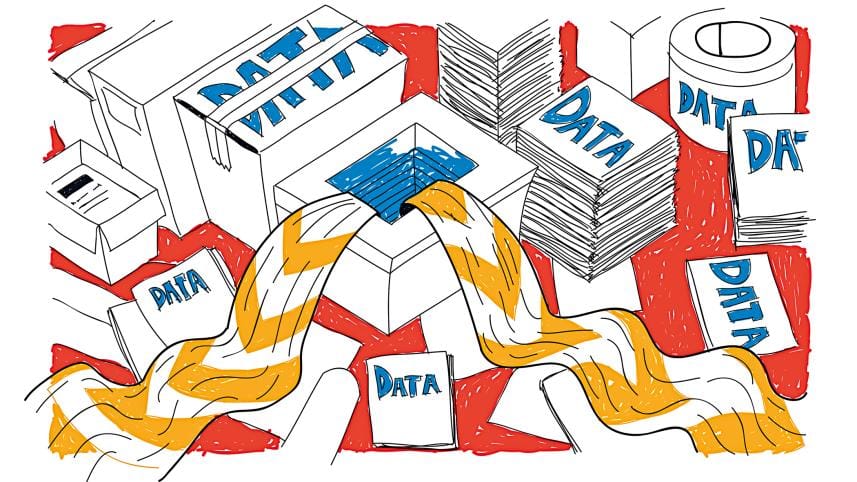
UNCTAD reported that more than half of developing countries still lack reliable data for half of the SDG indicators. Experts call this phenomenon the "data paradox", meaning we have more numbers than ever, but less usable knowledge than we need. The key reason is that development data exists in silos. It is scattered across ministries, development partners, NGOs, and statistical agencies. Projects build parallel systems, each with its own dashboards, definitions, and what not. And when the project ends, so does the data stream.
Data was supposed to make development transparent, but it also made it transactional. What was once only about people gradually became about numbers. Development actors began to design projects that looked "measurable". Governments designed programmes that would only fit the indicators, not moving beyond counting outputs towards understanding outcomes. To address this shortcoming, different frameworks were introduced.
The DCED Standard, MERL, MEL, and related models were designed to push the sector past mere output-counting and towards genuine outcome-level understanding. RBM (Results-Based Management) introduced a logic chain linking inputs to impact; DCED offered a verifiable method to prove market systems change; and MERL tried to integrate data, evidence, and learning into a single cycle. Later came frameworks such as PDIA (Problem-Driven Iterative Adaptation) and adaptive management, both advocating learning by doing rather than predicting.
Each model was an improvement on the last. However, one underlying challenge persisted: the sector became better at measuring activity than understanding change. Indicators multiplied faster than real insight. Reporting systems expanded while the practice of reflection lagged behind. Everyone wanted evidence of impact, yet the mechanisms built to generate it often produced compliance, not comprehension. In many instances, monitoring became a bureaucratic exercise. Data was gathered because it was required, not because it mattered.
Meanwhile, technology transformed the world of data itself. Satellites, digital surveys, and real-time dashboards were introduced to connect data with decision-making processes more efficiently. "Big data for development" became the new frontier, opening possibilities to predict migration, map poverty, or track deforestation from space. But the reality appeared different: data quality, interoperability, and ethical use lagged far behind innovation. Much of what is collected remains unverified, unshared, or unused—particularly in the Global South, where institutional capacity and coordination remain uneven.
In many instances, monitoring became a bureaucratic exercise. Data was gathered because it was required, not because it mattered.
South Asia offers a textbook example of this paradox. The region generates an immense amount of data through multiple development projects over the decades. Unfortunately, data integration remains limited. Most development programmes still maintain project-specific systems that fail to speak to one another. Learning captured in one project seldom informs another. Ministries maintain separate systems; NGOs track their own indicators; national statistical offices operate under their own mandates. The result is a fragmented data ecosystem, where progress is measured in spreadsheets rather than outcomes.
Globally, the development sector is entering what some call the "post-project era", where the impact of interventions depends less on discrete outputs and more on how knowledge and data circulate across systems. As development projects do not stay forever due to fixed timelines, what matters is how data outlives the projects that generated it.
The lesson from seven decades of data-driven development is not that we need more numbers, but that we need better conversations around them. Counting is easy. Connecting is hard. What matters now is not how much we collect, but whether our systems—global, regional, and local—can make sense of what we already have. The question is no longer about data scarcity, but about data governance: who holds it, who uses it, and to what end.
Sabbir Rahman Khan and Md Marjad Mir Kameli work as development practitioners at Swisscontact.
Send your articles for Slow Reads to slowreads@thedailystar.net. Check out our submission guidelines for details.
Comments