


Beyond the dream: The unspoken reality of international students
Like thousands of other students dreaming of a brighter future, I also set foot in Australia. At first, everything felt almost cinematic: the city lights, a new country, unfamiliar streets, and a sense of freedom I had never experienced before. Like many others, I carried a common belief: studying abroad would automatically lead to a settled, successful life, where everything would eventually fall into place.
Later, I realised this may have been my biggest misconception.
The first shock came on my very first day of class. We were immediately assigned a Python task. There was no gradual introduction, no easing into the subject. It was simply expected that everyone already had some level of coding knowledge. In Australia, programming and digital literacy are often introduced from a much younger age—something many international students are not always exposed to early on. Sitting in that classroom, listening to instructions I could barely follow, I suddenly felt something unfamiliar: as though I was already behind before I had even started.
The second shock came during my job search.
What I expected to be a straightforward process turned out to be far more difficult. There were thousands of applicants for every role. Many had strong communication skills, local experience, and familiarity with workplace culture.
Competing in that environment felt overwhelming. Every application began to feel like a small hope, followed by silence. Rejections became normal. Replies became rare.
During that phase, I slowly came to understand that surviving financially in a new country was its own kind of competition—one that no one truly prepares you for.
After countless rejections, I finally got my first job at McDonald’s as a crew member.
It did not feel like success. It felt like relief.
There was no celebration, no sense of achievement—just a quiet acceptance that I had found something that would help me get by.
My second shift was from 10 pm to 1 am. When I finished work that night, I realised something I had not properly considered before: I had no way to get home. There was no public transport available until early morning. I had no choice but to stay outside and wait.
From 1 am to 5:30 am, I sat alone on a bench in the 5°C cold, waiting for the first bus. The streets were empty. The city that had felt alive during the day became silent and distant at night. Time moved slowly. Every minute felt longer than it should have.
For many international students, the struggle often begins with not finding a job. But the irony is that even after getting one, the struggle does not end—it simply changes form.
In that silence, I became intensely aware of myself. Not of goals, not of plans—just of the present moment: the cold, the waiting, and the uncertainty of when things would finally begin moving again.
That entire night, my mother and sister stayed awake in Bangladesh. They remained on call with me, making sure I was safe and asking whether I was okay. I kept telling them I was fine. I kept repeating that everything was okay, even when it did not feel that way at all.
But that night remains very clear in my memory—not because something dramatic happened, but because nothing did. There was no event, no incident, no turning point. Just silence, cold air, and hours of waiting. Sometimes, those are the moments that stay with you the longest.
For many international students, the struggle often begins with not finding a job. But the irony is that even after getting one, the struggle does not end—it simply changes form.
Life slowly becomes a constant balancing act between studies, assignments, tuition fees, rent, groceries, cooking, and long work shifts. Every day begins to feel divided between responsibilities. Morning becomes study time, the afternoon becomes survival planning, and the night often becomes work. Many students end up taking two or even three jobs just to manage basic expenses.
In that process, time for rest slowly disappears. Sleep becomes irregular. Meals become rushed. Days begin blending into one another. Somewhere along the way, academic performance often starts to suffer—not because of a lack of effort, but because of a lack of time and energy.
Some students, in order to manage tuition fees and living costs, end up working beyond the hours permitted under their visa conditions. It is not always a decision made lightly; it is often driven by necessity. But it comes with risk. Visa conditions begin to feel like a constant background pressure, quietly shaping every decision, every shift, and every hour worked.
What begins as survival slowly turns into constant anxiety. Even small choices begin to carry weight. Every hour feels accounted for. Every decision feels calculated.
But most of these realities remain unspoken.
On social media, we often share only selected parts of our lives: smiling photos, café visits, group pictures, graduation dreams, and success updates. From the outside, everything appears to reflect progress, happiness, and achievement. But those images rarely reveal what happens in between.
Behind them are long nights of loneliness, financial stress, uncertainty, sleep deprivation, and the quiet pressure of simply trying to keep going. There is often no audience for the difficult parts, so they remain invisible.
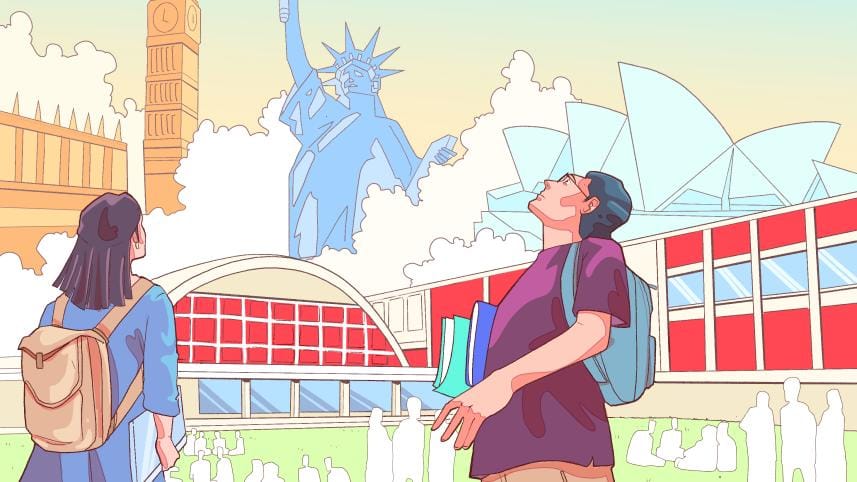
Being far away from family removes an emotional safety net that many people take for granted. There is no immediate comfort, no physical presence during breakdowns, no one sitting beside you in silence when things feel overwhelming. There are only phone calls—brief conversations delayed by time zones, trying to bridge distances that feel far greater than kilometres.
Slowly, many international students learn how to survive in a new country. They learn how to cook even when they are tired, how to work even when they are exhausted, how to pay rent on time, how to meet deadlines, and how to manage responsibilities that once felt completely foreign. They become adaptable in ways they never imagined.
But in the process, something quieter often gets lost. It is not always obvious. It does not disappear in a single moment. It fades slowly.
Saima Zaman Suchana is a final-year Information Technology student at Kent Institute Australia. She can be reached at suchana249akmcc@gmail.com
Send your articles for Slow Reads to slowreads@thedailystar.net. Check out our submission guidelines for details.
The killing of Sonadia’s mangroves: An eyewitness account

The future of a Sundarbans tigress
No girl should grow up without this knowledge
The mountain must not fall: Indigenous responses to landslides in Rangamati
Life and death on Bangladesh’s char islands
The sacred water world of the Sundarbans
The living knowledge of Bonojibis and why it matters

Sea widows: When fishermen never return from the sea
The untold suffering of Bangladeshi workers during Hajj
