


The living knowledge of Bonojibis and why it matters

On the map, we see a dense expanse of forest marked in green, divided between Bangladesh and India. This vast mangrove wilderness, known as the Sundarbans, remains the largest contiguous mangrove forest in the world. Since the colonial period, the name and imagination of the Sundarbans have been widely circulated and institutionalised through state narratives, conservation discourse, and popular representations.
Today, the tourism industry and conservation campaigns continue to portray the Sundarbans as “divine,” “untouched,” “virgin,” and a “natural heaven of beauty,” among other romanticised imaginaries. Such representations exoticise and romanticise the forest, transforming it into a consumable spectacle of wilderness.
Such representations provoke a division between humans and non-humans, advancing the claim that the place should be dedicated solely to nature. Since the colonial period, bureaucratic documents have framed the forest as a space where forest resources are foregrounded while humans appear only as insignificant dots, often rendered invisible on maps. The contemporary declaration of wildlife sanctuaries, alongside the permanent restriction of forest dwellers, has reinforced a fortress model of conservation that frames Bonojibis — forest-dependent communities who sustain their lives through the resources of the Sundarbans — as the principal threat to nature. Thus, in effect, fortress conservation has not only split the forest’s cartography but has also dispossessed the Bonojibis. In essence, the state and other-than-state actors, through their allied ontological assertions about the forest, erase the forest-entangled human. It is as if these people are enemies of the wild, rationalising a discourse of the forest without its people.
These ontological assertions of nature reverberate with the anthropocentric imagination rooted in modernity and imperial understandings of nature, where nature is framed through the dual categories of “waste” and “resource”. Only those elements of nature that serve anthropocentric interests are recognised as valuable or extractable, reducing nature to a passive object within the nature-culture divide. In this framework, the Sundarbans is imagined as pure, Bonojibis are framed as disruptive or as threats, and the “outsider” — including conservation movements, the eco-tourism industry, and state actors — is positioned as the protector of nature while simultaneously enabling its romantic reproduction and extraction.
The Bonojibis believe that Bonbibi is the mother of all living beings in the forest, irrespective of Hindu, Muslim, or indigenous communities, extending even to more-than-human beings. This faith enacts a kincentric ontology in which the forest is mayer kol—a nurturing home and source of sustenance for all living beings—that affirms that no being holds a superior rank and flattens anthropocentric relations of domination.
However, the often-invisible Bonojibis, living at the frontier of nature’s extractive regime in the Sundarbans, reclaim their existence through ecological knowledge and practices rooted in the forest. This understanding affirms that humans are an integral part of forest ecology and ultimately inseparable from the social body of the forest.
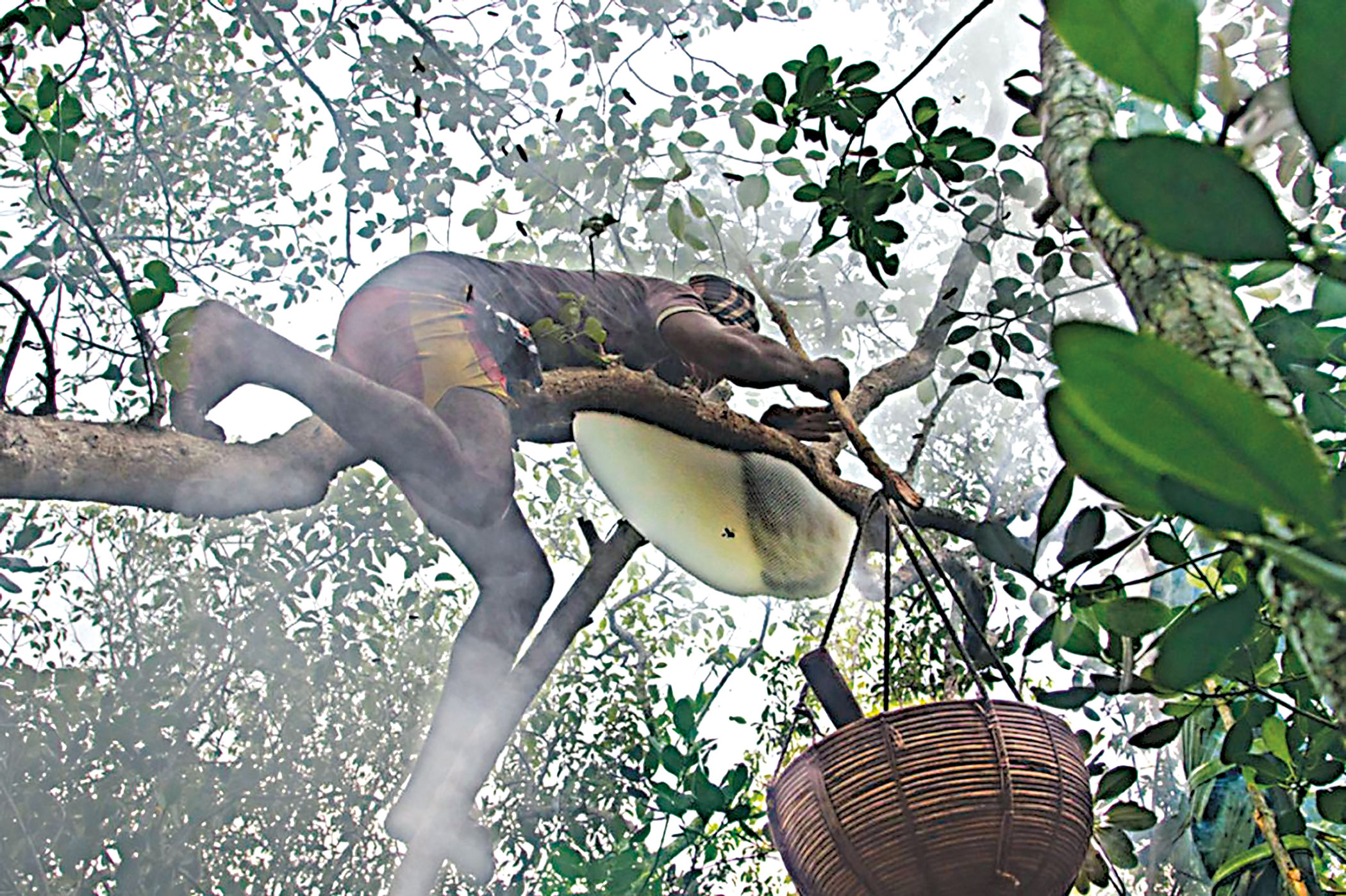
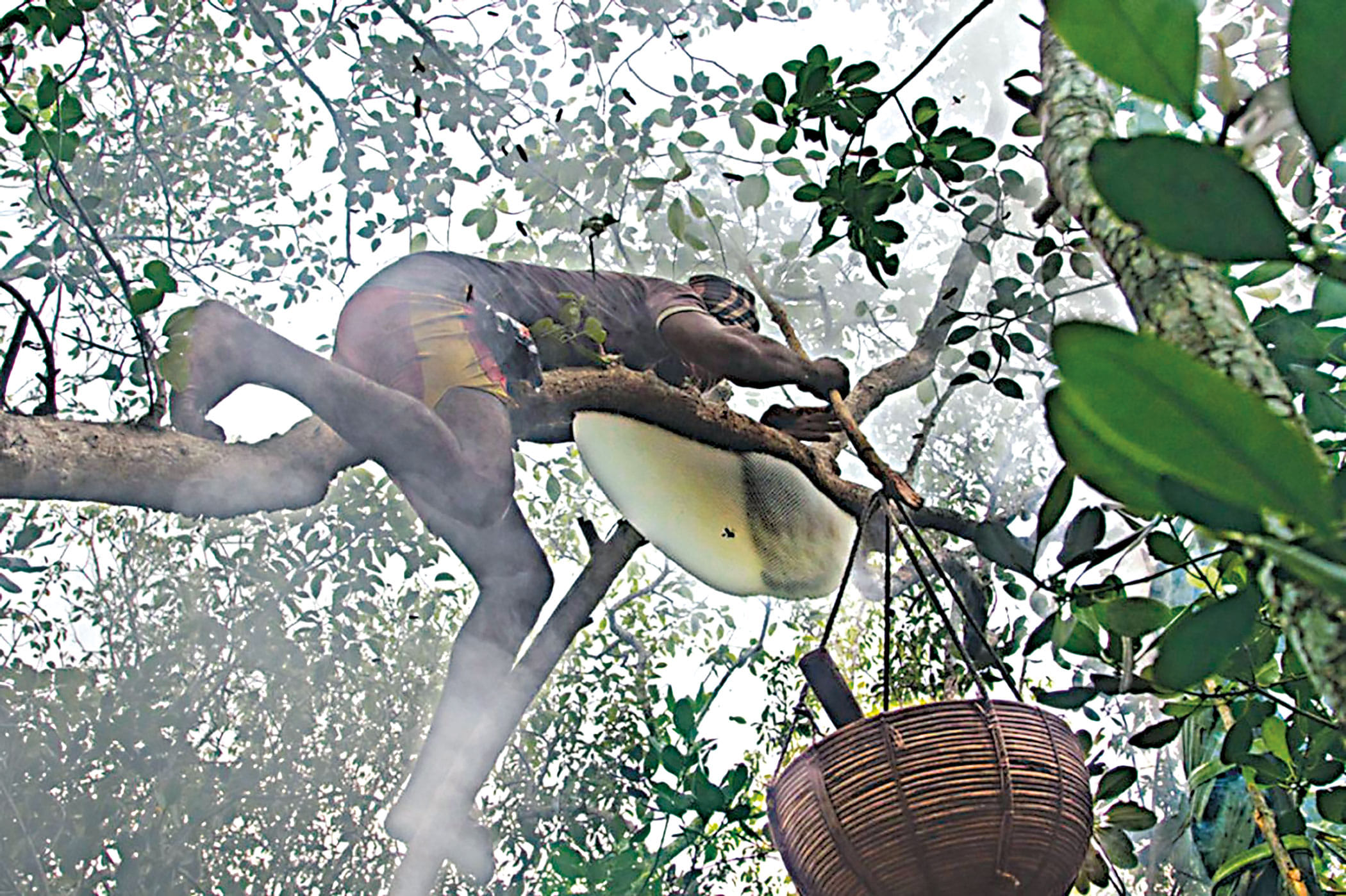
The Bonojibis, who live in and around the forest and sustain their livelihoods from its granaries, especially the devotees of Bonbibi, believe that the jungle is a sacred place. When they enter the forest, they believe they are stepping into the lap of their mother, Bonbibi.
One of the Bonojibis from the Sundarbans delta said that, right before entering the forest, they seek protection from Bonbibi through certain utterances. For instance: “Ma Bonbibi, we are in the forest (‘tomar koley’) because of hunger and scarcity of rice (Peter jalai, bhater jalai bone ashi; Ma, tumi rokkha koro). Ma (Bonbibi), you are the ‘Poti’ (sovereign authority) of the jungle. Please save us… Inside the forest, how will we save our lives, and how will we survive? If you do not protect us from tigers, who will take care of us?”
For the devotees of Bonbibi, the imagination of the forest is recalibrated through the metaphor of ‘mayer kol’ (mother’s lap), as they regard themselves as children of Bonbibi who live and survive in the jungle, just as children do in their mother’s embrace. The Bonojibis imagine the forest as mayer kol, describing it as a ‘pobitra jaiga’ (sacred place) for its devotees. Such imaginaries unfold an ethical relationship between people and place. By animating the forest as a sacred space, like mayer kol, they generate a distinctive moral order that shapes how devotees engage with the forest and wildlife. These ethical or moral guidelines, locally referred to as ‘bachok’ (a set of ritual and ethical practices), are associated with the belief in Bonbibi.
The Bonojibis believe that Bonbibi is the mother of all living beings in the forest, irrespective of Hindu, Muslim, or indigenous communities, extending even to more-than-human beings. This faith enacts a kincentric ontology in which the forest is mayer kol—a nurturing home and source of sustenance for all living beings—that affirms that no being holds a superior rank and flattens anthropocentric relations of domination.
While humans and non-humans exist within the same network of relatedness and sustenance, they mutually cultivate an ethic of survival and care. Such ecological knowledge, embedded in the forest and in everyday practice, shapes a non-anthropocentric sense of self within a web of more-than-human relatedness.
However, this relatedness suggests that forest dwellers should not deplete the forest or its wildlife; they are permitted to take only what is necessary for everyday survival. In any case, if they violate moral norms or associated ecological knowledge, Bonbibi will no longer protect the Bonojibis from tigers or other impending dangers in the forest. Thus, for the Bonojibis, ways of surviving—both making a living and protecting life—cultivate ethical subjects shaped by ecological knowledge.

Some of these common parlances can easily be heard if one roams around the Sundarbans delta. For instance, people often say: “Jungle bachle amra bachbo” (If the forest survives, we will survive), “Jungle na thakle amra thakbo na” (If the forest no longer exists, we will not be able to survive), and “Bonbibi ache bole jongol ache” (The forest exists because of the presence of Ma Bonbibi). All these common parlances of the forest have accumulated through long-term everyday lived experience in the forest, reflecting deeply knotted ties between the forest and its people.
These expressions convey a strong relational sense of place—a relational ontology—reflecting entangled lives with other-than-human beings. Most notably, human existence is mutually embedded with that of non-human beings. For them, the forest is not merely a “resource” but a living, relational entity with agency. Their existence and ways of survival are mutually correlative, challenging anthropocentric modes of becoming grounded in domination and extraction.
Md Raihan Raju is a senior lecturer (adjunct) at BRAC University He can be reached at raihanraju29@gmail.com.
Send your articles for Slow Reads to slowreads@thedailystar.net. Check out our submission guidelines for details.

The sacred water world of the Sundarbans

Sea widows: When fishermen never return from the sea

The untold suffering of Bangladeshi workers during Hajj

Can we save the school for Rangpur’s street children?

Interview / Why the Haor film Kura Pakkhir Shunye Ura matters today
Before you sip your tea, remember Chandpur 1921

Clay toys lose ground as plastic dominates childhood

Interview / Haor crisis is fundamentally a management failure: Ainun Nishat

The long road for women drivers in Bangladesh
