


Baikka Beel’s silent collapse

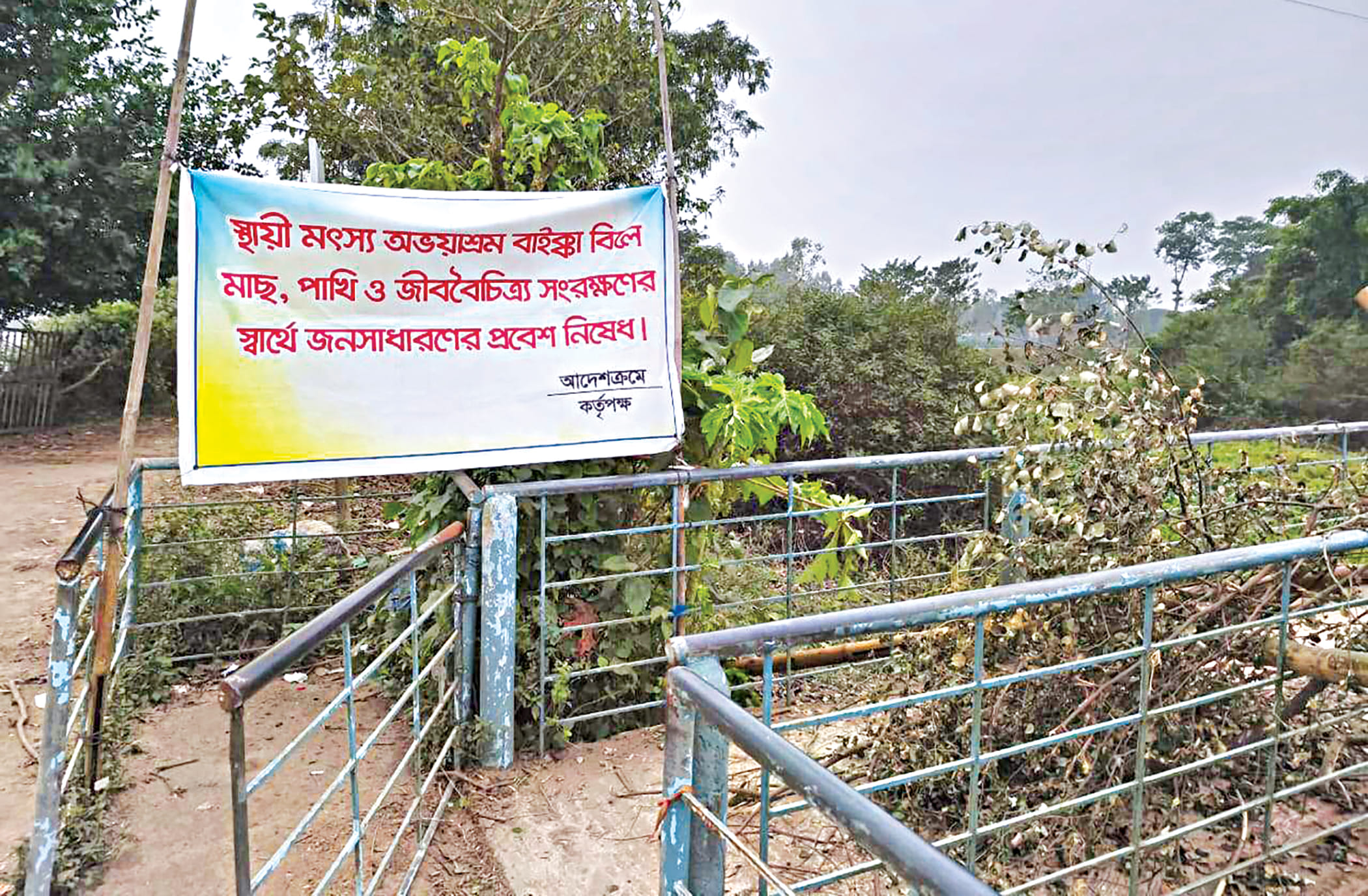
Baikka Beel, a wetland now facing a deepening crisis of protection, was officially closed to public access a year ago. On paper, the site enjoys sanctuary status. On the ground, however, the reality tells a very different story. Picnicking, birdwatching, bird hunting, fishing, and indiscriminate littering continue openly inside the protected area, with little evidence of effective monitoring or enforcement.
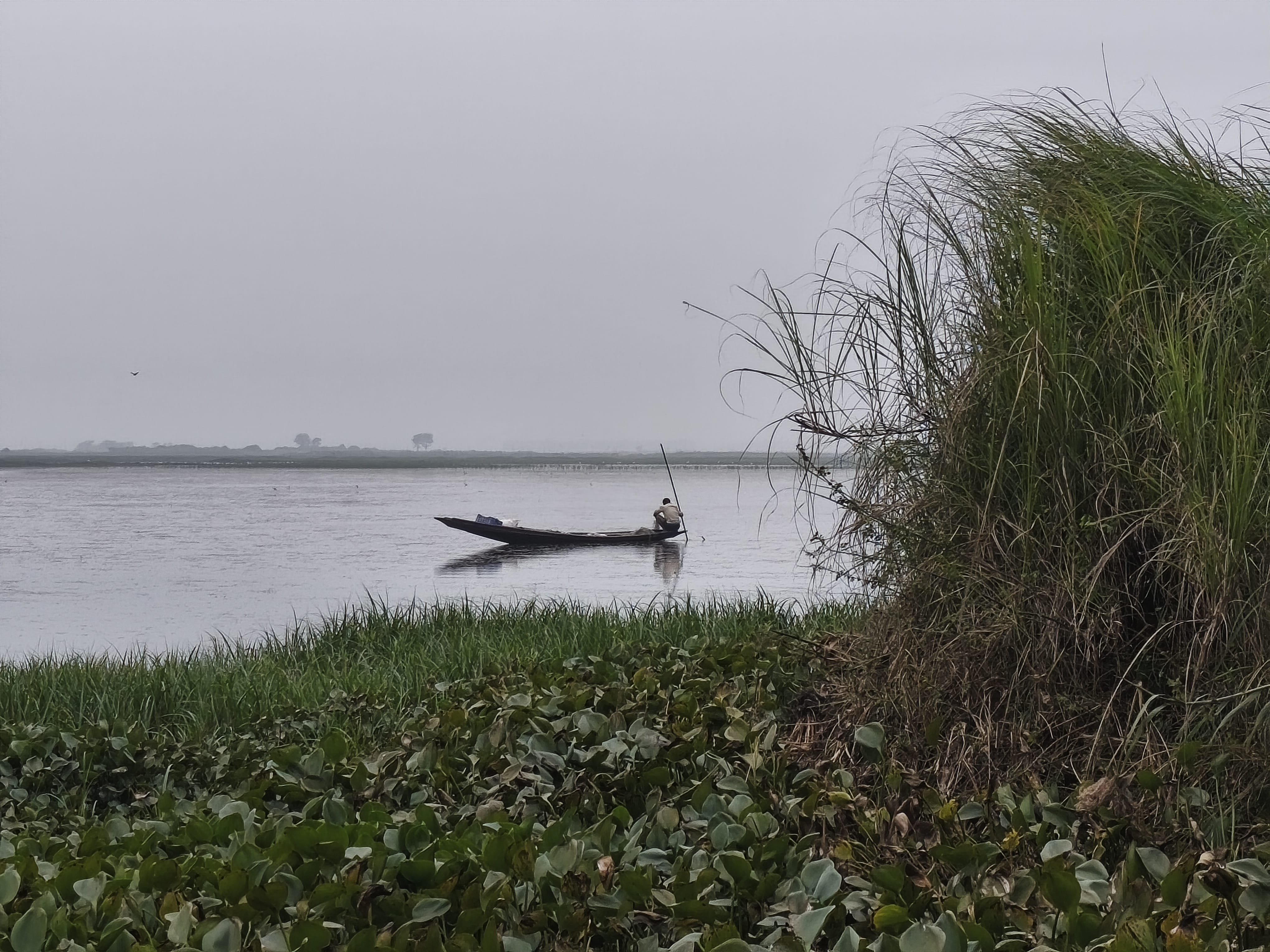
Local residents describe Baikka Beel as a wetland of roughly 100 hectares, situated east of Hail Haor in Srimangal Upazila of Moulvibazar district. Each year, migratory birds arrive from their wintering grounds, usually towards the end of the monsoon and before the onset of winter, and remain until late March. Over time, some species have even taken up permanent residence in the beel. Yet this ecological richness is steadily eroding. Nearly one-third of the wetland has already been lost to siltation, while poaching has caused a sharp and sustained decline in migratory bird populations.
Experts note that Baikka Beel was declared a bird sanctuary in 2003, covering an area of 100 hectares. In the years immediately following this declaration, bird numbers showed a noticeable increase. That initial success, however, proved short-lived. Persistent poaching and unregulated landfilling have repeatedly disrupted migratory patterns. An analysis of bird censuses conducted since 2008 reveals a clear and worrying decline in the average number of species recorded at the site.
Environmental activists warn that poaching is intensifying, while mounting human pressure on the haor ecosystem is accelerating biodiversity loss. Habitat degradation, food scarcity, constant human disturbance, and increasingly adverse environmental conditions are forcing migratory birds to abandon the area altogether.
ASM Saleh Sohel, Moulvibazar coordinator of Bangladesh Poribesh Andolan (BAPA), said that although laws exist to prevent bird hunting, enforcement remains weak. The forest department, he noted, frequently cites shortages of manpower, severely limiting its capacity to act. A lack of public awareness has compounded the problem, while deforestation and excessive human control over haors and beels continue to deepen food and habitat crises for wildlife. “If we are not aware now,” he warned, “the future will not forgive us.”
Baikka Beel has also been designated a fish sanctuary, yet fish theft has become rampant. In an effort to safeguard the sanctuary, the government formed the Baragangina Resource Management Committee, tasked with conserving the biodiversity of Baikka Beel as a permanent fish sanctuary. Despite these institutional measures, the absence of robust enforcement and sustained public awareness campaigns has left the wetland’s future deeply uncertain.

Locals say that in a sanctuary of this size, fish should be easily visible. Instead, fish stocks have declined sharply, further reducing bird presence. Night-time fishing continues unchecked, inflicting lasting damage on the beel’s broader biodiversity.
Tanvir Ahmed, a guard at Baikka Beel, said groups of 15 to 20 people are frequently seen entering the beel to steal fish, often carrying weapons. When guards try to intervene, clashes are common.
Bajlu Mia, general secretary of the Baikka Beel Baragangina Resource Management Committee, said that only four guards are currently responsible for protecting the vast wetland, which spans roughly 100 acres.
Following a visit by Farida Akhtar, adviser to the Ministry of Fisheries and Livestock, on February 25 last year, public access to Baikka Beel was officially restricted in order to protect fish and birds, and picnics were banned. Locals, however, say the directive has not been effectively enforced.
Srimangal Upazila Fisheries Senior Officer Joy Banik said raids are conducted at different times to curb illegal fishing and that the administration will continue to provide maximum support.
Nurul Muhaimin Milton, general secretary of the Moulvibazar Environmental Journalists’ Association, said birds captured in remote haors and beels are often sold secretly. Many villagers, he added, remain unaware that bird hunting is illegal, making stronger law enforcement, sustained public awareness campaigns, and regular raids essential.
Under the Bangladesh Wildlife (Conservation and Security) Act 2012, killing, capturing, selling, buying, or keeping wild birds is punishable by up to one year’s imprisonment, a fine, or both, with harsher penalties for repeat offences. Yet, Milton observed, the law remains weakly implemented.
Abul Kalam, Sylhet Divisional Forest Officer of the Wildlife Management and Nature Conservation Department, said regular raids are carried out in markets, during which birds are rescued and released. “We respond quickly when we receive information, and raids are conducted across the region. However, due to manpower shortages, it is not possible to completely stop hunting,” he said.
Dr Mohammad Abdul Aziz, Professor of Zoology at Jahangirnagar University, pointed to a significant coordination gap between the Fisheries Department and the Forest Department, which has undermined conservation efforts. He noted that development planning is often driven by economic priorities, with ecological concerns pushed aside. As a result, issues relating to birds and forests are frequently excluded from broader development strategies.
Mintu Deshwara is a journalist at The Daily Star.
Send your articles for Slow Reads to slowreads@thedailystar.net. Check out our submission guidelines for details.

Sea widows: When fishermen never return from the sea

The untold suffering of Bangladeshi workers during Hajj

Can we save the school for Rangpur’s street children?

Interview / Why the Haor film Kura Pakkhir Shunye Ura matters today

Before you sip your tea, remember Chandpur 1921

Clay toys lose ground as plastic dominates childhood

Interview / Haor crisis is fundamentally a management failure: Ainun Nishat

The long road for women drivers in Bangladesh

Who speaks for the tiger widows of Sundarbans?
