The cotton clause: How the US–Bangladesh trade pact could reshape regional textile trade
When the US–Bangladesh Agreement on Reciprocal Trade was signed in February 2026, attention focused on what Bangladesh was conceding: labour reforms, intellectual property commitments, export-control alignment, and broader strategic obligations. Those concerns are real. Yet buried within the agreement are provisions that may prove more consequential than the criticism surrounding them.
Bangladesh currently exports roughly $9–10 billion worth of garments annually to the United States, the world’s largest apparel import market. With an existing market share of around 8–9 per cent, the country has realistic potential to increase that share to 12–15 per cent in the medium term, unlocking an additional $5 billion in export earnings. The trade agreement is the mechanism that could make that trajectory possible.

Three elements stand out: a mechanism linking tariff preferences to purchases of American cotton, access to US-backed development finance, and flexibility in how rules of origin may ultimately be implemented. Together, they could reshape Bangladesh’s competitive position at a critical moment for its export economy.
The cotton clause
Article 5.3 commits the United States to a mechanism allowing eligible Bangladeshi textile and apparel products to enter the US market at a zero reciprocal tariff rate, with qualifying volumes linked to Bangladesh’s purchases of US-produced cotton and man-made fibre.
Critics have focused on the higher cost and longer shipping time of American cotton compared with Indian supply. But the deeper significance lies elsewhere. American cotton is widely regarded as a higher-quality fibre capable of producing finer yarns and more durable fabrics. The USDA’s 2026 report on Bangladesh’s textile sector notes that many Bangladeshi spinning mills already prefer US cotton but have historically been constrained by financing and logistics rather than preference itself.
The agreement’s most strategically significant feature may be what it leaves unspecified. The zero-tariff threshold and implementation rules are described as “to be specified”, leaving considerable room for negotiation. Bangladesh’s arrangement appears potentially different from traditional US textile agreements. Rather than explicitly imposing factory-level content rules, the mechanism links eligible export volumes to Bangladesh’s aggregate purchases of US cotton and fibre. If implementation ultimately follows a national-level model, Bangladesh could secure a far simpler and more commercially workable framework than many competitors face.
That distinction matters because Bangladesh’s garment industry has long depended on low-margin basic apparel. Access to higher-quality raw materials creates an opportunity to move into premium product categories, where margins are stronger and buyer relationships are more stable.
The obstacle, however, is working capital. Indian cotton can reach Bangladeshi mills within days through land routes, allowing short inventory cycles and limited banking exposure. American cotton requires months of shipping and extended letters of credit, tying up scarce bank limits for prolonged periods. For many mid-sized mills operating under tight liquidity conditions, that financing burden is effectively the true cost of switching suppliers.
The importance of what remains undefined
The agreement’s most strategically significant feature may be what it leaves unspecified. The zero-tariff threshold and implementation rules are described as “to be specified”, leaving considerable room for negotiation.
Bangladesh’s arrangement appears potentially different from traditional US textile agreements. Rather than explicitly imposing factory-level content rules, the mechanism links eligible export volumes to Bangladesh’s aggregate purchases of US cotton and fibre. If implementation ultimately follows a national-level model, Bangladesh could secure a far simpler and more commercially workable framework than many competitors face.
That distinction is particularly important in relation to India. Indian garment exports to the US continue to face significant tariffs, while rules-of-origin provisions under the evolving US–India trade framework remain uncertain. Bangladesh, by contrast, already imports all cotton duty-free and would not face additional border costs when switching from Indian to American supply.
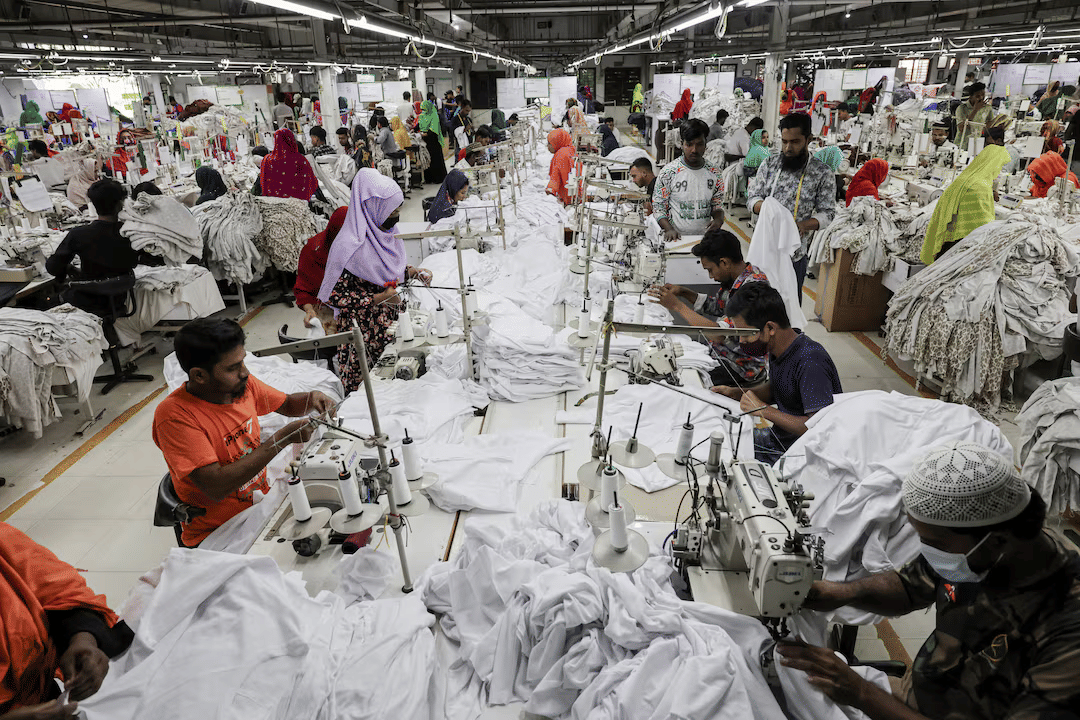
The arithmetic is straightforward. Once a Bangladeshi garment qualifies under the zero-tariff mechanism, even a small tariff advantage becomes commercially decisive in a low-margin industry.
“I explained in the Parliament House that Bangladesh gets a free pass, 0 per cent tax, and India gets 18 per cent tax. The result of this will be that Bangladesh’s textile industry will destroy India’s textile industry.”
— Rahul Gandhi, Leader of the Opposition, Lok Sabha, February 2026
The quote may reflect the anxiety within India’s textile sector: tariff differentials in apparel trade can rapidly shift sourcing patterns among global buyers.
Opening the door to US development finance
Article 5.1 commits the United States to working through the EXIM Bank and the US International Development Finance Corporation (DFC) to consider investment financing in critical sectors in Bangladesh.
As of December 2024, the DFC’s active portfolio in India exceeded $3.5 billion across sectors including renewable energy, infrastructure, agriculture, healthcare, and manufacturing. Bangladesh, by contrast, had no active DFC portfolio, as the agency had not previously been authorised to operate there.
The implications could be substantial. The DFC provides long-tenor loans, guarantees, equity investments, and political risk insurance — precisely the instruments historically missing for large-scale Western investment in Bangladesh.
The textile sector could also benefit directly. DFC-backed financing for spinning, yarn, and upstream textile capacity could help Bangladesh process US cotton at scale while moving further up the value chain. One potential application would be a central bonded warehouse for US cotton and man-made fibre inside Bangladesh. Supported through DFC- or EXIM-backed financing, such a facility could reduce the working capital burden associated with long-cycle imports and make large-scale use of American cotton commercially viable for a much broader segment of Bangladesh’s spinning industry.
Energy is likely to be the most immediate area of impact. Chronic gas and electricity shortages have become one of the country’s principal industrial bottlenecks, with many factories operating below capacity.
The textile sector could also benefit directly. DFC-backed financing for spinning, yarn, and upstream textile capacity could help Bangladesh process US cotton at scale while moving further up the value chain. One potential application would be a central bonded warehouse for US cotton and man-made fibre inside Bangladesh. Supported through DFC- or EXIM-backed financing, such a facility could reduce the working capital burden associated with long-cycle imports and make large-scale use of American cotton commercially viable for a much broader segment of Bangladesh’s spinning industry.
Beyond individual projects, DFC participation could reduce perceived political and financial risk, potentially catalysing larger flows of Western capital into Bangladesh’s manufacturing and infrastructure sectors.
A strategic hedge
Bangladesh graduates from Least Developed Country status in November 2026. Although a temporary grace period preserves duty-free European Union access until 2029, garments will eventually face higher tariffs in the market that currently absorbs roughly half of Bangladesh’s apparel exports.
The US agreement therefore functions partly as a hedge. If preferential access to Europe gradually narrows, Bangladesh will need an alternative zero-tariff pathway into another major consumer market before that transition occurs.
The Boeing purchases, LNG commitments, and opening to DFC financing form part of a broader strategic effort to deepen economic alignment with Washington in exchange for long-term market access.
The agreement does not guarantee a transformation of Bangladesh’s textile industry. But within its constraints, Bangladesh may have secured something important: access to higher-quality industrial inputs, a potentially valuable tariff mechanism, and entry into a development finance ecosystem that has long supported competing economies in the region.
Khadem Mahmud Yusuf is the managing director & CEO of Bangladesh Petrochemical Company Ltd.
Send your articles for Slow Reads to slowreads@thedailystar.net. Check out our submission guidelines for details.

Could India's Gen-Z rebellion begin with cockroaches?

The OpenAI–Musk dispute: Who controls the future of AI?

Why both Trump and Putin felt compelled to visit Beijing

What Bangladesh should understand about the Arakan Army’s Way of Rakhita doctrine
The hunt for the Holy Grail: The repurposed US-Israeli casus belli for Iran’s uranium
Does the US-Bangladesh trade deal mirror colonial economics?

What is the ‘Thucydides trap’ Xi warned Trump about?

What will stop killings at the Bangladesh–India border?
Can the Xi-Trump summit prevent a new Cold War?