


What Bangladesh should understand about the Arakan Army’s Way of Rakhita doctrine

In recent times, a theatrical shift has transpired in Myanmar’s political landscape. This shift came after the sit-tat’s (junta) cosmetic transformation following a disputed win in the last election. Soon after being sworn in as president, Ming Aung Hlaing—former chief of the junta and architect of the 2021 coup d’état—bowed to return to democracy. Meanwhile, during its 17th founding anniversary celebration, the Arakan Army (AA), a prolific challenger of the junta’s grip, reaffirmed its promise to ‘fight while building, build while fighting’. This dual strategy means expanding militarily and governing any captured land. Henceforth, speculations loomed large about the political ambition of the AA. Would it strive for autonomy, federation, or another goal? Navigating the politics of Rakhine became a central foreign policy dilemma for countries with borders in or interests in the region. A closer look at the AA’s manifesto can help unpack its political repertoire.
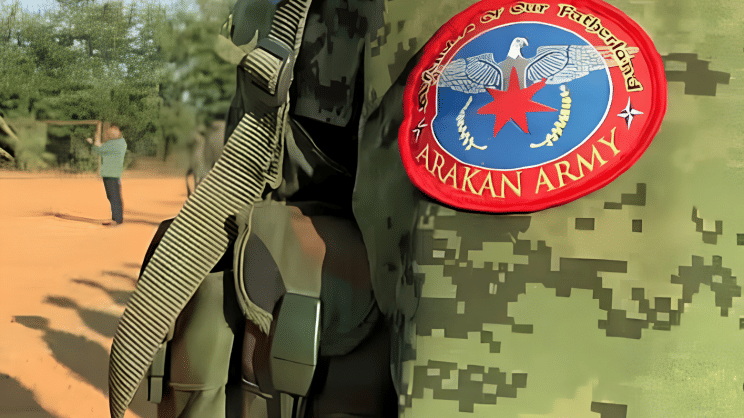
‘Way of Rakhita’ (WoR) is a doctrine with four ideological principles: nationalism, militarism, historical revisionism, and pragmatism. It came to the forefront in April 2014 after the declaration of Arakan Dream. Since its establishment in 2009, the AA has upheld the WoR in a bid to conquer Rakhine.
First, Arakanese nationalism is rooted in the concept of Rakhita. It denotes a community that was honoured for preserving its national heritage, ethics, morality, and race. This honour was held in the prosperous Arakan kingdom until it was captured by the Bamar Konbaung dynasty in 1874. Later, the kingdom endured ‘humiliation’ during the British and Japanese invasions. Arakanese nationalism seeks to reclaim the past glory, prosperity, dignity, and self-determination. During the pre-colonial period, the Arakan kingdom was a highly respected and prosperous region. Sittwe was the export and import hub with most ships routing from China and Europe.
Second, rolling with a bitter taste of invasion by outsiders in the Arakan kingdom, the AA’s manifesto concentrates on building a robust military capability. Even the manifesto sought to uphold the spirit of legitimate military resistance against all kinds of aggression to its fatherland, including the aggression from Myanmar’s junta. Therefore, this spirit transformed the AA into a force of nearly 5,000 soldiers, although it began with only twenty-seven.
A proto-state is a political unit, organised administratively and often around a local ethnic group, with some degree of autonomy. It establishes a ‘pattern of relationship’ where a ‘good rebel’ sentiment is developed among the population.
Third, historical revisionism links identity cohesion. During the Anglo-Burmese War, the Arakanese fought on both sides, probably in an effort to gain more autonomy. However, as the British gained ground, the Arakanese supported the British and eventually joined British Burma. Later, the Arakanese quickly rose in rebellion against British control, as the British had no intention of reinstating the Rakhine kingdom. The Burma campaign in 1942 brought Arakan under Japanese occupation. During World War II, initially, the Arakanese fought against the British. However, in early 1945, they switched allegiance to Allied power and fought against the Japanese forces. Therefore, the AA considers revising its mistakes in political vacillation and remains united in achieving its goals.
Fourth, the WoR promotes pragmatic action. It focuses on strategic steps towards liberation, legitimacy, and socio-economic development. This motto resonates with the call for a proto-state. A proto-state is a political unit, organised administratively and often around a local ethnic group, with some degree of autonomy. It establishes a ‘pattern of relationship’ where a ‘good rebel’ sentiment is developed among the population. This sentiment shifts allegiance to rebel governance. The AA’s pragmatism was materialised when it installed the Arakan People Authority (APA) in December 2019. This authority has economic, security, and judicial mandates that run alongside the existing junta administration.
Now, does the doctrine of WoR matter? This ideological doctrine could probably emerge as a guiding star for AA’s political behaviour within the aspired statehood in Rakhine and in its external engagements in the ensuing days. A critical evaluation of the doctrine raises a few queries: first, does it create Arakanese exceptionalism? Apparently, yes. The Arakan Kingdom comprised seven recognised races, except for Muslims. By promising to restore that identity, the manifesto remained exclusionary about the Rohingya identity. Though the king held some Muslim titles (nicknames) in the Kingdom of Mrauk U, none adopted Islam; rather, they remained Buddhists. Again, the AA hesitates to use the term ‘Rohingya’. To some extent, they prefer to use the term ‘Muslim inhabitants of Rakhine State’ to portray them as either foreign or a political matter of the junta.
The AA has a history of violence against Rohingyas, allegedly pushing some Rohingya groups like Arakan Rohingya Salvation Army (ARSA) to fight in favour of the junta. Moreover, trading the hope of citizenship, the junta has been recruiting Rohingyas under the new conscription law. Actually, this is the junta's proxy strategy to fight AA from within. However, exceptionalism and mistrust drive ‘otherisation’ of Rohingyas. As the manifesto concentrates on security and kinetic power, it may label the Rohingyas as a security threat and use violence against the Rohingyas in general.
Second, does pragmatism confuse? It is unclear whether the AA want autonomy, a loosely federalised framework or independence. It is still trapped in the loop of political vacillations. In January 2019, the AA chief showed up for ‘confederation status’, arguing that federalism is historically appropriate. In contrast, it adopted a flexible strategy on the question of independence. In January 2022, AA’s chief rejected the possibility of ‘immediate independence’ but reiterated attaining ‘internal sovereignty’(military control) first. This creates uncertainty whether the AA would translate internal sovereignty into a claim of independence in the future. Besides, if it is a confederation, the question arises whether Arakanese nationalism is compatible with the greater Burmese paternalistic nationalism (held by the junta), since both types of nationalism share historical antagonism.
In conclusion, the discrepancy between the AA’s doctrinal reading of exceptionalism and political statements in reality creates confusion over the Rohingya identity, which may complicate dignified repatriation of the Rohingyas. For external stakeholders, it would be more difficult to navigate the relationship between the junta and the AA in the coming days if the latter’s manifesto remains hesitant on political objectives.
Rubel Molla is a lecturer in the Department of Political Science, University of Dhaka. Currently, he is pursuing a master’s in the Department of War Studies, King’s College London as a Commonwealth Scholar. He can be reached: rubel@du.ac.bd
Send your articles for Slow Reads to slowreads@thedailystar.net. Check out our submission guidelines for details.