

Bastille Day and the quiet rise of Bangladesh–France strategic relations

Every year on July 14, France celebrates its national day—Bastille Day. This day is dedicated to the ideals of freedom, citizenship, and republicanism. For Bangladesh, this date means much more than another opportunity to congratulate a friendly nation. It is a chance to reflect on the strategic partnership that has quietly evolved from mutual friendship into a relationship shaped by a changing geopolitical context.
Relations between France and Bangladesh began immediately after Bangladesh gained independence, but the emotional foundations of these relations had been laid even before the independence movement. France has always been one of the countries where people expressed sympathy for Bangladesh’s struggle for freedom. André Malraux—the renowned French intellectual and former Minister of Cultural Affairs—symbolises these ties.

Throughout decades of diplomatic, cultural, development, and economic engagement, this relationship has been sustained. Today, however, it is no longer only about friendship.
France is not only a European power. It is also an Indo-Pacific power, with territories, citizens, a military presence, and strategic interests in the Indian and Pacific Oceans. In an increasingly fragmented geopolitical landscape, France has sought to establish strategic partnerships with countries that can help it maintain greater stability and strategic balance. Bangladesh, situated at the heart of the Bay of Bengal, fits naturally into this vision.
This is why the relationship has acquired a new significance. Bangladesh is no longer simply a market for exports, a recipient of development assistance, or a source of cheap labour. It is a rapidly developing middle power with a growing economy, a large population, a strategic maritime location, and increasing diplomatic confidence. For France, Bangladesh offers an opportunity to deepen its presence in one of Asia’s most dynamic regions. For Bangladesh, France offers technology, investment, defence cooperation, climate partnership, and an important European voice during an increasingly uncertain period in global politics.
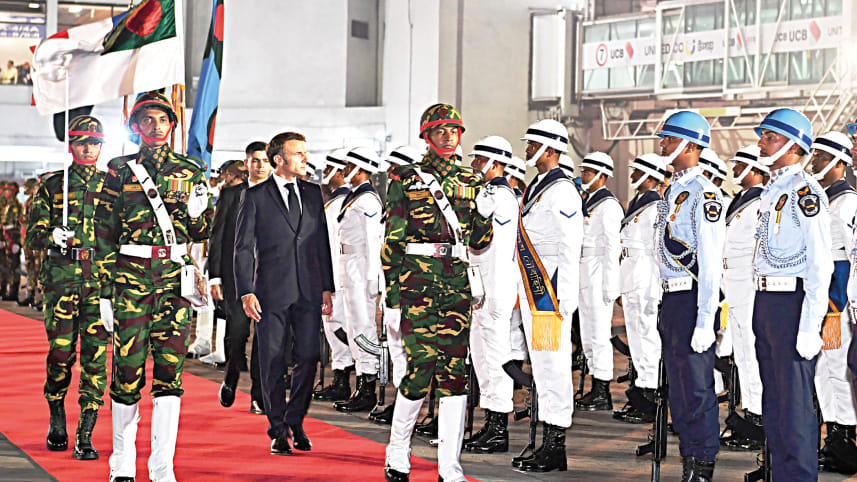
President Emmanuel Macron’s visit to Dhaka in September 2023 became a milestone in the development of relations between the two countries. It was the first visit by a French president to Bangladesh in more than three decades. More importantly, it signalled that Paris was prepared to regard Bangladesh as a strategic partner. The jointly emphasised values of peace, prosperity, people-centred connectivity, and strategic autonomy reflected a new phase in the relationship.
There are several areas that now require special attention.
First, there is trade and investment. Bilateral trade has been growing, but it remains heavily imbalanced. It is driven largely by Bangladeshi exports, mainly ready-made garments. This benefits Bangladesh, but at the same time it demonstrates the limitations of the current economic relationship. The next stage should place greater emphasis on diversification. Pharmaceuticals, agro-processing, the leather industry, information technology, renewable energy, logistics, and high-value manufacturing could all become part of a new economic agenda.
French companies are already present in Bangladesh in industries such as cement, energy, logistics, consumer goods, and industrial services. However, French investment remains well below its potential. Bangladesh needs more European investment as it prepares to graduate from LDC status. France can become an important partner in raising standards, facilitating technology transfer, promoting green production, and expanding access to the European market.
Secondly, there is climate and development cooperation. Bangladesh is widely regarded as one of the countries most vulnerable to climate change. France, as the host of the Paris Agreement and a leading advocate of climate finance, is well placed to become one of Bangladesh’s key partners in this area. France’s development cooperation in urban infrastructure, water management, clean energy, and climate resilience should be expanded. For Bangladesh, climate diplomacy is not merely an important global issue. It is a matter of survival, adaptation, and economic development.
Thirdly, there is technology and aerospace. Bangladesh’s first satellite, Bangabandhu-1, was built by the French company Thales. Discussions on Airbus aircraft and cooperation in the space sector demonstrate that this partnership has the potential to expand into high-technology industries. This is essential because Bangladesh’s future development cannot depend solely on inexpensive labour and traditional exports. It must become part of the global economy of digital infrastructure, aviation, artificial intelligence, satellites, and advanced services.
Fourthly, there is defence and maritime cooperation. Bangladesh’s future development is closely linked to the Bay of Bengal. Maritime security, disaster response, the blue economy, illegal fishing, search and rescue operations, and maritime domain awareness—all these fields are becoming increasingly important. France, with its presence in the Indian Ocean and its naval capabilities, can be a valuable partner in this regard. Of course, Bangladesh does not need to become a member of any military bloc. It simply needs to strengthen its capacities through a range of partnerships.
Perhaps this is the main lesson Bangladesh should draw from this experience. Bangladesh’s relations with France should not be seen as a choice against other countries. Dhaka does not need to choose between France, China, India, Japan, the United States, and Europe. Its interests lie in maintaining a broad range of partnerships. The more diverse Bangladesh’s international relationships are, the greater its strategic autonomy will be.
France is also important because it represents a different diplomatic language. It speaks of sovereignty, strategic autonomy, climate responsibility, and multilateralism. All these principles are highly relevant to Bangladesh’s own foreign policy priorities. At a time when more powers are seeking alignment, Bangladesh needs partners who understand the importance of flexibility.
However, opportunity does not automatically translate into achievement. Bangladesh must approach France with a well-designed agenda. It must identify priority sectors, remove barriers to investment, strengthen institutional coordination, and develop educational and policy dialogue. Symbolic warmth in bilateral relations is valuable, but this partnership now needs structure, continuity, and tangible results.
Bastille Day proves once again that history can change when a nation imagines a different future. Relations between Bangladesh and France are not revolutionary in this sense, but they are entering a period of quiet transformation. What began as a friendship forged in the aftermath of Bangladesh’s Liberation War has evolved into a strategic partnership with significant economic and technological opportunities.
For Bangladesh, the French connection is not only about Paris. It is about Europe, the Indo-Pacific, climate diplomacy, maritime security, and future development. If managed wisely, France can become one of Bangladesh’s most important partners in the coming decade.
In a world of strategic competition and geopolitical realignment, Bangladesh needs partners that broaden its choices. France can be one of them.
Zillur Rahman is a political analyst and President of the Centre for Governance Studies (CGS). He hosts Tritiyo Matra on Channel i and writes on geopolitics, strategic affairs, and governance. Follow him on X: @zillur.
 For all latest news, follow The Daily Star's Google News channel.



Comments