


The untold history of why Khaleda Zia entered politics
The military takeover by Army Chief Lt. Gen. Hussain Muhammad Ershad on 24 March 1982 failed to block, despite temporary setbacks, the forward march of the nationalist forces of Bangladesh led by the Bangladesh Nationalist Party (BNP). There were continuous attempts made to cause splits within the BNP and as part of those efforts some front ranking leaders were lured into joining Ershad. Everything said and done, the party survived all conspiracies to cripple and dismantle it. It was possible because Begum Khaleda Zia, an unlikely successor to Zia the statesman, rose to the occasion. She joined the BNP, relatively quickly learnt the art of politics and political leadership, carried forward the flag of Bangladeshi Nationalism and eventually, through a circuitous path, steered the party and won the political battle.
The assassination of President Ziaur Rahman on 30 May 1981 and the exit of the incumbent President Justice Abdus Sattar from power debilitated the BNP for some time. The party was looking for a rallying point replacing the ageing leadership of Justice Sattar. While the workers were united, the leaders at the centre had different stakes. Many also blamed Justice Sattar for his failure to protect the government against the military intervention. There are claims that he quietly collaborated with Ershad since his assumption of Presidency. Besides, Ershad was eager to buy support from the BNP after Zia's death. Over the intervening period before declaring martial law in the country, Ershad cultivated a close relationship with a section of the BNP leadership, mostly members of the cabinet, who eventually joined hands with Ershad.
As fissures developed in the BNP a debate came up about how to elect a Chairperson of the party and who should be nominated to contest in the upcoming Presidential election. Incidentally, there were no provisions in the party constitution about how to fill the vacancy of the party chief, if any. There was also no provision to make a Vice-Chair the Acting Chair. So, these two problems needed an urgent solution. Only the party National Executive Committee (NEC) could solve the problem. But without taking this provision into consideration some senior members decided to act on their own.
The NEC of the party met at Ramna Green, Dhaka on 13 June 1981 with Acting Chairperson Sattar in the chair. Without consulting others, Prime Minister Shah Azizur Rahman announced that Sattar had been nominated as the Chairperson and there was no dissent. Addressing the meeting, Sattar asked party leaders to hold two big public meetings in each thana and to air recorded speeches of Zia in these meetings to propagate the ideals of Zia. In addition to Shah Aziz, Secretary-General Badruddoza Chowdhury and senior leaders Mirza Golam Hafiz, Jamaluddin Ahmed and S.A. Bari AT addressed the meeting.
Maj. Gen. Nurul Islam Shishu (Rtd.) and Lt. Col. Akbar Hossain (Rtd.) wanted to propose the name of Begum Khaleda Zia as the Presidential candidate. Some of the attendees were not prepared for such a proposal. Shishu and Akbar were of the opinion that the BNP needed the legacy of Zia and only Begum Zia carried that legacy. Pointing out that Begum Zia was not a member of the party, the group led by Shah Aziz refused to accept the proposal. Scuffles broke out but were calmed. Ultimately, Shishu withdrew his proposal and Sattar qualified and was chosen to become the party candidate.
Meanwhile, 60 MPs of the party wanted to seek a requisition meeting of the BNP parliamentary party to discuss organisational issues. Expecting major trouble, Leader of the House Shah Aziz called a meeting of the parliamentary party on 21 June evening. During the meeting most of the leaders favoured an emergency council session to settle the issues of amending the party constitution and nominating the candidate for the Presidential election. In the face of opposition, Standing Committee Member Sheikh Razzaque Ali and Chief Whip Abul Hasnat announced that the party candidature would not be announced during the meeting on 22 June.
During the extended joint meeting of the Standing Committee, the NEC, the parliamentary party and the presidents of district committees on 22 June at the Bangabhaban, Presidential residence-cum-office, Minister of State Abul Kashem proposed the name of Sattar as the party candidate for the upcoming Presidential election. It was unexpected and did not go unchallenged. Maj. Gen. Nurul Islam Shishu (Rtd.) and Lt. Col. Akbar Hossain (Rtd.) wanted to propose the name of Begum Khaleda Zia as the Presidential candidate. Some of the attendees were not prepared for such a proposal. Shishu and Akbar were of the opinion that the BNP needed the legacy of Zia and only Begum Zia carried that legacy. Pointing out that Begum Zia was not a member of the party, the group led by Shah Aziz refused to accept the proposal. Scuffles broke out but were calmed. Ultimately, Shishu withdrew his proposal and Sattar qualified and was chosen to become the party candidate. As newspapers reported the incident saying that the party was facing a risk of split, Minister K.M. Obaidur Rahman in a statement on 1 July said the news story about the possible split in the BNP was misleading and fabricated. He claimed that he had been one of the MPs present in the Bangabhaban meeting and the MPs present had assured Sattar that they would work for him during the election. Those who were actively proposing the candidature of Sattar became so angry that they were about to beat Tariqul Islam and others.
Against this backdrop, a group of 70 MPs met Justice Sattar on 30 June and handed to him a 7-point charter of demand. The demands included: immediate holding of the national council; election of a party Chairperson by amending the constitution; filling up the five vacant seats in the Standing Committee; formation of a Central Election Management Committee, including leaders from different tiers of the party, to supervise the Presidential election; expulsion of unwanted and corrupt elements from the party as promised by Zia before his assassination; and creating the post of an elected Vice-President by amending the country's Constitution to face possible crisis in future, if any.
The meeting of the BNP parliamentary party on that day reached an agreement that the Vice-President would be the running mate of the President candidate in the election. A 10-member committee was formed to work out the modalities for amending the Constitution. But Shah Aziz played a cunning stroke and shortly before the winding up of the budget session proposed an amendment which said Leader of the House would concurrently be the Prime Minister and the Vice-President. This proposal infuriated the BNP MPs and in an unprecedented move they walked out in protest from the House. Ultimately, the Sixth Amendment to the Constitution was passed through a manipulation of the situation and the House was prorogued. But the heat was on. A group of supporters of Shah Aziz stormed the BNP central office and kicked out leaders and workers present there.
During the period, though Khaleda Zia was seen and repeatedly proposed as the new saviour of the party, she did not show much interest, barring casually meeting some of the party leaders. In an interview with the Bangladesh Television in June 1981, she basically talked about her life with Zia and how she managed the domestic responsibilities. But she was slowly coming out of her housewife's self, too.
However, the hole in the party unity could not be plugged in. Moudud Ahmed, in a statement on 31 August, said that the unity in the BNP had weakened after the death of Zia. The statement came out on the founding day of the BNP. A section of party leaders, as they expressed during a private conversation with this author, still believe that it was the beginning of the crack in the party. Moudud's statement was contested by Rafiqul Islam Mia, who in another statement on 2 September, said the statement was misleading and Moudud himself was involved in anti-party activities and was creating indiscipline in the party.
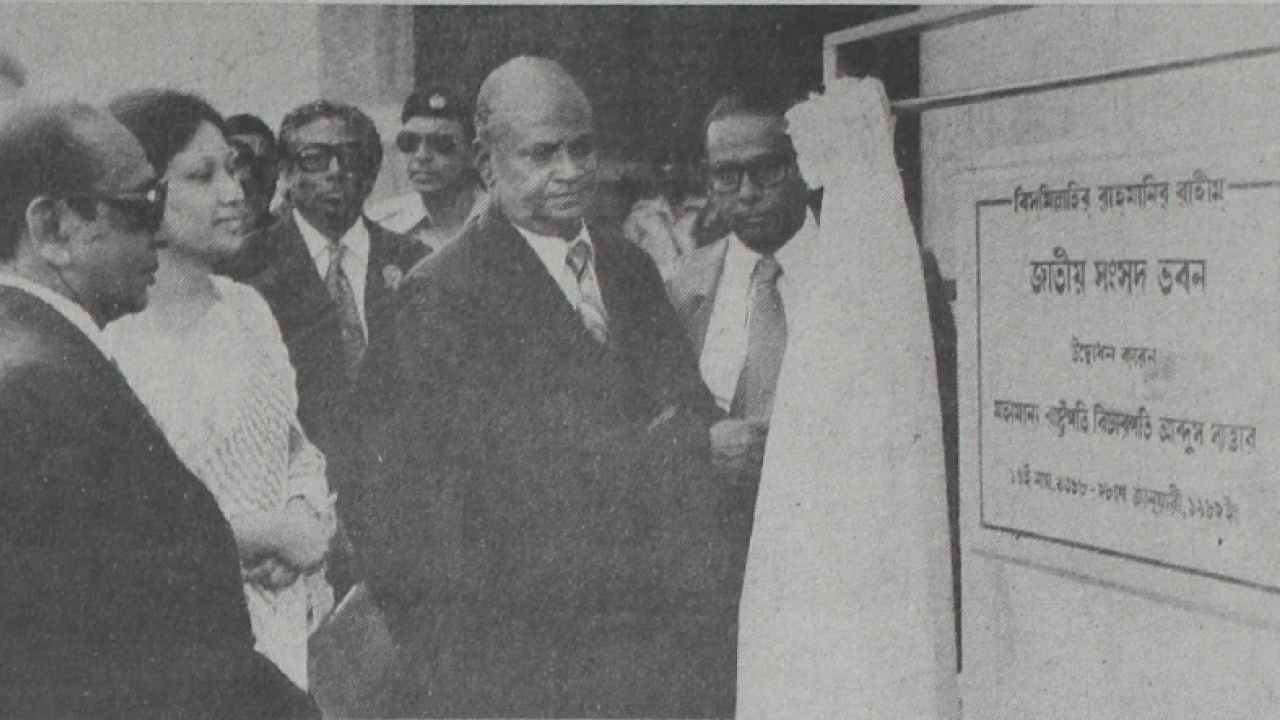
During the period, though Khaleda Zia was seen and repeatedly proposed as the new saviour of the party, she did not show much interest, barring casually meeting some of the party leaders. In an interview with the Bangladesh Television in June 1981, she basically talked about her life with Zia and how she managed the domestic responsibilities. But she was slowly coming out of her housewife's self, too. On 28 January 1982, she was seen attending the opening ceremony of the newly-finished Jatiya Sangsad (JS) Complex, parliament complex of Bangladesh, by President Sattar. Addressing the ceremony, Justice Sattar said the JS Complex on a lush green expanse and overlooking Zia's mazar would stand as a silent reminder of the late statesman's contribution to the revival of multi-party democracy in the country. Curiously, Ershad also wanted Begum Zia to become Vice-President of the country. A senior leader of the party, preferring anonymity, has said Ershad used both Anisul Islam Mahmud and Moudud Ahmed as the go-between to convey his suggestion to Begum Zia. But she was very upset hearing about the proposal. "She firmly believed that Ershad had been behind the conspiracy to kill Zia," one of the party leaders said.
However, the move to replace Sattar as Chairperson of the party continued. Party leaders and workers were asking for an extended meeting of the party to decide on the issue. The date to elect a Chairperson was set for 21 January 1982 and it was announced on 3 January 1982 that 20 members of the electoral colleges of the country's 10 political districts, other than that of the candidate, would vote in the election. It was also stipulated that the candidate would have to be at least 30 years old and any two members of the electoral colleges would propose and second the name of a candidate. The schedule for election was as follows: filing of the nomination papers on 6 January; scrutiny of the nomination papers on 7 January; and withdrawal of nomination papers on 11 January.
Visible differences surfaced about the candidature of Khaleda Zia versus Justice Sattar for the post of party Chairperson. Justice Sattar went to Begum Zia's house for a one-on-one meeting around the noon on 3 January. He had earlier summoned most of the cabinet members at six in the morning that day ahead of his meeting with Begum Zia and talked with them for about three hours. Though what transpired during the meeting of Begum Zia and Justice Sattar was not known it was reported that she was ready to join politics but was against any contest to become party Chairperson.
Earlier, on 2 January 1982, a group of 12 cabinet members, including Prime Minister Shah Azizur Rahman had met Begum Khaleda Zia at her residence. Besides, a number of party NEC members also met on 1 January and pleaded with her to become the party chief. This was done to thwart the move by the Standing Committee, the highest policymaking body of the party, which had approved the candidature of Justice Sattar for the position. It became clear that the cabinet was clearly divided on the issue: one group was rallying behind Justice Sattar fearing they might lose their ministerial posts in the event of Khaleda Zia securing the position while others were trying to demolish the influence of the anti-Bangladesh forces over the party.
Nazrul Islam Khan said: It became difficult to find a consensus candidate. President Zia had threе deputies: Justice Sattar was responsible for looking after the administration, Prime Minister Shah Aziz the JS and Professor Dr. Badruddoza Chowdhury the party. So no one was able to do anything independently. In view of the situation, Maj. Gen. Nurul Islam Shishu (Rtd.) wanted to become Chairperson and started mobilising opinion to that end, for which he was dropped from the cabinet. Ruhul Amin Howladar replaced Shishu Bhai [in the cabinet] representing Barishal. The supporters of Shishu Bhai were claiming that as he was the closest person to Zia he would be able to deliver goods. But he was politically not acceptable. Dr. B. Chowdhury's acceptability was challenged because of his controversial role when Zia had been assassinated. So Justice Sattar became the choice. But he was old and sick. Persons like Dr. Matin and Shamsul Huda Chowdhury, who were supporting the candidature of Justice Sattar, were also acceptable to some as the alternative leader. Others said a third person should be given the responsibility and during one of the discussions the name of Begum Zia was suggested. However, there were others who were trying to discourage her. But we insisted that she would be the symbol of unity.
Known dissidents Barrister Moudud Ahmed, Shishu, K.M. Obaid and others opined that without resolving the party's inner contradiction it would not be wise to convene the JS session. They said the objective to form the BNP with members from six political parties including Jagodal was not to form a new right-wing Muslim League (ML) but to establish the politics of consensus and follow a middle path. They claimed that 'a gang of eight' had paved the road to put people with ML background in the party leadership by misleading the President through concocted information.
Mayeedul Islam Mukul had a somewhat different version of the story. He said President Sattar asked him that Begum Zia be made the Chairperson. On the other hand, Maj. Gen. Nurul Islam (Rtd.), popularly known as Shishu and once considered very close to Zia, wanted to control the party and become the top man. But 'we opposed the move as he was an Indian agent'. Lt. Gen. Atiqur Rahman (Rtd.) also thought that Begum Zia was made Chairperson to keep the party united. The founding Secretary General of the party, Prof. Dr. A.Q.M. Badruddoza Chowdhury, said: Sheikh Hasina had returned to Bangladesh about two weeks before Zia was assassinated. She was Bangabandhu's daughter. We thought we needed Zia's wife to counterbalance the AL leadership [with Sheikh Hasina as its chief]. We knew Sheikh Hasina considered Zia a strong contestant. So we thought we needed someone who carried Zia's legacy. But Justice Sattar was not very happy with this move.
However, a few days later, after B. Chowdhury returned attending a UN session, a section of senior party members and a group of former ministers started lobbying to have a council session of the party before electing the new chief. They thought, with the election issue on the card, the council session would be obligatory and they would be able to amend the party constitution providing for electing the party leaders through a democratic process. But the Standing Committee was not ready to budge an inch as it was in favour of a person other than Justice Sattar, if Begum Zia did not want to become Chairperson. Meanwhile, different competing groups were trying to assert their control over the party. Against this backdrop, Khaleda Zia accepted the party membership on 4 January 1982.
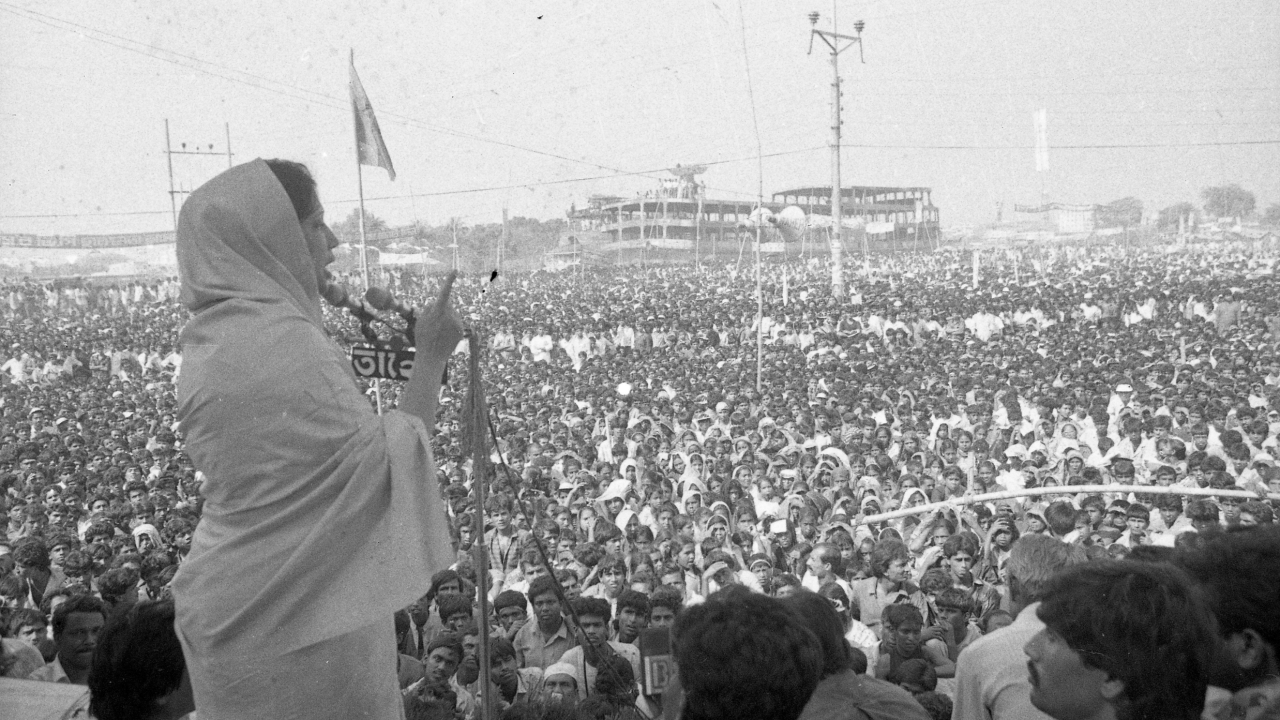
Explaining the situation, former MP and then BNP Publicity Secretary Ahmed Nazir said: Shafiqul Ghani Swapan, Anisul Islam Mahmud, Mahmudul Karim Chowdhury and I wanted that Begum Zia should become a member of the party. But she did not sign the membership form and asked us to talk to Secretary-General Dr. B. Chowdhury. When we approached B. Chowdhury he said he would not request Begum Zia to become the Chair as this would tarnish the image of Justice Sattar. After persuasion he took Swapan inside and said he could not openly support the candidature of Begum Zia but would talk to her over phone. He kept his word. When we met Begum Zia next she signed the membership form.
The same day, Justice Sattar submitted his nomination paper for the top post. Prime Minister Shah Aziz proposed Sattar's name while Deputy Prime Minister Jamaluddin Ahmed seconded it. "Military leaders, two intelligence agencies and two groups of the cabinet ministers - none wanted Begum Zia to become Chairperson of the party. To safeguard self-interest and interests of the masters Shah Aziz compelled Justice Sattar to sign the nomination paper." To drum up support for his candidacy, Justice Sattar invited MPs and some leading members of the party to a tea evening at the Bangabhaban. About 50 persons attended the tea party. As part of a compromise formula, some of the attendees proposed that Begum Zia be made a Vice-Chair. But Justice Sattar did not agree. On the other hand, a greater number of party leaders and MPs repeatedly called on Begum Zia that day to convince her to join the election race. Though she did not make any commitment publicly, it became clear that she would join the election. About 100 MPs and some former ministers sat in a meeting in the evening and decided to nominate Begum Zia as a candidate. Lt. Col. Akbar Hossain (Rtd.) collected nomination paper on her behalf. Begum Zia filed her nomination in the evening of 5 January 1982. Some 73 MPs welcomed Khaleda Zia's decision and in a meeting on 5 January evening said that this would enable the party to uphold the ideals and politics of Zia. The statement by the MPs came under fire next day from Central Organising Secretary Khalequzzaman Khan Dudu and Central Agriculture Secretary Sheikh Shawkat Hossain Nilu. They observed that the MPs had violated the party discipline by issuing the statement and requested President Sattar to immediately dissolve the JS and go for snap election.
Shah Aziz was very upset hearing that Begum Zia had submitted her nomination. He immediately called a meeting of the cabinet members at the Old Ganabhaban to review the situation but there was no media briefing. That there were differences in loyalty across the party spectrum became clear from the statements issued by different front organisations of the party, some backing Justice Sattar and others Begum Zia. Talking to a news agency on 5 January, former Deputy Prime Minister S.A. Bari AT, who had seconded Begum Zia's nomination, said her supporters were ready to sit for a dialogue on how to maintain the party unity. He said that politics of balance followed by Zia would also be maintained under the leadership of Begum Zia.
Member of the party Standing Committee and party election commission Barrister Nazmul Huda, in a statement on 5 January, criticised Shah Aziz and Jamaluddin Ahmed for proposing and seconding Justice Sattar. Incidentally, Shah Aziz and Jamaluddin Ahmed were also members of the election commission. Huda in his statement said the news carried by a section of the press that the party Standing Committee had unanimously decided to propose Justice Sattar was not true. He said the Committee as an effective part of the election process stood to see that the rules of election were properly followed so as to ensure a fair and impartial election.
On persuasion, Begum Zia met a group of journalists at her residence on 6 January. Briefly talking to them, she declined to comment on the prevailing situation within the party and the political situation but hastened to add that she would soon announce her final decision. During the meeting, Jamaluddin Ahmed, Abdul Aleem and Barrister Hasnat were waiting inside the house to finish the discussions they had been having with Begum Zia. Earlier, on the day, Shah Aziz and Jamaluddin had separately met Begum Zia twice to find a solution. Justice Sattar also had a telephonic discussion with Begum Zia but nothing was disclosed.
Meanwhile, in a statement on 7 January, 29 members of the NEC, including seven members of the Standing Committee, supported Justice Sattar's candidature. But former minister and a close friend of Zia, Capt. Nurul Huq (Rtd.) in a statement on 6 January announced his support for Begum Zia. Nurul Huq alleged that Justice Sattar was promoting factionalism. He said: "Shishu became an aspirant and started campaigning with the words that only he could replace Zia, nobody else. But who would go with Shishu? Stalwarts like Majidul Huq were very unhappy with Shishu. When the party was facing problems over unity some of us thought we needed a person around whom the whole party would rally. Obviously, the choice was Begum Zia."
In a sudden move on 7 January, Begum Zia withdrew from the race even before the election commission of the party could sit for scrutinising the nomination papers. So Justice Sattar was elected BNP Chairman unoppоsed. Begum Zia in a statement said following requests and assurances from Justice Sattar and in the greater interest of the country, the nation as well as the party she had pulled out of the contest. Justice Sattar had promised to her that he would work for implementing Zia's 19-Point Programme and for maintaining the unity and solidarity of the party, she added. Begum Zia regretted that for some time there had been a misunderstanding in the party which could have endangered the unity and solidarity of the party. "Against this backdrop, different sections of the party had asked me to take the responsibility of the party and in the greater interest of the party I had become a candidate," she added.
Begum Zia's withdrawal made unhappy the party leaders and activists who stood for her candidacy. In a meeting at the MP Hostel on 7 January night, about 70 MPs and a number of leaders of the party regretted her decision. Presided over by Vice Chairman Mahmudul Karim, the meeting also criticised the decision to reject the nomination paper of K.M. Obaid and termed it illegal and conspiratorial. However, in a surprise move on 17 January, Justice Sattar invited the dissidents to a dinner at the Bangabhaban. Initially, Begum Zia did not join the dinner but was later persuaded to attend by a special emissary of the President. Justice Sattar in his pre-dinner address requested the BNP leaders to uphold the party unity during the crisis being faced by the nation and the government. Hе also proposed to call the JS into session soon.
Known dissidents Barrister Moudud Ahmed, Shishu, K.M. Obaid and others opined that without resolving the party's inner contradiction it would not be wise to convene the JS session. They said the objective to form the BNP with members from six political parties including Jagodal was not to form a new right-wing Muslim League (ML) but to establish the politics of consensus and follow a middle path. They claimed that 'a gang of eight' had paved the road to put people with ML background in the party leadership by misleading the President through concocted information. Justice Sattar said he was not opposed to democratisation of the party provided that it was effected through a council session. But some powers should be vested in party Chairperson, he added. Begum Zia said Justice Sattar had requested her to take up the party leadership but later without any communication with her he himself submitted his nomination paper. The dinner thus did not yield any result.
The plenary was cut short because it was disrupted by slogans such as 'Don't accept the cabinet of Razakars', 'Killers of 1971 beware' and so on. The criticism of the local-level administration by party leaders also forced the leadership to shorten the meeting. When slogans were raised Prime Minister Shah Aziz left the dais for some time and came back later.
A special session of the party was called for 21 January 1982 at the Old Ganabhaban (old Prime Ministerial Office) to sort out the differences within the party and decide the future course of action. The members of the party's Standing Committee, National Executive Committee, leaders of the district and thana committees, leaders of the party's front organisations and some non-party lawyers were present in the meeting. The presence of the non-party lawyers was not welcome by many of the party and they termed their presence unwanted. The dissidents who had planned to submit a memorandum to party Chairman asking for democratisation of the party, removal of the ML elements from the party and pursue the politics of balance introduced by Zia failed to raise their demand.
Later, a group of 35 MPs and about 300 leaders and workers of the party joined in a meeting at Shere Bangla Nagar and adopted some resolutions to place before Justice Sattar. The resolutions included: demand for appointment of a Vice-President of the country before convening the Winter Session of the JS; electing Prime Minister and whips in the meeting of the parliamentary party and so on. The issue of appointing a Vicе President was meant to bring Khaleda Zia in as a future national leader. But Justice Sattar did not agree. There were words that Ershad also toyed with the idea but failed to manipulate the situation.
The plenary of the special session extended from 11 a.m. to 1.00 p.m. and Justice Sattar, B. Chowdhury and some local-level leaders of the party spoke on the occasion. The plenary was cut short because it was disrupted by slogans such as 'Don't accept the cabinet of Razakars', 'Killers of 1971 beware' and so on. The criticism of the local-level administration by party leaders also forced the leadership to shorten the meeting. When slogans were raised Prime Minister Shah Aziz left the dais for some time and came back later.
Justice Sattar, in his address, thanked the party leaders and workers for electing him Chairperson. He added that for democratisation of the party a three-member committee had been formed comprising Jamiruddin Sircar, Nazmul Huda and Sheikh Razzaque Ali. The committee would place recommendations during the next council meeting for amending the party constitution, he said. He further said it was not unusual to have differences of opinion in a big party like the BNP but 'everybody should rise above petty differences in the interest of the unity in the party'. The copy of a weekly, which termed B. Chowdhury as a KGB agent and Firdaus Quarishi as a RAW agent, was burnt to protest the 'malicious propaganda' against these BNP leaders. B. Chowdhury said the philosophy of Zia would have to be upheld in running the state and the administration and the party should have the upper hand in running the administration.
In that meeting I said we would have to bring in Begum Zia to lead the country and the party. Immediately after I said this Moudud Ahmed jumped up and took me to the washroom. There he said to me: "This is a dangerous proposal. She will be a demagogue. She is a housewife and Zia also did not bring her out. "
The inner party contradictions became very critical after Ershad assumed power. One group headed by Shamsul Huda Chowdhury, a minister under Zia, was quietly influencing others to join Ershad. To them, politics meant enjoying fruits of power. Another group insisted on deciding on the future course of politics to be pursued and especially about electing an effective Chairperson for the party. They wanted to create a new BNP on ideological lines. The other group, headed by former Prime Minister Shah Aziz and others, was trying to usurp the party leadership to fołlow a political line with rightist bias. Incidentally, the differences between the pro- and anti-independence forces became very sharp after the death of Zia.

Ahmed Nazir said: "The group led by Shah Aziz ganged up to siege the authority using Sattar. Earlier, before the Presidential election of 1981 we wanted someone young to become President. But the pro-Sattar group insisted on nominating Sattar as they planned to dissolve the JS after Sattar was elected. And then using the authority of Sattar they thought they would be able to nominate people, who were ideologically loyal to them, to contest the seats of parliament. Shah Aziz and others also moved the Sixth Amendment to the Constitution which said Prime Minister would become President in case the office of President fell vacant. We opposed the amendment and walked out of the parliament session. Later the amendment was amended and a revised amendment was passed. Then we had a meeting of the like-minded MPs. In that meeting I said we would have to bring in Begum Zia to lead the country and the party. Immediately after I said this Moudud Ahmed jumped up and took me to the washroom. There he said to me: "This is a dangerous proposal. She will be a demagogue. She is a housewife and Zia also did not bring her out. "
But Moudud Ahmed made a different statement in one of his books: "If BNP had nominated Begum Khaleda Zia to become President of the country, the political history of Bangladesh would have been different. No military leader could dare to intervene in running the affairs of the state."
Against the backdrop of such intra-party contradictions, Begum Khaleda Zia became the ultimate choice for the leadership. But why did Khaleda Zia, a typical housewife who had become widow at a critical age in terms of Bangladesh's culture, join politics? A sparkling beauty, she could never escape the public scrutiny since Zia's death. An auditing of the time and the process of her entry into politics has never been made.
Tariqul Islam said: We were convinced that if she had joined politics she would be carrying the charisma of Zia and this would be an added advantage for the BNP. Moreover, we were convinced that once she joined politics and was adorned by people she would not think of a personal life for her.
Mahfuz Ullah (10 March 1950 – 27 April 2019) was a renowned Bangladeshi writer, journalist, television personality, and environmentalist. This is an excerpt from Mahfuz Ullah's book Begum Khaleda Zia: Her Life, Her Story (2018).
Send your articles for Slow Reads to slowreads@thedailystar.net. Check out our submission guidelines for details.