My discovery of Sher-e-Bangla
Almost unnoticed, the 150th birth anniversary of Sher-e-Bangla A.K. Fazlul Huq has gone by, and this year marks his 152nd. As I sit down to write about him, I cannot help but echo the words of B.D. Habibullah, the biographer of Huq Saheb — is it at all possible for an ordinary man like me to write about such a great soul? Yet, I gather the courage to do so, perhaps because I share a subtle, indirect connection with Sher-e-Bangla himself.
It so happened that I became coincidentally involved in the recovery of several letters, telegrams, proposals for candidate selection, and lists of United Front nominees — all sent to Sher-e-Bangla in connection with the 1954 election.
I work in the Deposit Insurance Department of Bangladesh Bank, within a sub-division known as the Defunct Bank Monitoring Unit. Its main task involves tracing and managing the remaining assets (if any) of certain banks from the British and Pakistani periods that ceased to exist following the Partition of British India or after Bangladesh's independence.

Our department holds numerous cupboards, sacks, and boxes filled with old documents, which are occasionally inspected for this reason. We even have a dedicated team whose sole duty is to examine these papers. One member of that team, Ariful Islam was the first to come across a set of old letters and brought one of them to me.
Reading the letter, I realised it dated back to the 1954 United Front election — a correspondence addressed to Sher-e-Bangla. The writer was Abu Mohammad Toaha, a name that immediately sounded familiar; I knew of a politician by that name. I asked Ariful where he had found it. He said, "It was inside a sack among our old documents on the twelfth floor." He added that there were many more letters, including one supposedly signed by Sher-e-Bangla himself.
This immediately caught my attention. I said, "Let's go see where those letters are — we must retrieve them." We rushed down from the sixteenth floor to the twelfth. I asked the peon working there about the letters. To my dismay, he replied that they had been torn up and discarded. My heart sank. I ran to the dustbin where the torn papers were usually thrown. There I found scraps of paper, but not the kind of letters I was looking for.
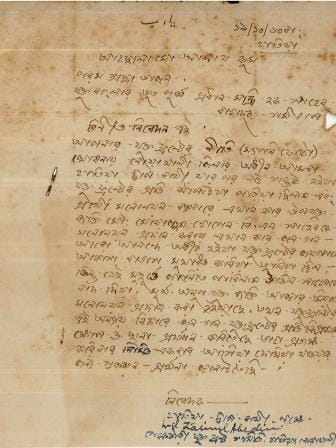
Then, moments later, our peon Momin came and said, "Sir, the papers you were looking for have been found. Shamim — another peon — kept them aside following Arif's instructions." What a relief! I immediately brought them in for inspection.
What we found was not only letters but also telegrams, leaflets, and several confidential reports prepared by a fact-finding committee that had been formed to evaluate candidates for the United Front election. The committee's job was to gather information about potential candidates and submit detailed reports. All these letters, telegrams, and confidential reports were addressed to Sher-e-Bangla himself.

How did these United Front election documents end up in our department? Could there be any connection between Sher-e-Bangla and this division — or even with Bangladesh Bank?
In truth, there is no direct or institutional link between Sher-e-Bangla and Bangladesh Bank or this department. Yet, there exists an indirect one that deserves explanation. Bangladesh Bank was appointed as the official liquidator for defunct banks in 1977. Before that, the responsibility was laid with lawyers of the High Court Division.
If we look into the life of Sher-e-Bangla A.K. Fazlul Huq, we know that he was a distinguished lawyer. In 1953, when the general elections were announced in East Bengal, he was serving as the Advocate General of the Dhaka High Court. It is therefore quite plausible that some of the lawyers who worked as official liquidators for defunct banks had close professional ties with him.
Moreover, some of them might have been members of the Krishak Sramik Party or active supporters of the United Front. Perhaps, through one of them, these letters and documents accidentally found their way into the archives of a defunct bank — and from there, into our department.
Of course, all of this remains conjecture.
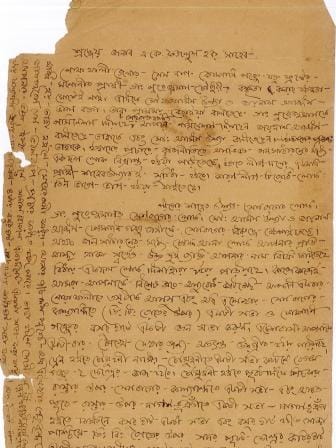
Among the recovered materials were letters, telegrams, reports of the Fact-Finding Committee, lists of potential candidates sent from different regions, the official list of United Front nominees, and various leaflets. All these letters, telegrams, leaflets, and reports were addressed to Sher-e-Bangla A.K. Fazlul Huq.
Sher-e-Bangla A.K. Fazlul Huq and the 1954 United Front election are inseparable from one another. The political coalition emerged primarily to free the people from the oppressive misrule of the ruling Muslim League and to establish the right of self-determination in East Bengal.
The 21-point manifesto of the United Front reflected the aspirations of East Pakistan's rising middle class, self-reliant peasants, and emerging industrial and business communities. The manifesto pledged not only social and economic rights through the development of education, agriculture, and industry in East Bengal, but also a commitment to democratic governance.

The 1954 United Front election was a turbulent moment in history, and at its centre stood Sher-e-Bangla. Every letter addressed to him was related to the election. The subjects of the letters, telegrams, reports, and leaflets included the persecution of United Front workers by Muslim League supporters and government officials, campaign strategies, the status of candidates in different constituencies, internal conflicts among nominees, requests for candidate changes, appeals for financial assistance from the party to conduct campaigns, and disagreements among leaders regarding nominations. The documents also vividly portray the hopes, struggles, and movements surrounding that election, as well as the deep respect and devotion that political leaders and ordinary citizens alike held for Sher-e-Bangla.
The discovery of these rare documents offers deeper insight into history, revealing new information while verifying past accounts and vividly bringing the story of the United Front election to life. I have published a book titled Sher-e-Bangla o Juktofront Nirbachan: Kichu Dushprappo Dalil ('Sher-e-Bangla and the United Front Election: Some Rare Documents'), based on these materials.
Tarun Yousuf is a poet and author.
Send your articles for Slow Reads to slowreads@thedailystar.net. Check out our submission guidelines for details.

Tuning the melody of Baul songs into peace education
Shreemati Rassundari and the making of the first autobiography by a Bengali woman
Nabayug: Nazrul’s radical pen and Fazlul Huq’s leadership
Reading Nazrul in an age of inequality

East Bengal’s victory and the memory of lost homes

The stolen haq of Qurbani hides
Tagore’s Dan Pratidan and the colonial remaking of Bengal’s moral world
Memories of Indigo Rebellion and the question of national identity
Part 1 / The forgotten art of Bengali advertising