


Myanmar’s hollow election: Rohingyas’ fate and Bangladesh’s geopolitical stake


Myanmar's upcoming election is unfolding in a landscape where the state scarcely resembles a unified political entity. The military junta's attempt to stage national polls is driven by a need to project legitimacy at a time when its authority is deeply eroded. Large sections of the country, particularly along the northern, eastern, and western borderlands, are controlled by ethnic armed organisations and resistance forces. These groups have carved out autonomous zones with their own administrations, revenue collection systems, and security structures. China-brokered ceasefire agreements have contained battles in some areas, but they have not restored central authority. Instead, they have produced a patchwork governance order, with competing jurisdictions responding to different political patrons. In such a fragmented environment, an election becomes an exercise in performance rather than a mechanism for political settlement.
The Rohingya question and the politics of erasure
 For all latest news, follow The Daily Star's Google News channel.
 For the Rohingya, the election offers no meaningful pathway toward recognition, rights, or safety. Their exclusion from Myanmar's political community has been entrenched for decades and was violently reinforced by the 2017 mass atrocities that pushed nearly a million refugees into Bangladesh. The current electoral framework preserves this architecture of exclusion. No major political force in Myanmar – whether aligned with the junta or opposed to it – has articulated a vision for reintegrating the Rohingya into national life. The civil war has further marginalised their plight, pushing the question of citizenship and accountability to the outer edges of political discourse.
For Bangladesh, this political void has immediate implications. The prolonged instability inside Myanmar has stalled repatriation efforts and diminished the prospects for creating conditions conducive to a safe return. As host communities in Cox's Bazar shoulder the social and economic weight of the refugee population, it becomes increasingly clear that no progress is possible without structural change in Myanmar's political order. The election does not create that change; it simply reproduces the conditions that have locked the Rohingya crisis into a dangerous stalemate.

China's expanding strategic footprint
Myanmar's internal conflict has become intertwined with China's strategic interests, making Beijing the most consequential external actor in shaping the country's trajectory. China's engagement is defined by a deliberate duality. It maintains formal ties with the junta to safeguard major infrastructure and energy projects, including pipelines and economic corridors that cut across contested terrain. Simultaneously, it maintains relationships with ethnic armed organisations that control border areas essential to Chinese trade and security. This multipronged approach allows Beijing to cultivate influence without committing to a political settlement. Its priority remains border stability, uninterrupted commercial activity, and the protection of long-term strategic assets.
This strategy reflects a broader regional pattern in which China prefers calibrated involvement over transformative engagement. Its deepening role in Myanmar signals to neighbouring states, including Bangladesh, that Beijing's approach to crises in its periphery is rooted in pragmatism rather than normative considerations. The geopolitical space China occupies in Myanmar is thus not simply a matter of influence; it is part of a wider reordering of power in mainland Southeast Asia.
India's security dilemma on its Eastern frontier
India faces a more complex challenge. Instability in Myanmar has reverberated across its northeastern borderlands, contributing to refugee inflows, illicit cross-border movements, and the resurgence of armed groups with long-standing grievances. New Delhi once viewed the Myanmar military as a critical partner for stabilising this frontier and for advancing connectivity projects central to the Act East policy. However, the military's weakening grip over territory has undermined this equation. Key infrastructure initiatives, including the Kaladan project and the trilateral highway, have been repeatedly disrupted by conflict and logistical insecurity. Local political sensitivities in Manipur and Mizoram further constrain India's ability to deepen engagement with Myanmar's military authorities.
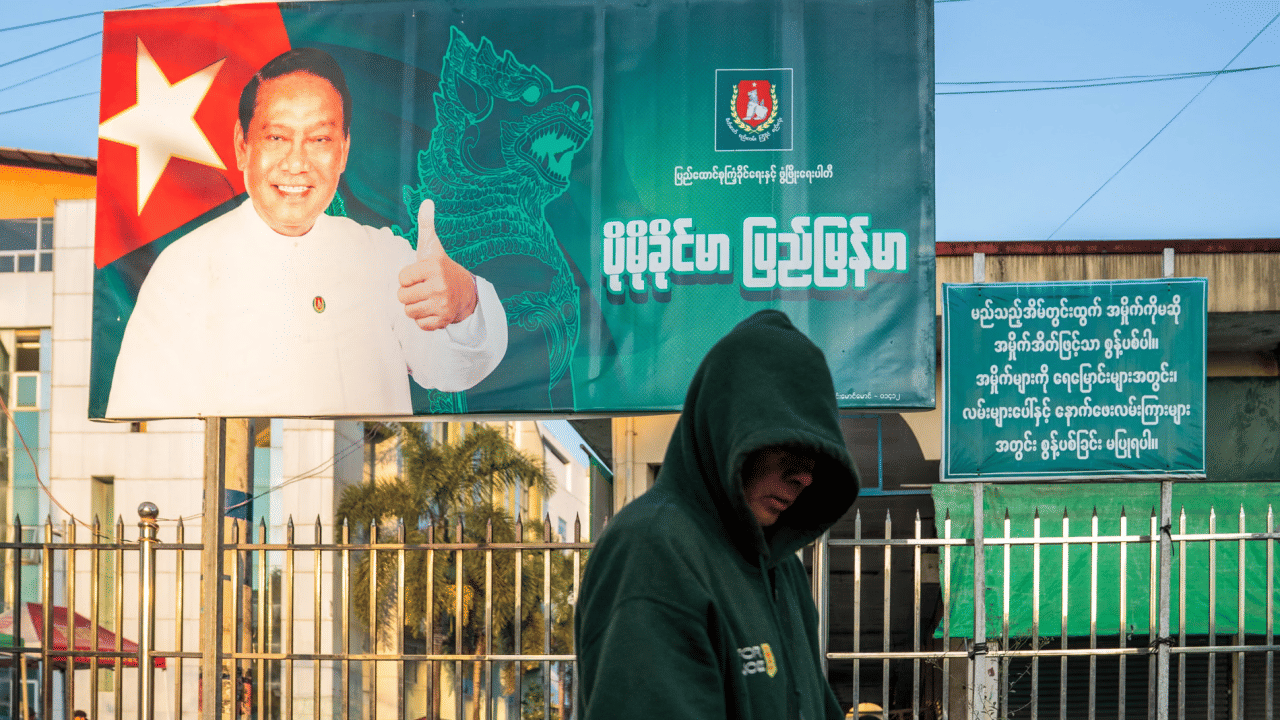
The upcoming election does little to resolve these pressures. Rather, it underscores the limits of relying on a regime that cannot assert control over its own territory. As India weighs its options, it confronts the uncomfortable reality that Myanmar's internal fragmentation directly impacts its regional ambitions and border management strategies.
ASEAN's constraints and the limits of regional diplomacy
ASEAN, long positioned as Myanmar's diplomatic anchor, has struggled to craft a coherent or influential response. The bloc's non-interference principle, coupled with internal political divisions, has hampered efforts to enforce its Five-Point Consensus or to pressure the junta toward substantive concessions. Some member states favour a tougher stance, while others prioritise stability and engagement. This divergence has produced a crisis of relevance for ASEAN, whose diplomatic interventions increasingly appear symbolic rather than effective. The election is unlikely to reverse this trend; instead, it highlights the bloc's structural inability to shape Myanmar's trajectory in a meaningful way.
Regional fatigue has also become evident. Years of conflict, humanitarian suffering, and stalled negotiations have created a sense of diplomatic inertia. While ASEAN remains formally engaged, its capacity to influence events inside Myanmar continues to diminish, leaving a vacuum into which other powers have stepped.

Western pressure and its limits
Western governments maintain a normative stance on Myanmar, rejecting the junta's legitimacy and implementing sanctions targeting military-linked businesses and key individuals. However, the impact of these measures has been limited. The military continues to draw revenue from border trade, resource extraction, and channels supported by regional powers. Moreover, Myanmar does not occupy a central place in Western strategic priorities compared with broader Indo-Pacific calculations centred on China's rise. This imbalance between moral condemnation and strategic commitment has created space for the junta to endure, even as it faces international isolation.
Bangladesh in a complicated geopolitical landscape
For Bangladesh, the geopolitical stakes are profound and multifaceted. The crisis in Myanmar intersects with national security concerns, humanitarian responsibilities, and regional diplomatic pressures. Bangladesh must navigate a delicate balance: maintaining a working relationship with the junta for the sake of repatriation, engaging China and ASEAN to sustain diplomatic momentum, and coordinating with Western partners and UN agencies to keep the Rohingya issue on the global agenda. These competing imperatives require strategic flexibility rather than alignment with any single external power.
Instability in Myanmar also complicates regional visions for connectivity and economic integration. Bangladesh's aspirations to benefit from broader Bay of Bengal and Indo-Pacific frameworks depend on a stable neighbourhood. A fragmented state on its southeastern border disrupts these opportunities and forces Dhaka to adapt its strategic outlook.

Myanmar as a regional pressure point
Myanmar's election reflects a deeper reality: the country has become a pressure point in the geopolitical contestations shaping South and Southeast Asia. Its internal fragmentation invites external involvement, while its location at the crossroads of multiple strategic corridors ensures that regional and global powers cannot ignore its trajectory. For Bangladesh, India, China, ASEAN, and Western governments, Myanmar represents both a humanitarian challenge and a strategic variable.
Beyond the illusion of political normalcy
Myanmar's election is unlikely to alter the fundamental drivers of conflict within the country. It is an exercise in political theatre designed to project normalcy in a state where legitimacy is fractured and authority contested. Yet its implications extend far beyond Myanmar's borders. The crisis continues to shape regional security dynamics, redraw geopolitical alignments, and impose strategic burdens on neighbouring states—none more so than Bangladesh.
A clear-eyed understanding of these dynamics is essential. For Bangladesh and the region, the path forward lies not in hoping for rapid political transformation within Myanmar but in preparing for a prolonged period of instability that will demand sustained diplomatic engagement, strategic patience, and resilient humanitarian management.
ASM Tarek Hassan Semul, Research Fellow, Bangladesh Institute of International and Strategic Studies (BIISS) and Cohort of the Indo-Pacific Young Leaders Program, Asia Pacific Foundation (APF), Canada.
Send your articles for Slow Reads to slowreads@thedailystar.net. Check out our submission guidelines for details.
Comments