


Three competing nationalisms and the battle for Bangladesh


When we speak about Bangladesh today, we often pretend as if there is one clear national story. In reality, three stories are competing to define who "we" are and are not. Islamic nationalism, Bangalee nationalism, and Bangladeshi nationalism are not just party slogans. These are three rival nationalist projects for imagining the country.
Nationalism seeks to align the state with a particular vision of the nation. Ernest Gellner describes it as the demand for a shared culture to have its own state. Benedict Anderson calls nations "imagined communities," where individuals feel connected through language, media, and shared practices, despite never having met. Eric Hobsbawm shows how many "ancient" traditions are actually modern inventions used to maintain power. At the same time, Anthony D. Smith argues that successful nations link modern citizenship to older myths and symbols. Taken together, nationalism is a project that constructs a community in people's minds, gives it a shared past and destiny, anchors it in state institutions, and usually identifies at least one threatening "other."
 For all latest news, follow The Daily Star's Google News channel.
 Measured by that lens, the three nationalisms of Bangladesh are three different ways of defining membership, memory, and enemies on the same land. Islamic nationalism is the oldest. Its roots go back to late colonial Bengal, long before Jamaat-e-Islami politics in the 1950s and 1970s. The partition of Bengal in 1905 and the founding of the All-India Muslim League in Dhaka in 1906 created a new arena in which Muslim elites organised as a community they saw as vulnerable in a Hindu-dominated political economy. Through the 1930s and 1940s, leaders such as A.K. Fazlul Huq, Huseyn Shaheed Suhrawardy, Maulana Abdul Hamid Khan Bhashani, and even the then-young Sheikh Mujibur Rahman moved within this wider Muslim frame, despite their differences. The "we" was the Muslim community; the reward was a state where Muslims would be safe and in charge; the implied enemy was "the Hindu."
The birth of Pakistan in 1947 looked like a clear victory. But the new state was split into West and East, separated by geography and culture. The central leadership tried to impose a single Muslim Pakistani identity, built around Islam and Urdu. In East Bengal, this project faced challenges and produced new tensions instead of harmony. In response, Bangalee nationalism emerged. With the language movement of 1952, the education movement of 1962, the Six Point Programme of 1966, and the mass uprising of 1969, a Bangalee political identity emerged that was no longer willing to be the submissive "eastern wing" of a Muslim Pakistan. That sentiment was transformed into an armed struggle with the Liberation War of 1971. The founding moment shifted from 1947 to 1971, and the enemy became the Pakistani military regime and its local collaborators.
The 1972 constitution tried to turn this experience into a state project. Nationalism, socialism, democracy, and secularism were announced as guiding principles. In theory, "Bangalee" was defined broadly. In practice, our version of nationalism was heavily majority culture-centred, which left many Biharis, indigenous communities, and non-Bangla speakers at the margins.
Islamic nationalism did not vanish with Pakistan's defeat. In independent Bangladesh, Jamaat-e-Islami was banned, and religious politics were pushed back from the centre of power, but mosque networks, madrasa structures, and religious sentiments survived. Proponents of Islamic nationalism remained in the background, waiting for an opening. That opening came indirectly through a third project: Bangladeshi nationalism.
After Mujib's assassination in 1975, General Ziaur Rahman became the president. Zia introduced "Bangladeshi nationalism" in his speeches and through constitutional changes. The focus moved from cultural Bangalee identity to a territorial Bangladeshi identity centred on citizenship. The "we" became those living within the borders of Bangladesh. The founding event remained the Liberation War of 1971, but it was reinterpreted less as an ethno-linguistic struggle and more as the birth of a sovereign state.
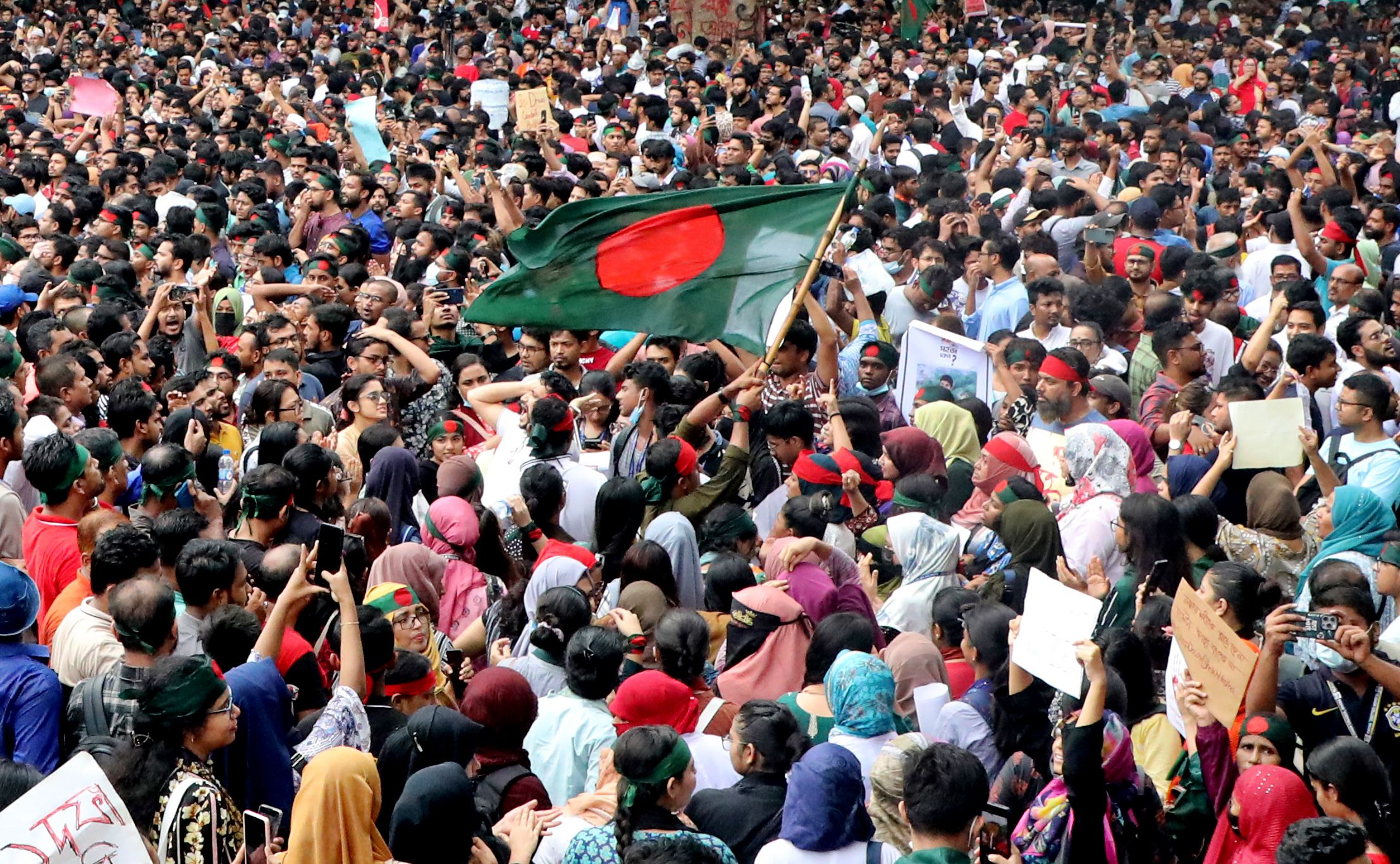
Bangladeshi nationalism, in a more generous version of history, could have produced a nationalism that respected multiple ethnicities and religions under one legal roof, while valuing 1971 as the founding moment of Bangladesh. That path, however, was never fully taken by the proponents of Bangladeshi nationalism. Party competition and regional geopolitics pulled Bangladeshi nationalism in another direction. It became the language of the BNP against the Awami League and often against India. Because of constitutional changes under Zia and later Ershad, Bangladeshi nationalism gradually came to be viewed by many as a softer cover for Islamic nationalism. However, there are fundamental differences between a territorial, citizenship-based project and a religious identity project.
When parliamentary democracy was restored in 1991, the script was more or less fixed. The Awami League carried the banner of Bangalee nationalism. The BNP projected itself as the guardian of Bangladeshi nationalism. It took a tougher line on India. Islamic parties, including a relegalised Jamaat, spoke in the language of Islamic nationalism, turning grievances about secular elites, global politics, and war crimes trials into a call for a more openly Islamic state. Each project tried to install its own heroes, martyrs, and villains into the national calendar and the schoolbooks. The weaknesses of this arrangement were obvious. Every change of government also means a change in the national story; the state never becomes a neutral home for all its citizens. It becomes a prize to be captured so that one's own version of the nation can be declared official and others erased. The country has gone through constant reinvention of tradition to secure power.
The last decade has pushed this instability to its limits. Since 2013, the re-emergence of Islamic nationalism has been impossible to ignore. The Shahbagh protests around war crimes trials, and the counter-mobilisation by Hefazat-e-Islam Bangladesh and other groups, brought Islamic identity to the centre of street politics again. The elections of 2014, 2018, and 2024 failed to receive public mandate. Therefore, public space for politics became narrow, leading to the opening up of room for alternative authorities. By August 5, 2024, Islamic nationalist currents had become a major force in the uprising.
Here lies the central problem. All three nationalisms are real, with genuine constituencies, histories, and grievances. None of them can wipe out the others, though it has been tried since our independence. Many Bangladeshi citizens carry elements of all three nationalisms at once: pride in Bangla, loyalty to Bangladesh as a state, and attachment to Islam. Parties also cross these lines for political reasons. In reality, nationalisms are messy in practice, even while elites try to turn them into clean, competing brands.
If we accept that none of these projects can be eliminated, the question changes. It no longer remains a question of which nationalism should win, but what kind of political order can keep the conflict from destroying the republic.
For Bangladesh, this moment demands a clear boundary between the battlefield of nationalisms and the machinery of the state. Parties can keep arguing over whether the country and nation are Islamic, Bangalee, or Bangladeshi, and over the meanings of 1947, 1971, and 2024. But certain things should stay out of this political fight. Elections have to be a peaceful way to change governments. Judges, bureaucrats, and the security forces must stay neutral and follow the law, not any political party. School books should be written and reviewed by credible authors and researchers. And every citizen must know they will get the same protection from the state, no matter their political inclination. These steps may not end the rivalry between the three nationalisms, but they will lower the risk of the destruction of the state. If institutions protect everyone and children grow up with openness to more than one version or interpretation of history, they will grow up to be less willing to hurt competitors. If we do not move in this direction, our national identity will keep dividing us, with graver consequences each time.
Asif Bin Ali is doctoral fellow at Georgia State University. He can be reached at abinali2@gsu.edu.
Views expressed in this article are the author's own.
Follow The Daily Star Opinion on Facebook for the latest opinions, commentaries, and analyses by experts and professionals. To contribute your article or letter to The Daily Star Opinion, see our guidelines for submission.
Comments