


Yes, no and 'confused': A closer look at the July charter as the referendum nears

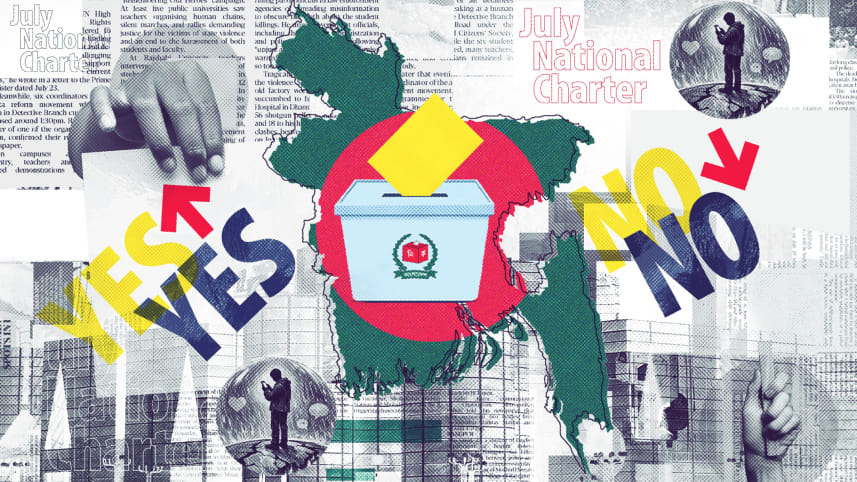
Following prolonged discussions between the National Consensus Commission (NCC) and various political parties on reforms in key state institutions, the July National Charter was signed on October 17, 2025. After the interim government assumed office in August 2024, six reform commissions were formed initially. Recommendations from five of these commissions—on constitutional reform, the electoral system, public administration, Anti-Corruption Commission, and judiciary—were distilled into 166 reform proposals.
In the first phase, the NCC held discussions with 32 political parties, followed by talks with 30 parties in the second phase. Through this process, the July charter was finalised with 84 reform proposals, many of them accompanied by notes of dissent from political parties. Several parties refrained from signing the charter, citing objections such as proposed changes to the fundamental principles of the constitution, failure to present an accurate historical context, a commitment not to challenge the charter in court, and the absence of clarity regarding the charter’s legal basis and implementation mechanisms.
 For all latest news, follow The Daily Star's Google News channel.
Areas where consensus was reached
The July charter contains a number of significant reform commitments on which participating political parties reached consensus. If the signatory parties implement these pledges upon assuming power, they could play an important role in Bangladesh’s democratic transition.
As part of the parliamentary reform, the charter proposes amending Article 70 of the constitution to allow members of parliament to vote independently on all matters except budgetary and confidence votes. The BNP supports this reform, albeit with conditions including constitutional amendments and exceptions related to national security or wartime situations. There is also consensus on limiting an individual’s tenure as prime minister to a maximum of 10 years, appointing opposition members as chairs of parliamentary standing committees (including the Public Accounts Committee) in proportion to their seats, and nominating an opposition MP as deputy speaker.
All political parties agreed on appointing the chief adviser of a non-partisan caretaker government through a five-member selection committee comprising the prime minister, leader of the opposition, and others. Similarly, the formation of the Election Commission would no longer depend solely on the prime minister’s preference; instead, election commissioners would be appointed through a five-member selection committee that would include the prime minister, leader of the opposition, and a judge of the Appellate Division.
The president would be granted authority to appoint key constitutional officeholders without the prime minister’s recommendation in certain cases, including appointments to the National Human Rights Commission, Information Commission, Bangladesh Press Council, and Law Commission. At the same time, the president’s discretionary power to grant pardons would be curtailed. Pardons would only be possible under legally defined principles and standards, and with the consent of the victim or the victim’s family.
To effectively separate the judiciary from the executive, the charter proposes establishing a separate secretariat for the Supreme Court and ensuring its financial autonomy. This secretariat would oversee the promotion, transfer, and discipline of subordinate court judges. Instead of appointing the chief justice at the prime minister’s discretion, the president would appoint the chief justice from the senior most judge or from the two most senior judges of the Appellate Division. There is also consensus on forming an independent Judicial Appointment Commission led by the chief justice.
On anti-corruption reforms, consensus includes abolishing the requirement for prior approval before filing cases against government employees, mandating annual public disclosure of income and assets by elected representatives and their family members, enacting beneficial ownership laws to curb corruption and money laundering, and introducing separate legislation to prevent conflicts of interest and abuse of state power.
Regarding police reform, political parties agreed to establish an independent police commission headed by a retired Appellate Division judge, tasked with investigating and resolving complaints against the police.
Consensus was reached—except by Jamaat-e-Islami—on granting financial autonomy to local governments and placing government officials under elected local representatives. All parties except Gano Forum and Nagorik Oikya agreed that local governments should have the authority to raise their own funds.
Areas without consensus
The Constitution Reform Commission had proposed forming a national constitutional council comprising representatives from the executive, judiciary, and legislature to ensure balance of power in key appointments, but it was dropped due to objections from the BNP and several other parties. Later, the National Consensus Commission suggested incorporating provisions in the constitution for appointing members of the Election Commission, Public Service Commission, Anti-Corruption Commission, Comptroller and Auditor General, and Ombudsman through selection committees. While there was consensus on EC appointments, several parties—including the BNP—dissented on applying this method to the other four institutions.
According to the existing constitution, the president is required to act on the advice of the prime minister in all matters except the appointment of the prime minister and the chief justice. Although the NCC initially proposed expanding presidential powers to appoint officials in 12 institutions, discussions ultimately narrowed this scope. The president would make appointments to the NHRC, Information Commission, press council, Law Commission, Bangladesh Bank governorship, and Bangladesh Energy Regulatory Commission (BERC) without the prime minister’s advice. However, the BNP and some other parties dissented on appointments to Bangladesh Bank and the BERC.
While there was agreement on establishing a bicameral parliament, consensus was not reached on the method of selecting members of the upper house. The Constitution Reform Commission proposed proportional representation based on vote share, but the BNP and others favoured allocating seats in proportion to lower house representation. The intended purpose of the upper house—to prevent absolute dominance by a single party in constitutional amendments and approval of major international treaties—would not be achieved if it simply mirrored the lower house. Notably, several parties, including the BNP, have also expressed dissent over the proposal that constitutional amendments and the ratification of international treaties should require approval from both chambers of parliament.
No consensus was reached on changing the fundamental principles of the constitution, with dissent expressed by Gano Forum, JSD, Bangladesh JASAD, CPB, BASAD, and BASAD (Marxist). Jamaat and several others objected to reforms related to local government autonomy, placing local officials under elected representatives, amending the Official Secrets Act, and recruiting teachers and doctors through separate service commissions.
The absence of women and representatives of religious and ethnic minorities in the NCC also shaped the charter’s limitations. Although there was agreement to gradually increase women’s representation in parliament to 100 seats, no decision was finalised—despite demands from the Women’s Affairs Reform Commission—on direct elections to reserved seats. There was partial consensus, with dissent, on requiring political parties to nominate at least five percent women candidates in the next general election and increasing this proportion by five percent in subsequent elections until reaching 33 percent. However, this provision will not be enshrined in the constitution.
What the July charter doesn’t include
Many important recommendations from the first-phase reform commissions were never discussed by the National Consensus Commission, and no effort was made to build political consensus around them. While the charter mentions expanding citizens’ fundamental rights, it does not specify which rights will be expanded or how. Instead, it states that detailed proposals will be outlined in the commission’s report.
Moreover, the NCC did not hold discussions on recommendations made by the second-phase reform commissions on labour, media, local government, women, and health. The heads of these commissions urged Chief Adviser Prof Muhammad Yunus to incorporate their recommendations into the July charter. They said in order to institutionalise democracy and build a new Bangladesh, reform initiatives in line with the recommendations of the second-phase commissions were equally essential. But no visible initiative was taken. Nor did the government clarify how these second-phase recommendations would be implemented, rendering their future uncertain.
The implementation order and referendum
On November 13, 2025, the interim government issued the July National Charter (Constitutional Reform) Implementation Order. Under this order, the parliamentary election and a referendum on the charter will be held on the same day. The referendum will be conducted on four constitutional reform proposals, and voters will be required to cast a single “Yes” or “No” vote on all four collectively.
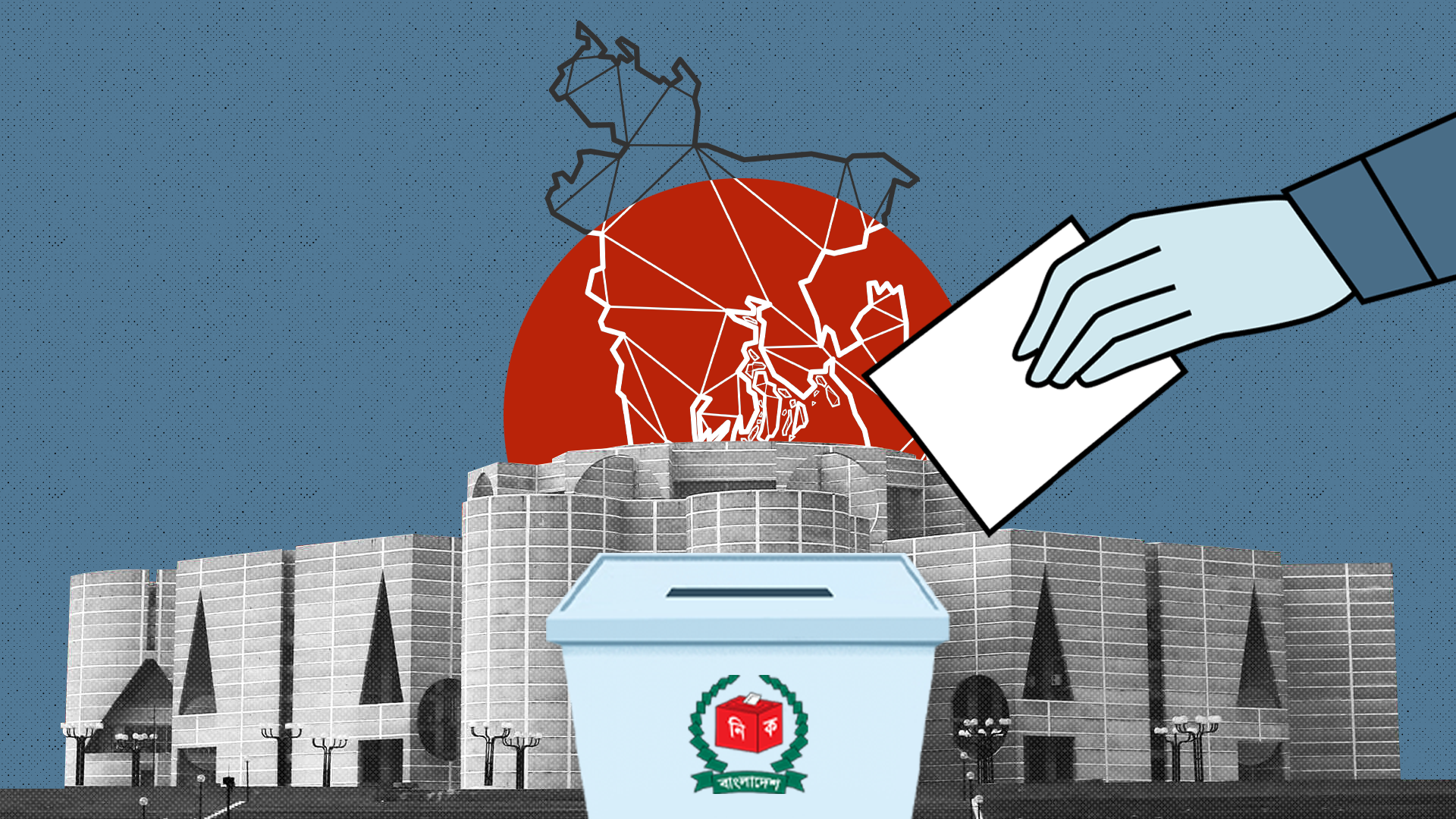
If the referendum passes, elected representatives will form a Constitutional Reform Council, serving concurrently as MPs. The council must complete constitutional reforms within 180 working days. Within 30 working days of completing the reforms, an upper house will be formed based on proportional representation of votes received in the parliamentary election.
Among the four proposals to be put to the referendum, the first states that the caretaker government, the Election Commission, and other constitutional bodies will be formed in accordance with the procedures described in the July charter. The second proposal states that a 100-member upper house will be formed in proportion to the votes received by political parties in the election. Any amendment to the constitution will require the majority approval of the upper house. The third proposal states that the political parties that win the next election will be bound to implement the 30 proposals on which consensus was reached in the July National Charter. The fourth proposal states that the remaining reforms described in the July charter will be implemented in accordance with the commitments made by the political parties.
It is noteworthy that the way the referendum proposal on the July charter has been framed allows some reforms to be implemented in line with the political parties’ notes of dissent, while other reforms do not allow for implementation based on notes of dissent. If the “Yes” vote prevails in the referendum, the reform proposals for which political parties’ notes of dissent will no longer remain effective include the formation of the caretaker government, EC, appointments to various constitutional offices, and the formation of the upper house through a PR system. This has been ensured through the first and second proposals of the referendum. For the remaining issues, the fourth proposal of the referendum states that political parties will be able to implement reforms in accordance with their respective notes of dissent or differing opinions.
This order for implementing the July National Charter may give rise to various complexities.
First, the referendum question included in the implementation order conflicts with the July charter that was signed. This is because the charter states that political parties would mention their notes of dissent in their election manifestos, seek public consent, and then act accordingly. However, the way the referendum proposal has been framed in the implementation order does not give due importance to political parties’ notes of dissent regarding the formation of the upper house, caretaker government, EC, and other constitutional bodies. If the “Yes” vote prevails in the referendum, an obligation will arise to implement the proposed reforms regarding the formation of the caretaker government, EC, and “other constitutional bodies” exactly as described by the National Consensus Commission in the July charter. Since it has not been clearly specified, complications may also arise regarding which bodies are meant by the term “other constitutional bodies.”
Second, if the outcome of discussions with political parties is disregarded and public opinion is sought directly, then the question arises: why should a referendum be held only on constitutional reform proposals? Why not hold a referendum on all the recommendations given by the 11 reform commissions?
Third, lengthy debates among political parties took place on constitutional reform proposals, yet consensus was not achieved on all issues. How reasonable is it, then, to ask the public to express their opinion with a single “Yes” or “No” on all these matters? Like political parties, ordinary citizens may agree on some issues and disagree on others. In that case, how can they express their views on all constitutional reform proposals with a single word? Moreover, has the public been adequately informed about all the positive and negative aspects of these reform proposals? Generally, referendums are held to seek public opinion on a constitution that has been adopted through majority voting after discussions and debates in a constituent assembly. Here, the exact opposite is being done: first holding a referendum and then asking the constitutional reform council to amend the constitution accordingly.
Fourth, by disregarding the political parties’ differing opinions on proportional representation in the upper house, formation of the caretaker government, and appointments to constitutional offices in the referendum question, the implementation of the entire July charter may be put at risk. This is because if a political party considers safeguarding these dissenting positions to be essential, it may campaign for a “No” vote against the entire referendum package. Since the referendum does not allow separate voting on the four proposals—even though there are four questions, there is only one answer—if any party disagrees strongly with even one proposal, it may be motivated to vote “No” for the entire referendum. By contrast, if the referendum had accommodated dissenting views, those parties would have voted “Yes” and would then have been bound to implement their respective promised reforms upon coming to power. Due to the interim government’s current referendum proposal, not only the dissenting proposals but also the implementation of the agreed-upon reform proposals may now fall into jeopardy. Even if the “Yes” vote prevails, the party or coalition forming the government after the election may refuse to implement certain reforms by citing their notes of dissent in the signed July charter, which could then create a different set of legal, constitutional and political complications.
How certain is implementation?
Even if the July National Charter secures popular approval through a referendum and gains the highest legal standing, its implementation will ultimately depend on the political will of future governments. Past experience offers little reassurance.
In 1990, during the anti-autocracy movement, three major political alliances published a joint roadmap promising free elections, independent state media, judicial independence, and protection of fundamental rights. None of these commitments were fully realised by subsequent governments.
There is no guarantee that the charter will not meet the same fate. Ensuring its implementation will, therefore, require vigilant oversight by political actors and civil society, alongside sustained pressure to enact reform recommendations excluded from the charter. Otherwise, as late Local Government Reform Commission Chair Prof Tofail Ahmed once warned, these reports may add little more than archival value to history.
Kallol Mustafa is an engineer and writer who focuses on power, energy, environment, and development economics. He can be reached at kallol_mustafa@yahoo.com.
Views expressed in this article are the author's own.
Follow The Daily Star Opinion on Facebook for the latest opinions, commentaries, and analyses by experts and professionals. To contribute your article or letter to The Daily Star Opinion, see our guidelines for submission.
Comments