


The NHRC ordinance saga: One step forward, two steps back


Bangladesh's rights watchdog, the National Human Rights Commission (NHRC), has been toothless and ineffective since its formation. Despite the violations of human rights at an alarming rate, ranging from extrajudicial killings and enforced disappearances to arbitrary detentions, custodial torture, and widespread suppression of dissent, the commission remained inactive and dysfunctional during the previous regimes. The legal loopholes, lack of independence and autonomy, limited mandate, and lack of enforcing authority, coupled with bureaucratic and political manipulations, made the body structurally weak and performative. The structural weakness and deliberate inaction of this rights watchdog helped the ousted regime to downplay the cases of human rights violations and to perpetuate oppressive rule while remaining unaccountable.
Last month, the interim government reformed the NHRC Act through an ordinance. The new law brings significant changes to make NHRC a strong, independent, and effective body. The updated law acknowledges Bangladesh's obligations under international human rights laws, broadens the legal mandate of NHRC, expands its investigative authority, stipulates remedial measures against human rights violations, introduces a national preventive mechanism to prevent cruel, inhuman, or degrading treatment, guarantees financial autonomy, and improves alignment with international standards like Paris Principles.
 For all latest news, follow The Daily Star's Google News channel.
 The law also widened the definition of human rights by including any human rights guaranteed under the constitution and laws of Bangladesh, and international human rights instruments ratified by Bangladesh, and those recognised by customary international human rights law consistent with the laws of Bangladesh.
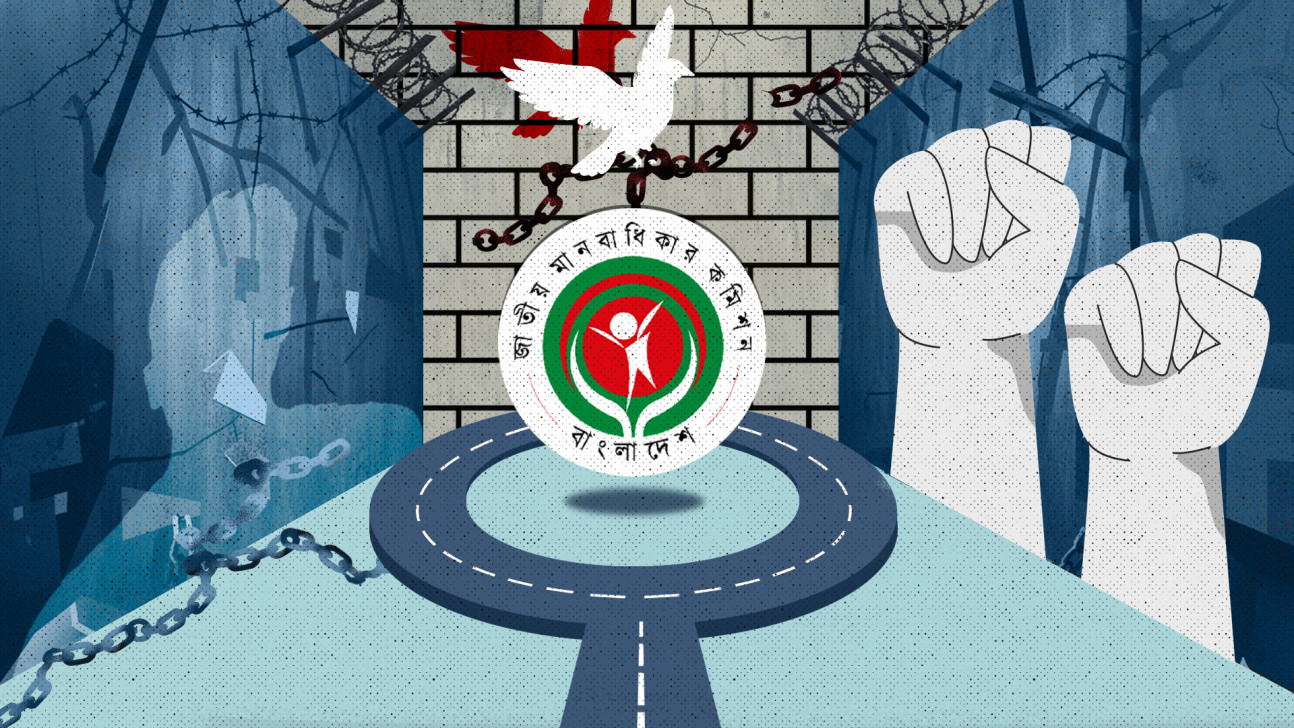
Under the ordinance, the commission shall be formed by one chairperson and four full-time members, out of whom one shall be from ethnic minorities or disadvantaged communities, and at least two will be women. The ordinance reformed the selection committee, which is entrusted to make recommendations on the appointment of the chairman and members of the NHRC. The committee shall be headed by an appellate division judge, nominated by the chief justice of Bangladesh. The other members of the committee will include two members of parliament, one from the ruling party and the other from the opposition party; one university professor with expertise in human rights; one human rights expert from civil society; one representative of ethnic minorities or underprivileged communities, and the president of the National Press Club. The inclusion of human rights experts, civil society members, and representatives from ethnic and disadvantaged communities makes a significant departure from the earlier selection committee.
While the interim government could be lauded for laying out a strong legislative framework for the NHRC, it is disappointing to note that within one month of passing the new law, the government has amended the ordinance to reinstate bureaucratic control on the selection committee. Transparency International Bangladesh (TIB) expressed deep concern that including the cabinet secretary on the selection committee of the NHRC undermines the commission's independence and credibility. The presence of a top-tier bureaucrat shall allow the government to exert undue influence over the formation of the commission, which is the same reason the commission has remained ineffective over the years.
The amended ordinance also replaces mandatory reporting of non-compliance with a permissive "may be informed" clause, jeopardising the potential this law aimed to deliver. This new arrangement not only implies dominant practices of reform-resistant bureaucrats but also weakens institutional autonomy and erodes public trust in the reform process.
It is equally frustrating that this rights watchdog body has remained dysfunctional for more than a year since the resignation of its chairman and members last year. This institutional vacuum allegedly enables the present government to claim compliance with reform while avoiding substantive scrutiny of recurring human rights violations. As per Ain o Salish Kendra (ASK), 29 people fell victim to extrajudicial killings and deaths due to torture in custody from January to November this year. During the period, 28 convicts and 55 under-trial prisoners died in jail. Reports indicate that the country witnessed a grim picture in terms of child abuse, violence against women, rising moral policing, arbitrary detentions, and mob violence this year. NHRC could play a significant role by addressing the above allegations of custodial death, cyber violence, disinformation, and increasing election-related human rights concerns and insecurities.
Apart from addressing human rights violations, NHRC, being inactive and dysfunctional, remains unable to perform its role in promoting compliance with international human rights obligations, including the implementation of UN treaty body recommendations and Universal Periodic Review (UPR) commitments. During the last UPR cycle (2023), Bangladesh received 301 UPR recommendations to improve its human rights record and comply with international obligations. However, the country fails to implement most of these recommendations, where NHRC could intervene.
The leadership vacuum in the NHRC not only indicates a strategy of inaction but also reinforces the need for an integrated roadmap for its institutional capacity development. While the interim government revised the NHRC law, it failed to provide a roadmap to implement it through a coherent institutional capacity development programme. A law may create pathways for a transformative beginning, but without accompanying strong institutional structure, capacity, and financial and administrative autonomy, the law remains performative. Frustratingly, this institutional paralysis, along with governance inertia, has continued even during the tenure of the interim government. A functional NHRC during the interim government could set a precedent on how an independent and effective watchdog body acts without influence and holds authorities accountable, and how the government responds democratically and lawfully. Unfortunately, this opportunity has been wasted.
The failure of NHRC is deeply rooted in systematic institutional weakness, bureaucratic inertia, and political instrumentalisation. In a political regime that does not fully internalise democratic and rights-based norms, institutional design and practice are highly influenced by the imperative of regime stability. This dominant logic of governance that prioritises regime stability over institutional accountability needs to be challenged and reoriented.
The July uprising created an opportunity for political reimagination and institutional renewal. The reenvisioned political compulsions centred on democratic accountability, rights, and institutional autonomy, as aspired by the reform agenda of the July National Charter, are instrumental in making NHRC an effective rights watchdog, capable of transcending political and bureaucratic manipulations.
Mohammad Golam Sarwar, a Chevening and Commonwealth scholar, is PhD researcher in law and alternative development at SOAS, University of London. He is also an assistant professor (on study leave) in the Department of Law at the University of Dhaka.
Views expressed in this article are the author's own.
Follow The Daily Star Opinion on Facebook for the latest opinions, commentaries, and analyses by experts and professionals. To contribute your article or letter to The Daily Star Opinion, see our guidelines for submission.
Comments