


Think twice before forcing a third language on school students

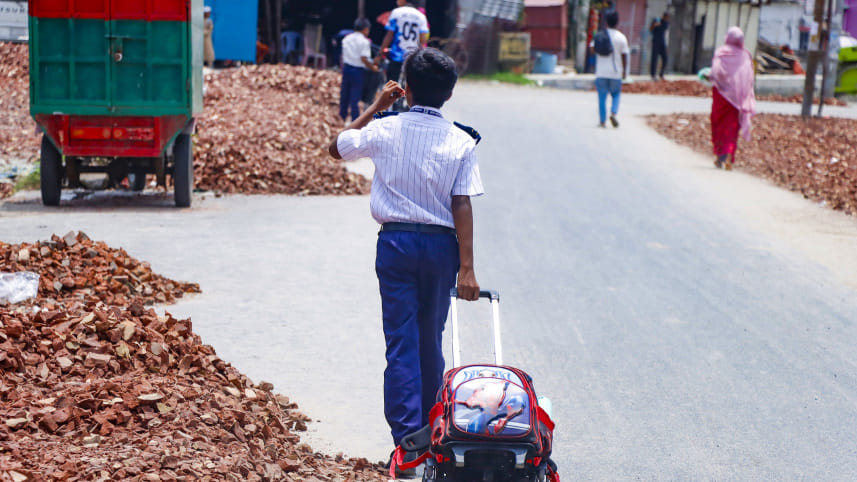
The education ministry, under the new government, has recently introduced a 12-point reform plan to update the national curriculum. It contains a few recommendations worth noting. Raising the education budget to five percent of GDP, for instance, is a commendable and long-overdue move. However, the agenda also reveals a concerning dilemma in terms of its priorities. For instance, it makes learning a third language compulsory at the secondary level.
Now, learning a new language is undeniably a positive thing. It can help students connect to the world better and even widen their scope of employment to include non-English-speaking countries. But cramming a third language into the national curriculum is a puzzling move considering our current educational crisis. For one, it is a massive cognitive burden on students who are currently struggling to master even their mother tongue. A study by the National Academy for Primary Education shows that a staggering 79 percent of third-graders lack basic skills in reading, writing, and understanding Bangla. Furthermore, over 42 percent of the population has reading skills below the fifth-grade level.
 For all latest news, follow The Daily Star's Google News channel.
 So making it compulsory for students to memorise the vocabulary of another foreign language beyond English may only worsen the culture of rote memorisation, which this government has explicitly promised to eliminate.
Furthermore, the idea that children must learn foreign languages in school to be globally competitive is also outdated. If the goal is workplace communication, targeted language courses for adults are sufficient enough. According to one study, even a one-week intensive course significantly boosts an adult’s focus and executive function. So, once they identify a real career need for it, an adult can easily pick up a specific language in a focused six-month course.
In contrast, the complex thinking required for problem-solving and cultural empathy (skills that most students lack) cannot be crammed into a six-month corporate seminar. Artistic thinking, too, is a massive, compounding learning process that must be nurtured throughout a child’s entire upbringing. Making art and music optional while making third language classes compulsory could eventually affect us as a nation.
Bangladesh is fast approaching the middle-income trap. Our industrial backbone, the readymade garments sector, makes up over 80 percent of our exports but remains stuck in basic manufacturing models. Foreign buyers hold all the creative and pricing power, leaving our factories to compete solely on cheap labour. In order to capture real value and increase profit margins, we should transition to designing our own products. But this is impossible to do without a workforce trained in aesthetic principles, spatial reasoning, and industrial design. Our nationwide “design deficit” ensures that we remain the executors of foreign ideas rather than the creators of our own.
Beyond the economy, art education on a national level is vital for raising better citizens and improving our Human Development Index. Cultural and creative industries drive sustainable growth and empower populations. Arts education can also improve academic writing and boost compassion for others. Furthermore, music and art are vital components for ensuring good mental health.
When we systematically deprive a population of aesthetic education, we create a nationwide culture of “artlessness.” This deficit shows up brutally in our physical environments. We see it in the messy sprawl of our megacities, where poor urban planning ruins the visual identity of our infrastructure and turns them into concrete jungles of chaos. Civic aesthetics—that is, the moral duty to keep shared spaces clean, follow traffic laws, and behave cordially—is not a natural trait, and is best taught through the humanities and arts. Societies that take aesthetics seriously usually produce citizens who view public pollution as a personal, even moral, failure.
Knowing a foreign language is a valuable asset for the modern worker, but it is largely a practical tool. Art, music, literature, and design, however, are the soil from which civilisation, innovation, and empathy grow. If the government truly wants education to be a nation-building project, it must resolve this flaw in its agenda. Policymakers need to recognise that an appreciation for beauty, a talent for original design, and a compassionate civic outlook are not elite privileges. They are the mass prerequisites for a prosperous and peaceful Bangladesh.
Benzir Ahammed Shawon is a computer engineer and a graduate student of Applied Mathematics and Computational Science at North South University. He can be reached at write.benzir@gmail.com.
Views expressed in this article are the author's own.
Follow The Daily Star Opinion on Facebook for the latest opinions, commentaries, and analyses by experts and professionals. To contribute your article or letter to The Daily Star Opinion, see our guidelines for submission.




Comments