


Restoring public confidence in the judiciary is a test for the government
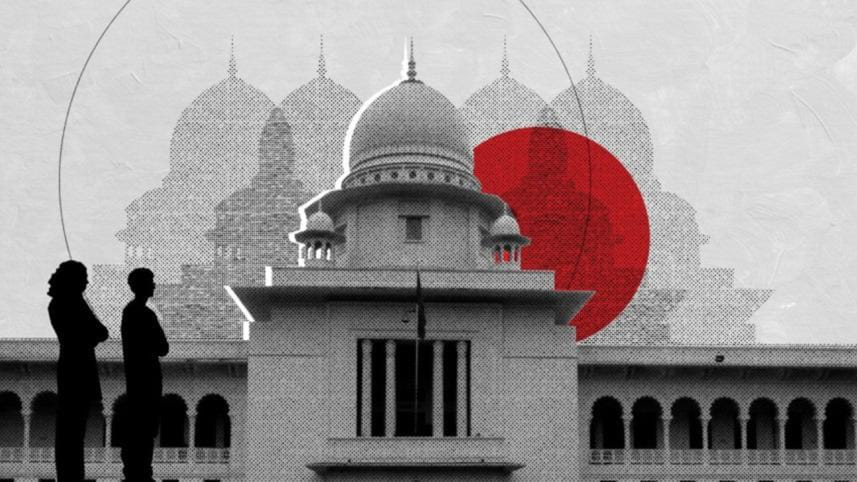
With a resounding two-thirds parliamentary majority, Bangladesh’s new government assumes office with formidable expectations. Chief among them is the restoration of public confidence in a justice system that, for many citizens, has come to evoke anxiety rather than assurance.
In the decades following independence, the country’s higher judiciary was widely regarded as a constitutional sentinel. Landmark judgments strengthened the separation of powers, defended fundamental rights, and articulated doctrines intended to restrain executive overreach. The Supreme Court in Dhaka came to be viewed as a symbol of republican promise: that power would answer to law, not the other way round. Even amid political upheaval, there were moments when judges asserted autonomy with quiet resolve, reinforcing the belief that the courts could stand apart from partisan contests.
 For all latest news, follow The Daily Star's Google News channel.
 That inheritance has been severely strained under the government of Sheikh Hasina. What began as decisive political consolidation after a landslide victory in 2008 gradually hardened into a centralisation of authority in which legal mechanisms were increasingly perceived as instruments of control. Human rights organisations, opposition leaders and sections of the legal profession have long alleged that criminal law and procedural devices were deployed to weaken political rivals. Opposition figures often found themselves facing multiple cases across different districts at once, ensuring a carousel of court appearances, bail hearings, and procedural adjournments. Even in the absence of conviction, the burden of process—financial, reputational, and psychological—proved punitive. In such circumstances, the journey through the system became a sentence by itself.
The scale of arrests during periods of political tension compounded these concerns. At various junctures, particularly ahead of elections or mass demonstrations, thousands of opposition activists were detained. Charges frequently invoked public order or security provisions framed in broad terms. Families and defence lawyers spoke of “ghost cases” in which unnamed accused persons were subsequently identified as opposition supporters. Bail, critics argued, was inconsistently granted and pre-trial detention sometimes appeared to function as a means of deterrence rather than a strictly necessary safeguard, whereas government officials maintained that firm measures were required to preserve stability in a combustible political environment often marked by street confrontation. Bangladesh’s political culture has rarely been placid. But the cumulative effect of mass arrests, contested prosecutions, and the visible entanglement of political conflict with courtroom proceedings has led to a steady erosion of public trust.
In any democracy, the line between legitimate prosecution and political litigation depends not only on statutory authority but on credibility. When a substantial segment of the electorate believes that legal proceedings are calibrated to sideline opponents, the moral force of verdicts weakens—whatever their technical merit.
Doubts were further amplified by concerns over judicial appointments and administration. Critics argued that postings and promotions within parts of the judiciary reflected partisan proximity rather than professional distinction. Senior members of the bar warned of the chilling effect that executive influence—or even the perception of it—can have on judicial independence. Over time, the distinction between accommodation and autonomy appeared blurred. For ordinary citizens, the implications were not confined to high-profile political trials. Civil disputes languished. Criminal cases drifted through endless adjournments. Backlogs swelled. The impression took hold of a system capable of swift action when political stakes were high, yet paralysed when everyday litigants sought redress.
Courts rely on legitimacy, not coercion, and their authority depends on the belief that decisions are impartial. When that faith falters, compliance weakens and social cohesion suffers.
The newly elected government has inherited not only the institutional issues but also this legacy of scepticism. Restoring trust, therefore, will require confronting the past candidly. Laws that enabled mass arrests and broad prosecutorial discretion, particularly under the guise of national security or digital regulation, must be carefully reviewed and refined to prevent abuse. Judicial appointments and disciplinary mechanisms need to be insulated from partisan influence. Cases widely perceived as politically motivated may warrant principled review to ensure fairness. Crucially, political leaders must exercise restraint: public commentary on ongoing cases or pressuring of investigators erodes confidence. Institutional culture evolves slowly, but leadership that respects boundaries can accelerate sustainable reform.
Restoring trust will not be accomplished through speeches or legislative arithmetic. It will emerge incrementally, case by case, as citizens observe whether the law is applied consistently regardless of political affiliation. Independence cannot be proclaimed; it must be practised. A two-thirds majority in parliament can make or amend statutes with ease but it cannot compel public belief. That must be earned through visible fairness, procedural rigour, and a demonstrable departure from the patterns that have led many in Bangladesh to question whether justice was blind, or merely blindfolded depending on the circumstance.
If the new government succeeds in disentangling law from partisanship, it will do more than rehabilitate an institution. It will revive the foundational promise of Bangladesh: that power is subordinate to principle, and that courts exist not to shield the powerful but to protect the rights of all. For a country long harbouring democratic aspirations, the next chapter will be written on the steady, unglamorous work of restoring faith in justice. Whether those courtrooms can once again command trust may prove the defining test of Bangladesh’s democratic resilience.
Md. Arifujjaman is additional district judge at Solicitor Wing of the Law and Justice Division at the Ministry of Law, Justice and Parliamentary Affairs. He can be reached at arifujjaman.md@gmail.com.
Views expressed in this article are the author's own.
Follow The Daily Star Opinion on Facebook for the latest opinions, commentaries, and analyses by experts and professionals. To contribute your article or letter to The Daily Star Opinion, see our guidelines for submission.
Comments