


A year of living dangerously
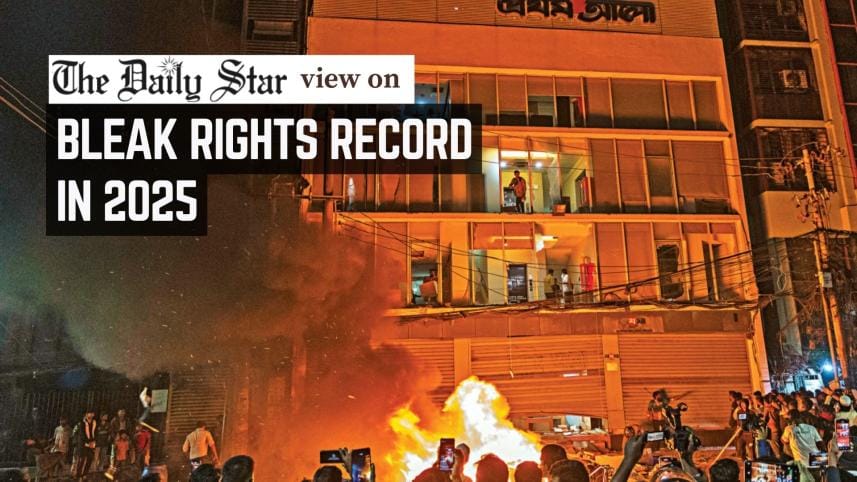
It is disheartening that what began as a year of political transition has ended in a grim tableau of lawlessness. Two rights organisations have described the situation as "unstable and deeply concerning," a verdict borne out most starkly by a surge in lynchings and mob violence. Ain o Salish Kendra (ASK) recorded at least 197 deaths in mob attacks in 2025, up from 128 the previous year. Manabadhikar Shongskriti Foundation (MSF) puts the number of deaths from lynchings at 166. The victims of mob violence cut across society—men and women, members of religious minorities, and even freedom fighters—and the trend seemed to intensify as the year wore on.
On December 18, for instance, a mob in Mymensingh beat a garment worker, Dipu Chandra Das, before burning him to death over unproven allegations of blasphemy. Around the same time in Dhaka, mobs looted and torched the offices of The Daily Star and Prothom Alo. It feels distant now that, following the bloody uprising in 2024, people expected the interim government to restore order. Instead, targeted repression by the previous regime has been replaced by the chaotic tyranny of the street. Mobs have vandalised statues, harassed women, and attacked cultural institutions. Hindu homes and temples have also been targeted. The streets have grown unruly, while law enforcement was absent in many cases.
 For all latest news, follow The Daily Star's Google News channel.
Election-related violence has added another dimension. After the election schedule was announced, MSF documented 26 incidents linked to nominations and campaigning, leaving three people dead and 249 injured. In one chilling episode, Sharif Osman Hadi, a leader of Inqilab Moncho and a potential candidate in the Dhaka-8 constituency, was shot dead in a daylight attack. Alongside this breakdown, another disturbing pattern persists. ASK documented 38 extrajudicial killings in 2025, all reportedly occurring during so-called "crossfire" or "gunfights" while suspects were in custody. At least 116 inmates died in prison, with most deaths officially attributed to illness, although cases of suicide, torture, and unexplained fatalities were also reported. Perhaps most chilling is the discovery of 641 unidentified bodies, many found bound with tape and dumped by roadsides or in rivers.
Press freedom—often the first casualty of disorder in Bangladesh—has also been suffocating. Beyond the arson attacks on media offices, three journalists were killed during the year, and nearly 400 others were harassed or abused. MSF cited the continued abuse of laws to intimidate and silence reporters.

As we have said before, the interim administration cannot simply wait out the clock. It must work proactively to ensure that peace in the run-up to the February election is not marred by chaos. If it can hold the line, the post-election period may, we hope, serve as a circuit-breaker to prevent violence from becoming a permanent feature of our national life; a government elected with a genuine mandate could muster the authority needed to rein in mobs and dismantle the culture of impunity. That is perhaps the narrow path out of this morass.
Comments