


Female migration declines amid abuse, unsafe conditions

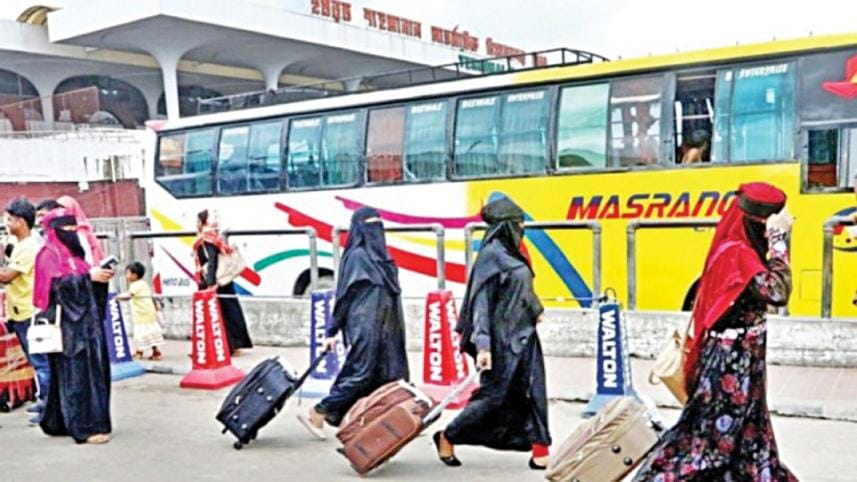
The migration of female workers abroad has been gradually declining over the last four years due to multiple problems, including the lack of exploration of new labour markets, unsafe working conditions, and abuse in destination countries.
Most of them travel to Saudi Arabia, the United Arab Emirates, Oman, Jordan, and Lebanon, where they mainly work as housemaids or garment workers.
 For all latest news, follow The Daily Star's Google News channel.
 According to the Bureau of Manpower, Employment and Training (BMET), 40,088 women have migrated by September this year. Last year, 61,158 women went abroad, while the figure was 76,108 in 2023 and 105,466 in 2022.
Before the Covid-19 pandemic, over 100,000 women migrated each year, according to BMET data.
Experts say women are increasingly discouraged from working abroad. Many see their dreams of a better life shattered due to abuse, lack of medical care, forced prostitution, long working hours, insufficient food, and sexual harassment.
Tuly Akhter (pseudonym), a resident of Khulna,
spent Tk 1.5 lakh from her savings to reach the UAE, hoping to earn a better income as a housemaid. However, her dreams soon turned into a nightmare.
Upon arrival in Abu Dhabi, she was taken to the Howard Johnson Hotel in Ajman, operated by Bangladeshis Sayem and Payel, also known as Ranu.
With the help of Payel's mother, Tuly was trafficked into forced prostitution. She recently returned to Bangladesh with the assistance of an NGO.
Tuly is not alone. Many women face similar challenges and are forced to return to escape abuse and unsafe conditions.
BMET receives numerous complaints from returning female workers every year.
A recent study by the Ovibashi Karmi Unnayan Programme, titled "A Far Cry from Justice for Migrant Workers," also highlights the widespread abuse and violence faced by women abroad.
The study found that 94 percent of returning women experienced regular physical and mental abuse. Forty-seven percent reported sexual harassment, while 97 percent were denied medical care.
Eighty percent did not receive enough food, and 82 percent worked from early morning until midnight. Fifteen percent were locked in rooms without food or water, and 97 percent were denied weekly leave.
Most female workers did not receive employment contracts before leaving Bangladesh.
BRAC has reported assisting over 100 returnee workers over the last six years, most of whom are women. These workers suffered physical, mental, or sexual abuse, and many experienced severe trauma due to overwork and low pay.
According to the Wage Earners' Welfare Board, the bodies of 412 female migrant workers were returned over the last five years since 2021, with 84 of them having died by suicide.
From 2017 to 2022, 69 percent of female workers' deaths were officially reported as natural. However, 48 percent of families do not trust the reports, according to the Refugee and Migratory Movements Research Unit.
Migration and refugee expert Asif Munier said women are not adequately prepared to compete abroad, so most of them work as domestic help or garment workers.
"Society still views female migrants negatively. Most female migrants are unskilled, which limits their opportunities. The government has not provided sufficient training or explored new labour markets. As a result, the number of women going abroad continues to decline," he added.
Shariful Hasan, associate director at BRAC Migration Programme and BRAC Youth Platform, said socially and economically vulnerable women mainly go to Saudi Arabia to work as housemaids.
Instead of improving their situation, their vulnerabilities increase due to abuse and torture. Many women even die by suicide as a result, he added.
Other countries, including Indonesia, have addressed the safety of their female migrant workers.
"They train women in caregiving and nursing, helping them move away from unskilled domestic work. Bangladesh has not yet taken any such steps," he said, adding that the government must focus on skill development for women.
"Only skilled women can migrate safely and obtain opportunities abroad to improve their fortunes."
Comments