


The investment climate: a long view


The famous British economist John Maynard Keynes once said, “The economist must study the present, in the light of the past, for the purposes of the future”. Thus, as we analyse the current economic situation to suggest a pathway for the future, we seek guidance from history.
Let us go back to the beginnings of the Daily Star. Established by the eminent journalist Syed Mohammad Ali, known to many simply as S.M. Ali, the Daily Star hit the newsstands for the first time in January 1991.
 For all latest news, follow The Daily Star's Google News channel.
 Globally, it was a time of momentous transition. The Berlin Wall had fallen in November 1989, and on Christmas Day 1991, about a year after the Daily Star was established, the Soviet hammer and sickle flag was lowered for the last time over the Kremlin.
This heralded the beginning of one of the most momentous economic experiments in recent times - the transition from a socialist to a market economy in large parts of Europe and Central Asia. But an even more far-reaching development had already commenced. China had started liberalising its economy in the late 1970s and, in 1986,had applied for membership to the GATT. This eventually led to China’s joining the WTO, the successor to the GATT, in 2001. This ushered in an unprecedented era of globalisation with significant implications for Bangladesh.
Changes were happening in Bangladesh’s neighborhood too. One day in July 1991, Manmohan Singh, India’s then finance minister, stood in the grand building designed by Edwin Lutyens to present to the Indian parliament a special budget. It announced a set of bold liberalising measures that brought transformational change to the Indian economy.
Daily Star’s arrival also coincided with a transitional moment for Bangladesh. A decade-long autocratic rule had just ended, and the country was on the cusp of a democratic transition. With the democratic transition also came a series of economic reform measures that helped create a conducive investment climate and increased business confidence. These reforms created a pivotal moment in the economic transformation of Bangladesh. It consolidated the shift, initiated in the late 1970s, from a predominantly public sector-driven economy to a more liberalised and private sector-oriented one.
Bangladesh’s first major agenda was to enhance food security by raising rice production through the widespread use of HYV rice, including the spread of a third rice crop, i.e., boro. The government initially relied on a public sector model of distributing the necessary inputs to farmers. But concerned about the inefficiency and corruption associated with this model, the government started liberalizing the agricultural input market in the early 1980s, with more substantial reforms happening in the late 1980s and early 1990s.
In the industry, the government began to open space for private investment, moving away from the public-sector dominance ushered in by a pervasive nationalisation policy in 1972. This shift gained momentum in the early 1980s with substantial privatisation efforts and deregulation, including easing licensing requirements for new industries. Innovative policies such as back-to-back letters of credit and bonded warehouse systems boosted the nascent garment industry, while the 1982 Drug Policy fostered growth in the local pharmaceutical sector.
However, more comprehensive measures were required. The 1990s marked a pivotal decade with major reforms, including the introduction of the value-added tax (VAT) and reforms in import tariffs. The government was initially hesitant to reduce tariffs due to fears of losing revenue and hurting domestic firms unable to compete with imports. However, an increase in tax revenues following the introduction of the VAT in 1991 alleviated the revenue concerns, and bold tariff reforms were carried out in the early 1990s, creating a more open trade regime. This boosted the industry by making it easier and cheaper to import capital machinery and other inputs.
Another significant development was the opening of sectors traditionally under government control, aligning with global trends in developing economies. In 1989, Bangladesh allowed private provision of mobile telephony, initially as a monopoly, but later introduced competition through licensing of three additional providers in the second half of the 1990s. In the power sector, the 1996 Private Sector Power Generation Policy led to the commissioning of the first private power plant in 1998.
These reforms helped increase business confidence, which also got a boost from a growing economy and the associated increase in demand. Significant increases in remittance inflows and export earnings, which increased 2.5 times and 3.5 times, respectively, during the 1990s, also helped. The pace of structural reforms slowed in the 2000s as the focus shifted toward infrastructure development, including expanding power generation capacity, establishing economic zones, and investing in transport infrastructure.
Some reforms did happen, though. By the early 2000s, the limitations of a fixed exchange rate system became evident, prompting Bangladesh to adopt a managed float system after establishing risk management mechanisms to handle currency volatility. In the mobile telecoms sector, the rules of the game were further clarified through the separation of the regulatory and policy functions of the government in the early 2000s. Mobile financial services were introduced a decade later, in 2011. However, efforts to reform the VAT regime faced opposition, stalling progress, while governance issues in the financial sector worsened. In the infrastructure sector, impressive progress was dented by corruption and cost escalations.
Overall, Bangladesh’s economic reforms from the 1980s to the early 21st century reflect a steady, albeit gradual, transition toward a more open, market-oriented economy. At the same time challenges in governance and implementation remain and, in many cases, have worsened. Entrepreneurship has indeed blossomed thanks to the reforms. But businesses in Bangladesh continue to face a wide range of obstacles. Many firms struggle to get the basic inputs they need, such as finance, raw materials, skilled workers, or reliable electricity. Across the board, businesses often get stuck dealing with complicated laws and regulations, and inconsistent enforcement. Infrastructure is also a problem. Roads, rail lines and ports are deficient in many ways. As a result, transport is slow and expensive. This is a particularly serious problem for export-oriented firms, which are also handicapped by inadequate services such as insurance, logistics, quality assurance labs, and training.
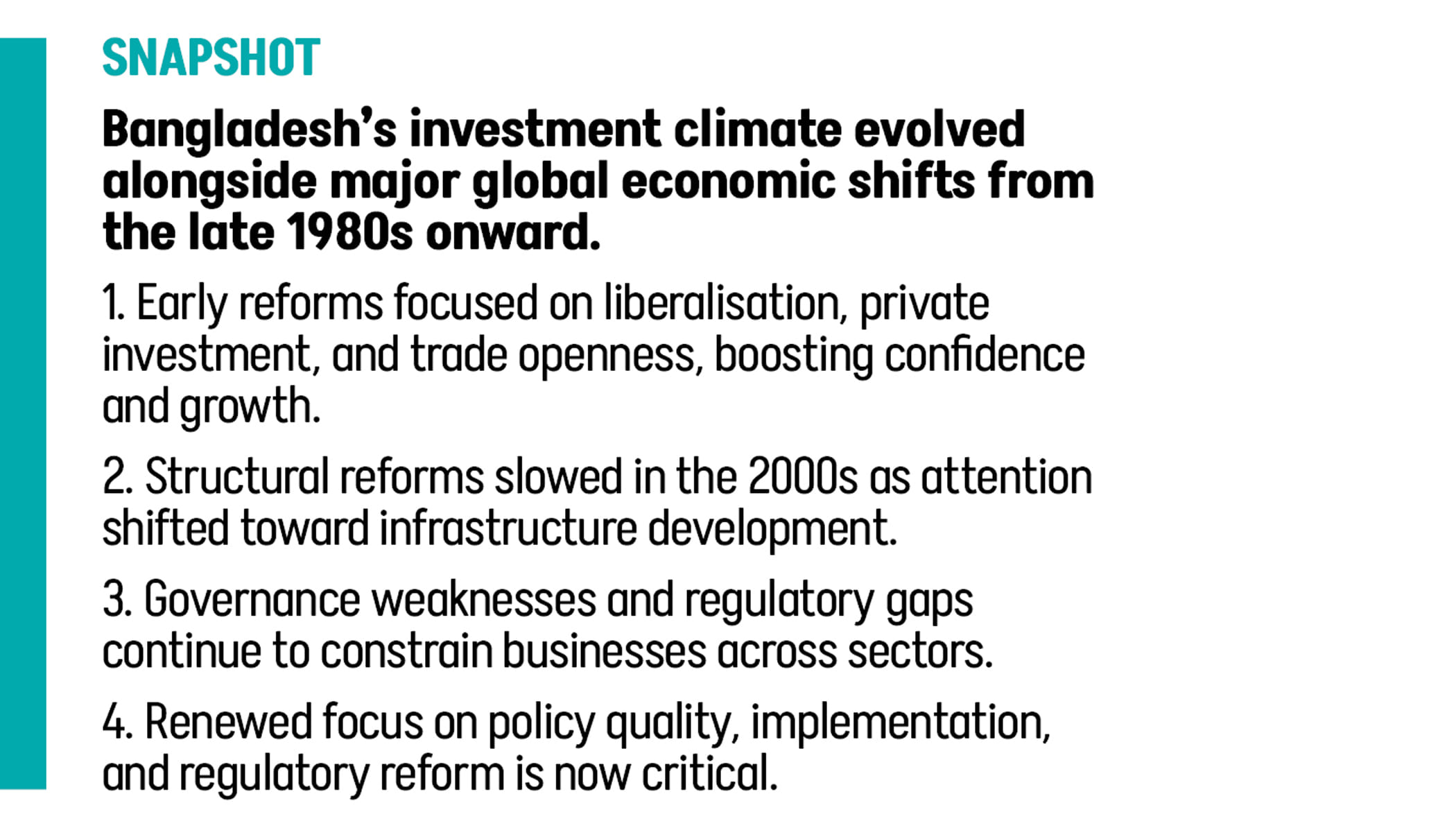
In summary, the problems with the investment climate are pervasive but the nature or intensity of the constraints often vary by firm type. This means that while many actions will be cross-cutting, some will be targeted at specific firm types, such as small enterprises or export-oriented firms.
As mentioned above, the focus of the earlier period, i.e., till roughly the turn of the century, was largely on the software side (policy reforms), with the important exception of the rural road expansion and construction of EPZs in the late 1980s and the 1990s. By contrast, the later period focused more on hardware (infrastructure building).
The time has come to focus once again on the software side while the effort to build efficient infrastructure and logistics continues. In the interest of space, I shall focus on two topics: one general (overall management of investment climate reforms) and one specific (regulatory governance).
Improving the investment climate starts with better policymaking. The government needs stronger capacity to design and implement reforms, and it should work more closely with the private sector to understand real-world problems. Regular dialogue—through structured meetings, sector-based forums, and periodic surveys—can help build trust and ensure that reforms reflect business needs.But having good policies on paper is only half the job. Implementation is often where things fall apart. A results-focused approach, with clear monitoring and feedback, can help turn plans into real improvements. And coordination across government agencies is essential. When responsibilities overlap or agencies don’t communicate, processes slow down, businesses get confused, and investment suffers.

Illustration: Adrin Sarwar
Regulations exist to set clear rules for businesses, making sure profit-making doesn’t come at the cost of public interests—whether it’s environmental protection, product quality, worker safety, or fair wages. Good regulations give businesses clarity, support innovation, and help the economy grow. But for regulations to work well, they must be relevant, easy to understand, and properly enforced. In Bangladesh, many rules are outdated, overlapping, or badly administered. This makes compliance costly and opens doors for harassment—problems that hold businesses back.
At the same time, some areas don’t have rules at all. In a fast-changing technological world, these regulatory gaps can cause confusion and missed opportunities. The early uncertainty about how to regulate Uber in Bangladesh is a good example of why new business models need clear and forward-looking rules. While some reforms have happened, the pace of regulatory modernisation is still too slow compared to technological change. This reactive approach makes it harder for Bangladesh to compete in the global digital economy.
To address this, a central regulatory reform body could play a vital role. Its job would be to track technological trends, identify gaps in existing regulations, study what other countries are doing, and develop a long-term strategy for updating Bangladesh’s laws. It could also review current rules, create an inventory of regulations, and recommend what needs to be changed or removed. Introducing regulatory impact assessments—used in many countries—would help evaluate costs and benefits before new rules are introduced. Line ministries would get training and technical help, making regulatory reform more coordinated and proactive. Countries like South Korea, Mexico, and the UK already use such central agencies effectively. The time has come for Bangladesh to follow their path.
Syed Akhtar Mahmood is an economist and author with three decades of experience in global investment-climate policy and regulatory reform. He is also an economist and author. Formerly with the World Bank, he has worked for three decades on investment climate reforms across the globe. He was a member of the government’s Task Force on Economic Re-strategising and serves on the Economic Advisory Council of the US government’s Millennium Challenge Corporation.
Comments