


Rohingya Genocide: ICJ begins hearings on case today
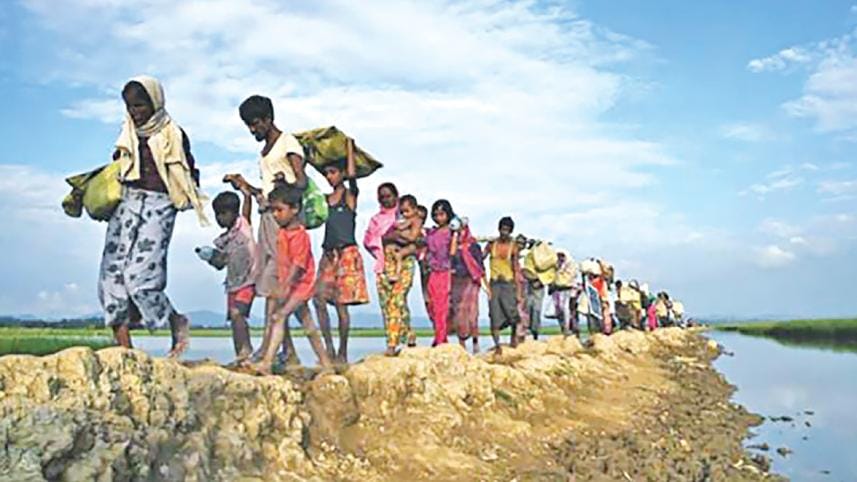
The International Court of Justice will today begin public hearings in the case concerning Rohingya genocide, bringing renewed hope of ending decades-long suffering of the ethnic people denied of citizenship.
The public hearings at the ICJ in The Hague, Netherlands, will continue until January 29, according to a press statement.
 For all latest news, follow The Daily Star's Google News channel.
 “The hearings will be devoted to the merits of the case and will include the examination of witnesses and an expert called by the parties,” it said.
“Seeing Gambia’s landmark case against Myanmar finally enter the merits phase delivers renewed hope to Rohingya that our decades-long suffering may finally end,” said Wai Wai Nu, founder and executive director of the Women’s Peace Network, in a joint statement issued by the Human Rights Watch.
“Amid ongoing violations against the Rohingya, the world must stand firm in the pursuit of justice and a path toward ending impunity in Myanmar and restoring our rights,” Nu said.
On November 11, 2019, The Gambia filed the Rohingya genocide case against Myanmar with the ICJ.
In 2017, about 750,000 Rohingya citizens fled a military crackdown in Myanmar and took shelter in Bangladesh.
In its application, The Gambia alleged that Myanmar breached its obligations under the Genocide Convention and that it must cease forthwith any internationally wrongful act and perform the obligations of reparation in the interest of the victims of genocidal acts.
As a basis for the ICJ’s jurisdiction, the applicant invokes Article IX of the Genocide Convention. The application was accompanied by a request for the indication of provisional measures.
On January 23, 2020, the ICJ made an order indicating a number of provisional measures addressed to Myanmar.
Following the filing by The Gambia of its memorial, Myanmar raised preliminary objections to the jurisdiction of the ICJ and to the admissibility of the application.
By its judgement of July 22, 2022, the ICJ found that it has jurisdiction, on the basis of Article IX of the Genocide Convention, to entertain The Gambia’s application.
Subsequently, Myanmar filed its counter-memorial. The Gambia and Myanmar then filed a reply and a rejoinder, respectively.
Declarations of intervention under Article 63 of the Statute of the ICJ were filed by Canada, Denmark, France, Germany, the Netherlands and the United Kingdom (jointly), the Maldives, Slovenia, the Democratic Republic of the Congo, Belgium and Ireland.
The ICJ found these declarations admissible.
Human Rights Watch in a statement said the Myanmar military has long subjected the Rohingya people to various atrocities, including the ongoing crimes against humanity of apartheid, persecution, and deprivation of liberty.
Since late 2023, Rohingya civilians have been caught in the fighting between the junta and the Arakan Army, an ethnic armed group. Both sides have carried out grave abuses, including extrajudicial killings, widespread arson, and unlawful recruitment.
“The Myanmar military’s vicious cycles of abuses and impunity need to end,” said Shayna Bauchner, Asia researcher at Human Rights Watch.
“This should begin with governments holding the junta to its legal obligation to comply with the ICJ-ordered provisional measures.”
Comments