


Next govt must tackle poverty, wage freeze

With the national election less than a month away, political parties are finalising their manifestos. The Daily Star spoke to economists to identify the pressing issues that should top the agenda for parties.
Two years ago, Mahbubur Rahman, a resident of Savar, worked in a garment factory on the outskirts of Dhaka. Following a prolonged illness, he was forced to leave his job and now struggles to support his wife and two daughters on meagre wages by working as a nursery labourer.
 For all latest news, follow The Daily Star's Google News channel.
 Mahbubur, who completed secondary education, represents the fragile reality of the labour force. While he remains hopeful that the upcoming election will stabilise the industrial sector and allow him to return to factory work, his descent from formal employment to precarious survival illustrates a trend that leading economists recommend must take centre stage in political manifestos ahead of the February election.
Economists argue that without a roadmap for redistributive justice and job creation, the widening economic divide threatens to undermine social stability.
Since the 1980s, Bangladesh has been a model for poverty reduction, but post-pandemic economic shocks and high inflation have reversed these gains.
According to new estimates by the Power and Participation Research Centre, the poverty rate climbed to 27.93 percent in mid-2025 from 18.7 percent in 2022.
Mustafizur Rahman, a distinguished fellow at the Centre for Policy Dialogue (CPD), described the trend as “very worrying”.
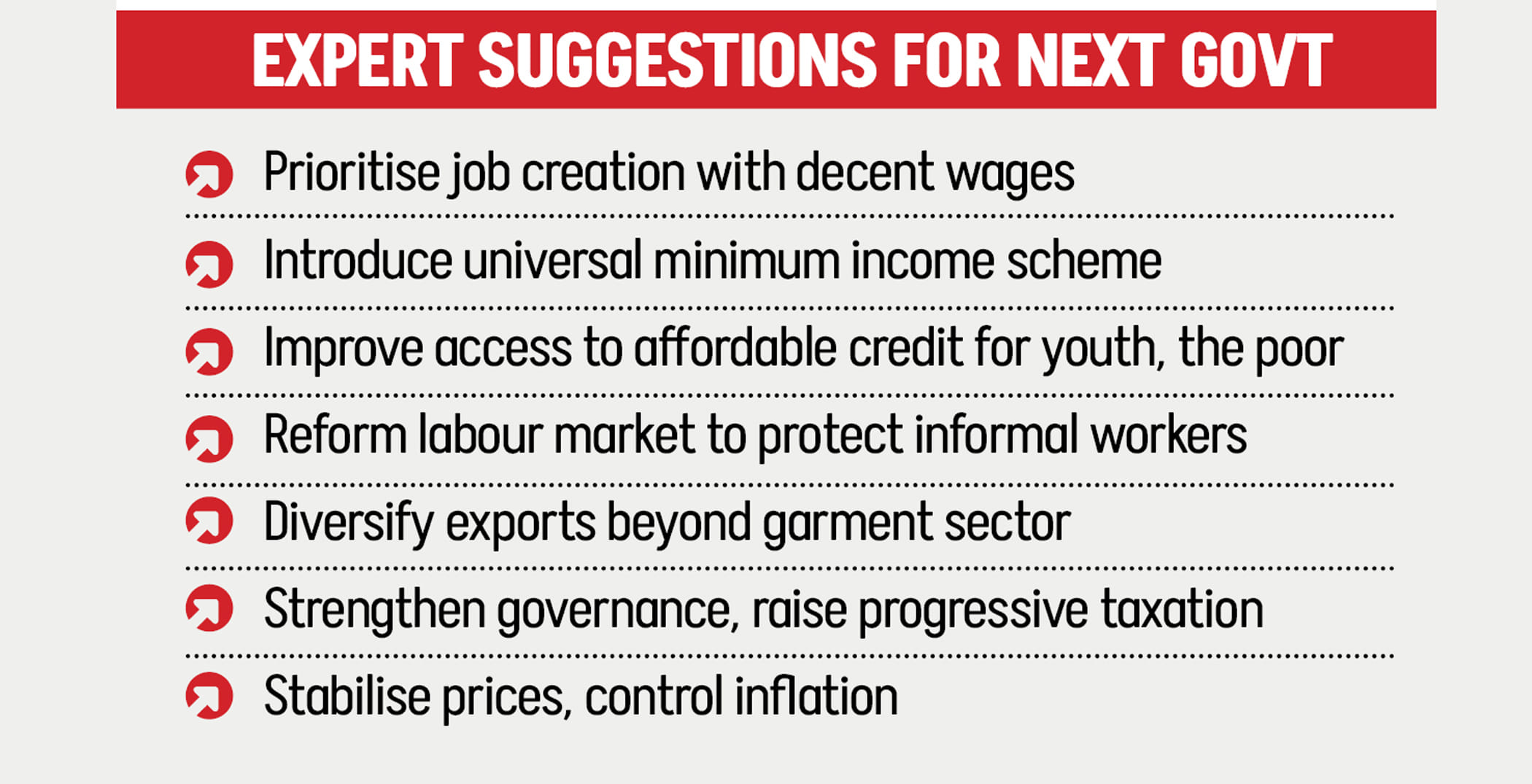
While short-term financial support is necessary for vulnerable groups like Mahbubur’s family, it is not a cure. Sustainable reduction, he argued, requires job creation in trade, exports, and small businesses rather than temporary stopgaps.
The crisis is not limited to job losses; it also plagues the employed, driving skilled workers out of the formal sector.
Harun Or Rashid, who completed higher secondary education, abandoned his job as a security guard at a commercial bank because the Tk 12,000 monthly salary could not sustain his family of six, including his mother and three children.
Harun now drives a battery-run rickshaw in Dhaka’s Mugda and Motijheel areas, earning approximately Tk 30,000 per month. While the job switch has allowed him to survive, he lamented that he has no other option.
He added that he would be much happier if there were viable opportunities in the formal sector.
Harun’s dilemma reinforces the argument made by Zahid Hussain, a former lead economist at the World Bank’s Dhaka office, who emphasised that political parties must focus on the quality of employment.
Zahid Hussain warned that safety nets are not a sustainable long-term solution and that the next elected government must focus on job creation and wages.
This requires a clear outline for export diversification, as the economy remains dangerously over-reliant on the apparel sector.
While the garment industry generates over $40 billion annually, data from the Export Promotion Bureau reveals that no other sector fetches more than $1 billion. Concurrently, the investment climate has cooled, with central bank data showing private sector credit growth slowed to 6.58 percent in November from 7.66 percent a year earlier.
To address the immediate liquidity crisis facing families like Harun’s and Mahbubur’s, Towfiqul Islam Khan, additional research director of the CPD, has proposed a “universal minimum income” scheme.
Towfiqul proposed a monthly cash support initiative for families living below the poverty line, designed to be rolled out in phases.
The government should initially bring 28 lakh families in 11 poverty-prone districts under the scheme, followed by 80 lakh families in 36 districts, and eventually 1.47 crore families nationwide, according to his proposal.
Towfiqul also suggested a “credit card” for financially disadvantaged young people, offering interest-free and collateral-free loans of up to Tk 100,000 to foster self-employment, alongside medical benefits of the same value for families.
Implementing these comprehensive measures will cost approximately Tk 120,000 crore, equivalent to 2 percent of the country’s GDP. He argues that this expenditure is necessary to prevent vulnerable groups from falling further behind due to job insecurity and limited access to credit.
Mustafizur Rahman of CPD advocated for higher direct taxation to fund increased allocations for health, education, and social safety nets.
He warned that simply promising to reduce poverty would not suffice without a concrete plan, adding that tackling corruption is an economic imperative as poor governance directly exacerbates inequality.
Despite the consensus on necessary reforms, there is widespread scepticism regarding political will. Anu Muhammad, an economist and former chair of Jahangirnagar University’s economics department, observed that while manifestos often feature lofty rhetoric, implementation rarely follows.
While manifestos may include commitments to poverty reduction and addressing inequality, the real issue is the extent to which these priorities are reflected in concrete action, he said.
“To truly give importance to these two issues, Bangladesh would need a fundamental shift across all policy areas. Whether it is education policy, energy policy or employment policy, such decisions must be made by the government itself -- not by the World Bank or the IMF,” he said.
Without effective home-grown policies, the hopes of workers like Mahbubur and Harun may remain unfulfilled.
Comments