


July Uprising being commercialised like Liberation War, says CGS president
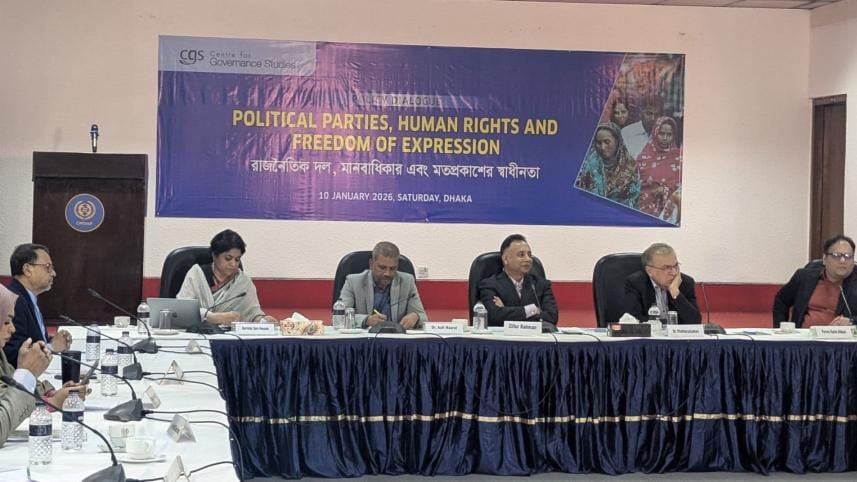
The narratives of the July uprising are now being "commodified" in the same manner the Liberation War was "traded on" for the last 15 years, Zillur Rahman, president of Centre for Governance Studies (CGS), said today.
"We tried to turn these (narratives) into a business. I would say this was commercial, just as business was done with the Liberation War for the last 15-16 years. But none of this lasts if it doesn't have a connection with the people," he said.
 For all latest news, follow The Daily Star's Google News channel.
 Zillur made these remarks while addressing a policy dialogue titled "Political Parties, Human Rights and Freedom of Expression," organised by CGS at the CIRDAP auditorium in Dhaka around 10:30am.
The CGS president said the Students Against Discrimination movement was founded on two core causes: a stand against discrimination and the demand for the government's fall.
"But the narratives we heard afterwards, on the basis of which reform commissions and consensus commissions were formed, were not part of the discussion then," he added.
Heavily criticising the country's political culture, Zillur said, "In Bangladesh, we see that whoever goes to Lanka becomes Ravana."
"Whether they are political leaders or members of civil society, their faces remain the same once they sit in the chair of power," he added.
Terming the arson attacks on the offices of Prothom Alo and The Daily Star as the most shameful event in recent history, Zillur questioned the role of the state apparatus during the incidents.
"When the offices of these two papers burned, where was the government? Where were the law enforcement agencies?" he asked.
"Everyone became vocal after the incident; the chief adviser and advisers phoned editors to express regret. But what was to happen, had already happened."
Zillur expressed alarm over the validation of "mob culture" by state actors, citing a high-ranking government figure who had justified "pressure groups" as people exercising rights due to past oppression.
"We are seeing the consequences of the state ensuring this 'right'," he said, pointing to the demolition of the historic Dhanmondi 32 residence.
"Six months after the uprising, Dhanmondi 32, a significant historical structure, was demolished in front of everyone. No one stopped it," he said. "If this happened in July or August 2024, one might accept it as the act of angry people. But six months later, in a country claimed to be stable, how does this happen?"
Referencing Chief Adviser Prof Muhammad Yunus's earlier assurance to the Hindu community that establishing the rule of law would resolve their grievances, Zillur asked, "Where is the rule of law in the country today? What have they done in these 13-14 months?"
He highlighted the brutal killing of Dipu Chandra Das to underscore the severity of the situation. "We say there are no minorities here; everyone is equal. Yet, Dipu Chandra Das was beaten, hanged from a tree, and his body burned. Where was the state?"
"Today, there is no guarantee on the street that you will survive. Is there even any guarantee that you will be saved from humiliation?" he questioned.
Transparency International Bangladesh (TIB) Executive Director Iftekharuzzaman, human rights activist Sara Hossain, and various political leaders were also present at the dialogue.
Comments