


Interest rate cut not a one-off decision: finance adviser
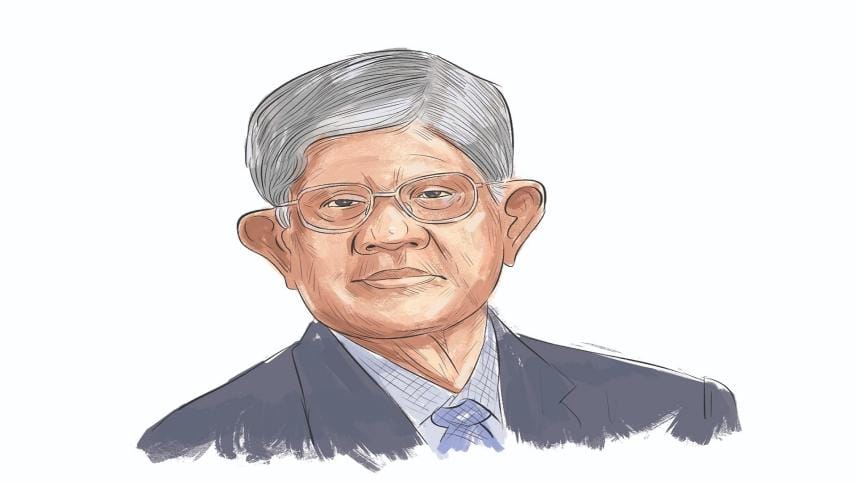
Lowering interest rates is not a matter of a single decision, as it risks disrupting the overall economic balance, Finance Adviser Salehuddin Ahmed said today.
Cutting interest rates without proper coordination among treasury bills, the banking sector, and market mechanisms could have adverse effects on the broader economy, he said at an event in Dhaka.
 For all latest news, follow The Daily Star's Google News channel.
 The adviser noted that interest rates are often discussed as if there were simple solutions, but in reality, reducing rates on one front can create pressure elsewhere in the economy.
Referring to the recent decline in treasury bill yields, Ahmed said its impact would gradually be reflected in the market.
However, if interest rates on treasury bills or savings instruments are increased, deposits in banks would fall, posing risks to the banking system.
The adviser said the core function of the banking sector is to build a bridge between savings and lending.
“Banks and non-bank financial institutions play this intermediary role, and any weakness in this structure negatively affects the entire economic system,” he said.
He was speaking at the publication ceremony of the Banking Almanac at the Centre on Integrated Rural Development for Asia and the Pacific in Dhaka.
Although the Banking Almanac does not provide direct investment guidance, it is an important data source for analysing the banking sector, Ahmed said.
The publication includes key information such as paid-up capital, authorised capital, capital ratios, provisioning, retained earnings, and credit-deposit ratios.
Discussing the current state of the banking sector, the adviser said the situation was critical when he assumed office. However, recent data analysis indicates signs of positive change in provisioning and lending activities at some banks, which are reflected in the Banking Almanac.
On inflation, he said it cannot be controlled through monetary policy alone, adding that sustainable solutions require supply-side management, market supervision, and cooperation from both businesses and consumers.
The adviser urged journalists not to portray Bangladesh solely in a negative light but to highlight positive developments alongside constructive criticism, as the country has made notable progress despite many constraints.
Comments