


Can Bangladesh diversify beyond the garment sector?

After more than three decades of policy debates, hundreds of research papers, and countless newspaper columns, yet another piece on export diversification in Bangladesh may seem redundant, but its very repetition underlines both the gravity of the problem and how elusive a credible way out has remained. If anything, the problem has worsened, as Bangladesh’s exports have become increasingly concentrated, with readymade garments now accounting for around 85 per cent of total merchandise exports. The country’s export basket is among the least diversified in the world. According to one export diversification index due to UNCTAD, where higher values indicate greater concentration and scores range from 0 (most diversified) to 1 (most concentrated), Bangladesh recorded a score of 0.87 on average during 2020–2022, far higher than the LDC average of 0.66 and well above Viet Nam at 0.54, India at 0.45, and China at 0.38. It has been estimated that since 2000, new products have contributed less than 5 per cent of Bangladesh’s export growth, compared with 19 per cent in India, 22 per cent in Cambodia, 25 per cent in Sri Lanka, 33 per cent in China, 42 per cent in Viet Nam, and 62 per cent in Malaysia.
Why garments were the exception, not the model
 For all latest news, follow The Daily Star's Google News channel.
 The dominance of the readymade garment sector did not emerge from a neutral policy environment but from a particular set of global and domestic circumstances that no other industry in Bangladesh ever enjoyed. From the 1970s until the early 2000s, the global trade regime under the Multi-Fibre Arrangement restricted textile and clothing exports from many developing countries, including the newly industrialised economies of East Asia. This diversion of global sourcing pushed investment towards lower-cost locations such as Bangladesh. Combined with duty-free market access under LDC provisions, this created an exceptional and time-bound competitive advantage for garments, one that never materialised for other sectors. The effect was amplified by the fact that tariffs on garments in major markets are substantially higher than for most other products, in the European Union, for example, MFN tariffs on many manufactured goods are typically around 3–4 per cent, compared with roughly 12 per cent for garments, making preferential access far more commercially valuable for clothing exports and reinforcing firms’ incentives to specialise in this sector. Domestic trade policy reinforced this asymmetry. The garment sector benefited from a suite of targeted export support measures, which facilitated it to scale rapidly.

Why non-RMG entrepreneurs remained focused on the domestic market
Any discussion on export diversification needs to address one basic myth. It is often argued that Bangladesh failed to diversify despite having policies intended to support exporting activities, particularly outside the garment sector. Trade policy in Bangladesh has, however, remained largely inward-looking. High tariffs and other trade taxes have made selling in the domestic market far more attractive than exporting.
The average nominal protection rate is now around 28 per cent, making Bangladesh one of the most protected economies in the world. For many products, once all duties are added, protection becomes much higher. Under such conditions, investing to serve the domestic market is a safer and more profitable choice than entering export markets, which involve unfamiliar demand, stricter requirements, and higher commercial risk.
Quality and standards further worsen the lack of export diversification. Export markets require higher product quality and compliance with labour and environmental standards. In the domestic market, these standards are grossly absent. Producing for local consumers is therefore easier and often more profitable. This explains why Bangladesh has many industries thriving at home, from food to footwear to fertilisers, from cement to ceramics, and from furniture to pharmaceuticals, yet only a few are exported in any meaningful way. As a result, while we produce a wide range of goods for domestic consumers, most are simply not export-ready.
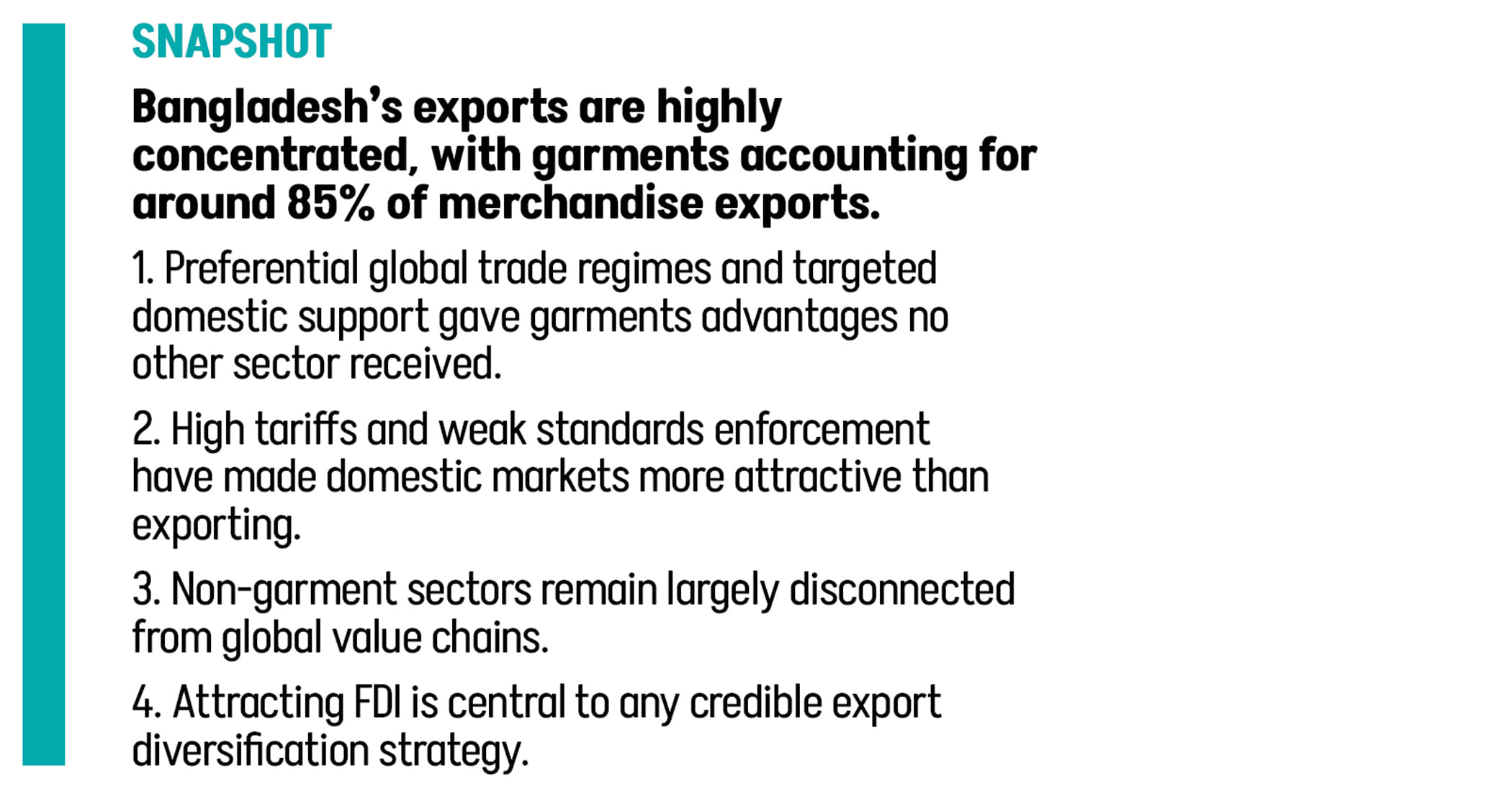
A natural question then is how garments managed to overcome these difficulties while most other sectors did not. The key reason is that the RMG industry was almost entirely export-oriented from the very beginning and deeply embedded in global value chains. Producing almost exclusively for foreign buyers, garment firms aligned themselves with international sourcing networks, buyer requirements, and delivery schedules, rather than with domestic market conditions. This allowed them to remain largely insulated from the domestic protection regime. Facilities such as bonded warehouses enabled duty-free access to imported inputs, while competition was determined by global prices and standards, not by protection at home. Preferential market access under the LDC framework further reinforced this model. Non-garment sectors, lacking such integration into global value chains, remained exposed to domestic protection and had little incentive to incur the costs and risks required to become export-ready.
Why non-RMG exports remain limited: domestic production, missing the global value chain
While applied trade policy in Bangladesh, together with weak enforcement of quality and standards, has largely encouraged firms to produce for the domestic market, far less attention has been given to integration into global value chains. In today’s world, exporting is not just about manufacturing a product. Design, branding, compliance, logistics, retailing, and even after-sales services are all part of a complex but essential system. For a shoe manufacturer or a furniture maker, focusing only on production is rarely sufficient unless they are producing for established brands or retailers abroad. In a long-standing protectionist economy like Bangladesh, these realities have been largely overlooked, not only in policy debates but also in official strategy documents, which tend to treat exporting as an extension of domestic production rather than as participation in an integrated global system.
Why FDI is the missing link
This is where foreign direct investment usually plays a critical role. FDI often brings with it direct links to global buyers, established brands, supply chains, technology, and managerial know-how. Through foreign firms or joint ventures, local producers gain access to design specifications, quality control systems, compliance practices, and international distribution networks that would otherwise be extremely difficult to achieve. Without such links, firms must independently identify buyers, meet complex standards, and establish credibility in competitive markets, all of which are costly and risky. In Bangladesh, this role of FDI has been limited outside garments. Ironically, while most garment exporters are local entrepreneurs, their success has depended heavily on close and sustained relationships with foreign buyers and global supply chains, a dimension that is often underappreciated in policy discussions.
Perhaps the most critical precondition for non-garment export success and meaningful diversification in Bangladesh is attracting foreign direct investment. Bangladesh has struggled to attract FDI because of high trade protection, regulatory complexity, weak contract enforcement, infrastructure bottlenecks, and the absence of a clear, sector-specific investment strategy. In contrast, countries that have expanded exports rapidly and diversified successfully, such as Viet Nam, China, Cambodia, and Malaysia, placed FDI at the centre of their export strategies, using foreign firms and joint ventures to anchor domestic production within global value chains. While addressing infrastructure gaps, skills shortages, and institutional weaknesses will inevitably take time, export diversification cannot wait for all these constraints to be fully resolved. What is needed now is a focused and credible push to attract FDI into non-garment sectors through targeted measures and a clearer investment policy that recognises FDI as a catalyst for export growth rather than a peripheral objective.
Dr Mohammad Abdur Razzaque is an economist and serves as Chairman of Research and Policy Integration for Development (RAPID), a Dhaka-based think tank.
Comments