


Brick kilns ravage land, waterbodies

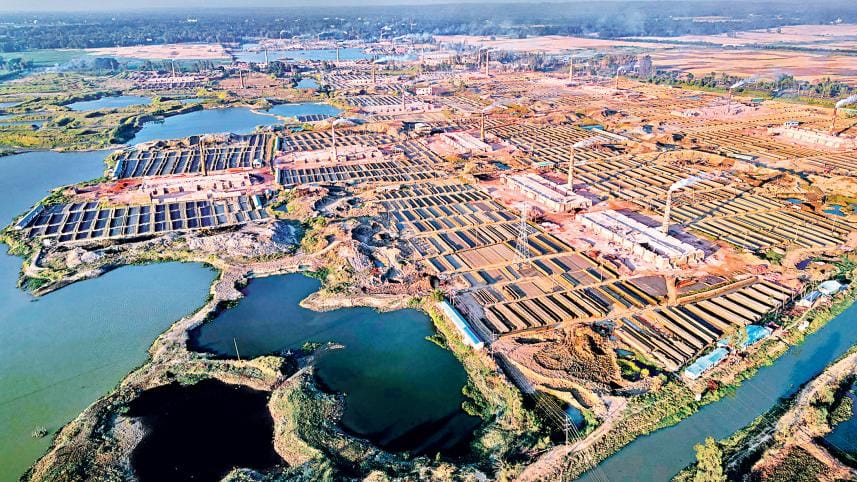
A decade ago, travellers on the Dhaka–Chattogram highway could see lush hill forests and fertile fields while passing through Satkania. Today, the landscape is dominated by rows of brick kilns belching smoke and scarring the land.
Government data shows at least 70 brick kilns operate in Satkania upazila, 41 of them illegally. Both licensed and illegal kilns are stripping fertile topsoil from farmlands and hills to produce bricks, raising concerns over food security and environmental degradation.
 For all latest news, follow The Daily Star's Google News channel.
 Similar expansion of brick kilns has also been reported along the highway in neighbouring Patiya, Chandanaish and Lohagara upazilas.
“Brick kilns are not only removing fertile topsoil from farmlands; smoke from the kilns is also polluting the air and reducing crop growth and productivity,” said Md Moniruzzaman, Satkania upazila agriculture officer. He said farmers are failing to achieve expected yields due to kiln-related pollution.
Over the past five years, at least 75 acres of cultivable land have been damaged, according to the Satkania upazila agriculture office. As many as 20 brick kilns are operating in Kaliaish union alone.
During a recent visit to the area, this correspondent saw large pits across most agricultural land within one to two kilometres of the kilns. Thick smoke has polluted the air throughout the locality. Farmers say their livelihoods are collapsing.
Abdul Kader, a farmer from Ward 9 of Kaliaish union, said he used to cultivate chilli and potato on about 100 decimals of land each year but has now switched to mustard and a local variety of beans.
“Smoke from the kilns is damaging our crops. Chilli plants shed their leaves, and potatoes do not grow properly since the brick kilns began operating in this area. We can no longer rely entirely on farming and are having to survive through alternative livelihoods,” he said.
Another farmer, Abu Taher, said soot and ash from nearby kilns ruined his tomato crops for two consecutive seasons.
“Our farmland is gradually becoming fallow. To save agriculture, this must be stopped,” he said.
According to locals and some officials, excessive coal and wood burning remains widespread during the brick-making season, despite restrictions, filling surrounding villages with thick smoke.
“During the season, we have to keep doors and windows shut. Even the fruit trees in our yards are no longer bearing fruit,” said Abu Taher.
Delwar Hossain, assistant conservator of forests in the Chattogram South Forest Division, said authorities are maintaining surveillance and have stopped the transport and burning of firewood in kilns.
However, hills are still being excavated to supply soil for brick production, increasing the risk of landslides during the monsoon.
In Aeochia union, several hills are being cut to supply soil to kilns. “Hill cutting continues openly, with little fear of intervention, as enforcement remains weak,” said Md Hasan, a local resident.
Ashraf Uddin, assistant director of the Department of Environment’s Chattogram office, said action is taken whenever information on hill cutting is received. He said a case was filed in the area last November.
Experts warn that the combined impact of air pollution, topsoil removal and hill cutting is alarming.
“Topsoil loss reduces agricultural productivity, hill excavation destabilises the land and increases landslide risks, while smoke emissions damage crops and public health,” said Md Kamal Hossain, professor at the Institute of Forestry and Environmental Sciences at Chittagong University. “If this continues, the environmental and socio-economic consequences will be severe.”
Local officials acknowledge the presence of illegal kilns, though enforcement remains limited.
Khondakar Mahmudul Hasan, upazila nirbahi officer of Satkania, said illegal kilns are still collecting soil through syndicates, although they are no longer burning firewood this season.
“We are conducting regular operations. If illegal kilns can be shut down, environmental damage will be reduced. However, many owners have obtained stay orders from the courts,” he said.
According to the upazila administration, at least 15 kilns have been fined about Tk 20 lakh this season for various violations.
Didarul Alam, owner of Payel Bricks, said hundreds of families depend on the sector. “We urge the government to simplify the brick kiln law to help sustain this industry,” he said.
Jamir Uddin, director of the Department of Environment in Chattogram, said authorities plan to challenge court stay orders allowing illegal kilns to operate.
“We hope the courts will cancel the stay orders once the facts are presented, leading to the closure of illegal kilns and enforcement of environmental safeguards,” he said.
Comments